March 17, 2006 feature
Cryogenic Phonon Scintillators to Help in Search for Dark Matter
What do WIMPs and MRIs have in common?
Besides being acronyms, both the dark matter candidate and the medical diagnostic technique could benefit from the next generation of cryogenic scintillators being developed. While physicists are primarily focusing on the search for dark matter and answers to how the universe is built, they’re creating a detector with superior energy resolution and distinguishing capabilities that could have repercussions beyond the questions of the universe.
Based on the way that galaxies spin, cosmologists believe that a form of matter which doesn’t reflect light must exist in the universe. Not only does this dark matter affect how galaxies spin, but a particular amount of it would balance out the total mass of the universe so that it’s not so light that one day it collapses back in on itself. Cosmologists wonder what dark matter could be made of that makes it so enigmatic and massive, and theorists favor a type of particle called a WIMP (Weakly Interacting Massive Particle). On very rare occasions, WIMPS may interact with nuclei in normal matter and impart a tiny amount of recoil energy to the nuclei.
Although physicists may be able to detect this recoil energy, they face a couple of large challenges. For one, the amount of recoil energy is so small that current detectors haven’t been able to pick up any signals. Also, a background of space radiation and cosmic rays interfere with the energy of the nuclei, and make it difficult for detectors to distinguish the two sources.
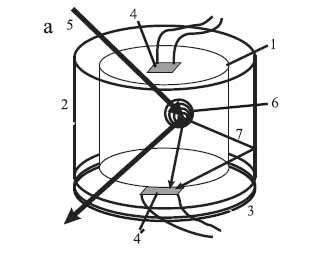
Physicists V. Mikhailik and H. Kraus from the University of Oxford are looking for materials that might work for a new type of detector called a cryogenic phonon scintillator detector (CPSD). As they report in a recent Journal of Physics D: Applied Physics, CPSDs could have superior energy resolution and the ability to discriminate between particles and radiation, and possibly be able to detect rare WIMP interactions.
The high hopes for the new CPSDs stem from the way that these detectors work. CPSDs are constructed of crystals that increase in temperature when energy is deposited in them. Because these scintillating crystals can distinguish the subtlest temperature differences at the lowest temperatures, CPSDs operate optimally at temperatures close to absolute zero (in the 10-15 millikelvin range, or nearly –459°F) for the best chance of detecting WIMP events.
Since operating CPSDs at extremely low temperatures is an entirely new area of research, Mikhailik and Kraus experimented with different types of materials to determine which give sufficient light at extremely low temperatures. At the same time, the materials must have very low intrinsic radioactivity in order to discriminate between different types of radiation.
“In the first phase of the experimental search for WIMPs, a few CPSD detectors made of CaWO4 crystals (material which is used worldwide as x-ray screen in medical diagnostics) have already been tested and delivered excellent results,” Mikhailik told PhysOrg.com. “The next experiment will plan to use different scintillation targets with a total mass of about 100 kg, which should allow verification of a WIMP signal.”
The physicists’ deeper understanding of the potential of CPSDs at low temperatures also has applications in fields such as medicine and security inspection. For example, CPSD technology could enhance image quality in diagnostic tools and reduce a patient’s radiation doses. CPSDs at low temperatures could also pick up signals from neutrons and use their ability to penetrate metal shielding made of heavy nuclei, which interact predominantly with the lighter nuclei in materials of interest.
“Apparently the search for cryogenic scintillators today is the science-driven initiative that will prepare the grounds for technological progress in respective areas tomorrow,” wrote Mikhailik and Kraus.
Citation: Mikhailik, V. B. and Kraus, H. Cryogenic scintillators in searches for extremely rare events. J. Phys. D: Appl. Phys. 39 (2006) 1181-1191.
By Lisa Zyga, Copyright 2006 Physorg.com


