Synchrotron x-ray experiments in the world's strongest magnetic field
A combination of high magnetic fields and "quantum beam" such as synchrotron x-rays or neutrons is one of most powerful experimental means to examine the magnetic and the electronic properties of strongly correlated electron systems and of functional materials for spintronics applications.
Recently, a team of Japanese researchers have succeeded in performing the high magnetic field synchrotron x-ray experiments up to 51 Tesla at the BL22XU beamline of SPring-8 (Fig 2).
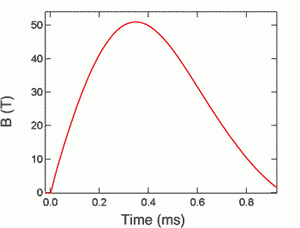
It is the world's strongest magnetic field used for the quantum beam experiment. As the first series of experiments, the field-induced valance transitions in rare-earth inter-metallic compounds have been studied by means of x-ray absorption spectra and x-ray diffraction.
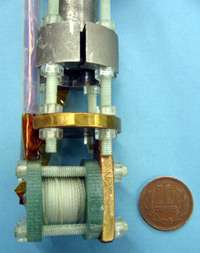
The key of this achievement is the use of the miniature pulsed-magnet (Fig 1). The volume and the energy of the present magnet are as small as 1 % of those of conventional pulsed magnet.
Moreover, the miniature pulsed-magnet is readily installed into the standard cryogenic system of a conventional diffractometer. This feature enables us to perform such high field experiments rather easily. The present achievements will open a variety of new applications in x-ray scattering and x-ray spectroscopy in extremely strong magnetic fields.
This work was done as the collaboration work among Okayama University, Japan Atomic Energy Agency and Tohoku University, and was supported by Grant-in-Aid for Scientific Research on priority Areas “High Field Spin Science in 100 T” from the Ministry of Education, Culture, Sports, Science and Technology (MEXT). The part of the results of this work was published in Journal of the Physical Society of Japan.
Citation:"High Field X-ray Diffraction Study on a Magnetic-Field-Induced Valence Transition in YbInCu4", Y. H. Matsuda, et. at., Journal of the Physical Society of Japan, Vol. 75 No. 2, February, 2006
Source: SPring-8


