New route for heredity bypasses DNA
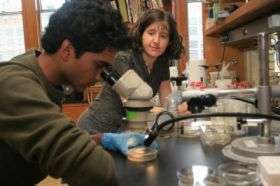
A group of scientists in Princeton's Department of Ecology and Evolutionary Biology has uncovered a new biological mechanism that could provide a clearer window into a cell's inner workings.
What's more, this mechanism could represent an "epigenetic" pathway -- a route that bypasses an organism's normal DNA genetic program -- for so-called Lamarckian evolution, enabling an organism to pass on to its offspring characteristics acquired during its lifetime to improve their chances for survival. Lamarckian evolution is the notion, for example, that the giraffe's long neck evolved by its continually stretching higher and higher in order to munch on the more plentiful top tree leaves and gain a better shot at surviving.
The research also could have implications as a new method for controlling cellular processes, such as the splicing order of DNA segments, and increasing the understanding of natural cellular regulatory processes, such as which segments of DNA are retained versus lost during development. The team's findings will be published Jan. 10 in the journal Nature.
Princeton biologists Laura Landweber, Mariusz Nowacki and Vikram Vijayan, together with other members of the lab, wanted to decipher how the cell accomplished this feat, which required reorganizing its genome without resorting to its original genetic program. They chose the singled-celled ciliate Oxytricha trifallax as their testbed.
Ciliates are pond-dwelling protozoa that are ideal model systems for studying epigenetic phenomena. While typical human cells each have one nucleus, serving as the control center for the cell, these ciliate cells have two. One, the somatic nucleus, contains the DNA needed to carry out all the non-reproductive functions of the cell, such as metabolism. The second, the germline nucleus, like humans' sperm and egg, is home to the DNA needed for sexual reproduction.
When two of these ciliate cells mate, the somatic nucleus gets destroyed, and must somehow be reconstituted in their offspring in order for them to survive. The germline nucleus contains abundant DNA, yet 95 percent of it is thrown away during regeneration of a new somatic nucleus, in a process that compresses a pretty big genome (one-third the size of the human genome) into a tiny fraction of the space. This leaves only 5 percent of the organism's DNA free for encoding functions. Yet this small hodgepodge of remaining DNA always gets correctly chosen and then descrambled by the cell to form a new, working genome in a process (described as "genome acrobatics") that is still not well understood, but extremely deliberate and precise.
Landweber and her colleagues have postulated that this programmed rearrangement of DNA fragments is guided by an existing "cache" of information in the form of a DNA or RNA template derived from the parent's nucleus. In the computer realm, a cache is a temporary storage site for frequently used information to enable quick and easy access, rather than having to re-fetch or re-create the original information from scratch every time it's needed.
"The notion of an RNA cache has been around for a while, as the idea of solving a jigsaw puzzle by peeking at the cover of the box is always tempting," said Landweber, associate professor of ecology and evolutionary biology. "These cells have a genomic puzzle to solve that involves gathering little pieces of DNA and putting them back together in a specified order. The original idea of an RNA cache emerged in a study of plants, rather than protozoan cells, though, but the situation in plants turned out to be incorrect."
Through a series of experiments, the group tested out their hypothesis that DNA or RNA molecules were providing the missing instruction booklet needed during development, and also tried to determine if the putative template was made of RNA or DNA. DNA is the genetic material of most organisms, however RNA is now known to play a diversity of important roles as well. RNA is DNA's chemical cousin, and has a primary role in interpreting the genetic code during the construction of proteins.
First, the researchers attempted to determine if the RNA cache idea was valid by directing specific RNA-destroying chemicals, known as RNAi, to the cell before fertilization. This gave encouraging results, disrupting the process of development, and even halting DNA rearrangement in some cases.
In a second experiment, Nowacki and Yi Zhou, both postdoctoral fellows, discovered that RNA templates did indeed exist early on in the cellular developmental process, and were just long-lived enough to lay out a pattern for reconstructing their main nucleus. This was soon followed by a third experiment that "… required real chutzpah," Landweber said, "because it meant reprogramming the cell to shuffle its own genetic material."
Nowacki, Zhou and Vijayan, a 2007 Princeton graduate in electrical engineering, constructed both artificial RNA and DNA templates that encoded a novel, pre-determined pattern; that is, that would take a DNA molecule of the ciliate's consisting of, for example, pieces 1-2-3-4-5 and transpose two of the segments, to produce the fragment 1-2-3-5-4. Injecting their synthetic templates into the developing cell produced the anticipated results, showing that a specified RNA template could provide a new set of rules for unscrambling the nuclear fragments in such a way as to reconstitute a working nucleus.
"This wonderful discovery showed for the first time that RNA can provide sequence information that guides accurate recombination of DNA, leading to reconstruction of genes and a genome that are necessary for the organism," said Meng-Chao Yao, director of the Institute of Molecular Biology at Taiwan's Academia Sinica. "It reveals that genetic information can be passed on to following generations via RNA, in addition to DNA."
The research team believes that if this mechanism extends to mammalian cells, then it could suggest novel ways for manipulating genes, besides those already known through the standard methods of genetic engineering. This could lead to possible applications for creating new gene combinations or restoring aberrant cells to their original, healthy state.
Source: Princeton University


