Radical Antarctic telescope "would outdo Hubble"
September 16, 2004 Radical Antarctic telescope "would outdo Hubble"

A novel Antarctic telescope with 16-m diameter mirrors would far outperform the Hubble Space Telescope, and could be built at a tiny fraction of its cost, says a scientist from the Anglo-Australian Observatory in Sydney, Australia.

Tests by a team from the University of New South Wales, reported in the journal ‘Nature’ this week [16 September], show that the ‘Dome C’ site in the Australian Antarctic Territory is by far the best place ever tested on Earth for doing infrared and optical astronomy.

“A telescope there would perform as well as a much larger one anywhere else on Earth. It’s nearly as good as being in space”, said Dr. Will Saunders of the Anglo-Australian Observatory.

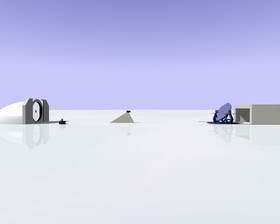
At the SPIE Astronomical Telescopes and Instrumentation conference in Glasgow in June, Dr. Saunders presented a concept for an unusual telescope that’s well matched to the special conditions at Dome C, both in its optical design and in the way it’s built.

It looks nothing like other telescopes. Much of it could be built of ‘icecrete’–snow compressed to form blocks as hard as concrete–while its mirrors could be made of the glass used for office windows.

Under the superb atmospheric conditions at Dome C this simple telescope could make razor-sharp images of large areas of sky.

Dr. Saunders estimates that his design would cost about a fifth as much as one of the extremely large telescopes now being planned. These have mirrors 30-100 m in diameter and price tags of US$700 million and up. The Hubble Space Telescope cost a few times more: about US$2.2 billion at launch.

“With this simple telescope you could do the exquisite imaging that the extremely large telescopes plan to do, at a fraction of their cost” Dr. Saunders said. “But, unlike them, this telescope would also be a great survey instrument, able to map the whole sky with Hubble-like clarity.”

Source: Anglo-Australian Observatory


print this article email this article download pdf blog this article bookmark this article     Stumble it Digg this share on Facebook retweet share on Reddit add to delicious
Rate this story - not rated yet


September 16, 2004 all stories

Comments: 0

not rated yet
  • Stumble this up

  • Digg this

  • share this

  • hide
  • Related Stories

  • Astronomers find coldest, driest, calmest place on Earth
    created Aug 31, 2009 | popularity not rated yet | comments 0
  • Hunting for Planets in the Dark
    created Nov 19, 2009 | popularity not rated yet | comments 0
  • SOFIA Seeks Secrets of Planetary Birth
    created Nov 19, 2009 | popularity not rated yet | comments 0
  • Maps Unveil the Source of Starburst Galaxy's Winds
    created Nov 18, 2009 | popularity not rated yet | comments 0
  • Discovery of a Retrograde or Highly Tilted Extrasolar Planet
    created Nov 18, 2009 | popularity not rated yet | comments 0


Other News

Baby can wait as expectant dad finishes spacewalk (AP)

Baby can wait as expectant dad finishes spacewalk

Space & Earth / Space Exploration

created 15 hours ago | popularity 3 / 5 (2) | comments 0

(AP) -- A spacewalking astronaut put aside the impending birth of his daughter and blazed through his first-ever venture outside the International Space Station on Saturday.


Unseasonably hot and dry weather combined with strong winds to fan scores of blazes in the country's southeastern states

Australia issues 'catastrophic' alerts as fires rage

Space & Earth / Environment

created 21 hours ago | popularity 4 / 5 (3) | comments 0

Australia has issued "catastrophic" alerts after record-breaking temperatures and wild lightning storms sparked more than 100 fires across the country, officials said Saturday.


Commuters wait on the platform shrouded by fog in London

Climate change not man-made, say majority of Britons: poll

Space & Earth / Environment

created Nov 15, 2009 | popularity 3.3 / 5 (15) | comments 46

Less than half of Britons believes that human activity is to blame for global warming, according to a poll carried out for The Times newspaper and published on Saturday.


Mysteriously warm times in Antarctica

Mysteriously warm times in Antarctica

Space & Earth / Earth Sciences

created Nov 18, 2009 | popularity 4.2 / 5 (21) | comments 28

(PhysOrg.com) -- A new study of Antarctica's past climate reveals that temperatures during the warm periods between ice ages (interglacials) may have been higher than previously thought. The latest analysis ...


UN: Fight climate change with free condoms (AP)

UN: Fight climate change with free condoms

Space & Earth / Environment

created Nov 18, 2009 | popularity 3.1 / 5 (11) | comments 25

(AP) -- The battle against global warming could be helped if the world slowed population growth by making free condoms and family planning advice more widely available, the U.N. Population Fund said Wednesday.