Locust research could tell us why Elvis preferred peanut butter sandwiches
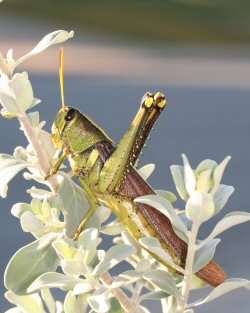
It’s said that Elvis Presley’s love of fried peanut butter sandwiches started during his impoverished childhood, and the fat-soaked snack remained a favourite dish for the rest of his life. Locusts and Elvis could have something in common. In a study published in Science, Oxford researchers showed that the value given by locusts to a particular food depended on their condition at the time of eating it first.
The researchers set up trials to look at how organisms learn and on what basis they choose. They manipulated the preferences of the locusts: the insects met peppermint-flavoured grass when they were hungry and lemon-flavoured grass when they were not so hungry, and later behaved as if peppermint-flavoured grass was preferable. When they reversed the treatments, the locusts reversed their preference.
Professor Alex Kacelnik in Oxford’s Zoology Department, one of the authors of the study alongside Spence Behmer and Lorena Pompilio, said: ‘This is interesting because value depends on the condition of the organism at the time it learns, and thus what the animals learn depends on their condition and not only the properties of the food. We call this learning mechanism “state-dependent valuation”.’
Humans may lose their objectivity and add value to things for the same reasons. The story goes that Elvis Presley’s mother would make his sandwiches as a treat when he was young and living on a subsistence diet. When Elvis was at the height of his fame, he may have enjoyed a high-rolling lifestyle but instead of choosing expensive, luxury foods with higher nutritional value, the peanut butter sandwich remained a firm favourite. Scientists can speculate on whether, as in the case of the locusts, the memory of something casts a shadow on the value we give it.
Professor Kacelnik said: ‘Sometimes we give interpretations to human behaviour based on our perception of why we do certain things, and in fact maybe these interpretations are simple narratives we build ourselves to explain our behaviour, when in reality that behaviour is determined by very fundamental, biological processes which are inaccessible to our consciousness and are common in very distant organisms.’
Researchers from the Zoology department have already carried out studies that show birds do similar things and this effect may override the real quality of the rewards. For instance, starlings, which normally hate waiting for food, may prefer pecking at a blue key that makes them wait fifteen seconds for food to a red key that makes them wait only ten seconds, if the blue key had been previously encountered when the bird was particularly hungry. This happens even when the starling demonstrates precise knowledge of the delay to food in each case, so they choose what they ‘know’ is a worse option.
This latest research into locusts suggests the point at which this mechanism may have been acquired could go even further back in evolutionary terms. It also casts light on why organisms sometimes don’t seem to behave in an optimal or adaptive way. Researchers speculate that such choices might be a sensible way of making decisions and we have not discovered why, or that it is really against the interest of the organisms and it’s simply that evolution could not produce a better outcome.
People often view the invertebrate brain as a simple, dedicated microchip that does few jobs, and yet this research suggests some of the basic processes of learning are well represented in those very simple brains, and some solutions found by the common ancestor of insects and humans are still around.
The department plans to carry out more research into all mechanisms of learning and decision-making by a variety of organisms, ranging from humans to insects.
Source: University of Oxford


