Scientists find cultural differences among chimpanzee colonies
January 7, 2008
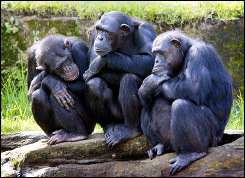
Socially-learned cultural behaviour thought to be unique to humans is also found among chimpanzees colonies, scientists at the University of Liverpool have found.
Historically, scientists believed that behavioural differences between colonies of chimpanzees were due to variations in genetics. A team at Liverpool, however, has now discovered that variations in behaviour are down to chimpanzees migrating to other colonies, proving that they build their ‘cultures’ in a similar way to humans.
Primatologist, Dr Stephen Lycett, explains: “We knew there were behavioural differences between chimpanzee colonies, but nobody really knew why. It was assumed that young chimpanzees developed certain behavioural characteristics from the genes passed down from their parents, but there was no evidence to clearly support this. It was also thought that because behaviour was dictated by biology, chimpanzees did not have a ‘culture’ in the same way that humans do.”
By looking at how chimpanzees prepare their food, the research team discovered that one colony used stone tools to crack nuts, whereas another colony used wooden tools as well as stone. They found these methods of preparing food have spread 4000km from East to West Africa over the more than 100,000 years. The team also found this true of other techniques, such as grooming. The research suggests that behavioural variety is due to how chimpanzees socialise rather than genetics as previously thought.
To investigate the theory further researchers built an evolutionary tree of chimpanzee behaviour in East and West Africa as well as a genetic family tree. They had expected to find that those with similar genetic patterns also shared behavioural similarities. Instead, they found that some chimpanzees shared behavioural similarities with those that were genetically different from them.
Dr Lycett, added: “This explains why some colonies, for example, use similar methods for finding food, adopting certain behaviour and adapting different methods to suit their own environment. In this sense we can see for the first time that culture exists in our closest relatives.”
The research is published in Proceedings of the National Academy of Sciences USA.
Source: University of Liverpool
-
Mandrill monkey creates tool for a pedicure (w/ video)
Jul 25, 2011 |
4.8 / 5 (4) |
7
-
Captive chimpanzees show signs of compromised mental health
Jul 05, 2011 |
4.7 / 5 (7) |
13
-
I control therefore I am: chimps self-aware, says study
May 04, 2011 |
4.7 / 5 (16) |
26
-
Differences in human and Neanderthal brains set in just after birth
Nov 08, 2010 |
4.6 / 5 (13) |
0
-
Robots that develop emotions in interaction with humans
Aug 12, 2010 |
4 / 5 (12) |
27
-
Engineers build first sub-10-nm carbon nanotube transistor
Feb 01, 2012 |
4.9 / 5 (30) |
30
-
Something old, something new: Evolution and the structural divergence of duplicate genes
Jan 31, 2012 |
4.6 / 5 (7) |
1
-
The hidden nanoworld of ice crystals: Revealing the dynamic behavior of quasi-liquid layers
Jan 30, 2012 |
5 / 5 (3) |
1
-
Stock market network reveals investor clustering
Jan 27, 2012 |
3.9 / 5 (23) |
8
-
Of microchemistry and molecules: Electronic microfluidic device synthesizes biocompatible probes
Jan 26, 2012 |
5 / 5 (1) |
0
More news stories
Grass to gas: Researchers' genome map speeds biofuel development
Researchers at the University of Georgia have taken a major step in the ongoing effort to find sources of cleaner, renewable energy by mapping the genomes of two originator cells of Miscanthus x giganteus, a large perenn ...
19 minutes ago |
5 / 5 (1) |
0
|
The power of estrogen -- male snakes attract other males
A new study has shown that boosting the estrogen levels of male garter snakes causes them to secrete the same pheromones that females use to attract suitors, and turned the males into just about the sexiest ...
3 hours ago |
not rated yet |
0
|
Experts reveal how plants don't get sunburn
(PhysOrg.com) -- Experts at the University of Glasgow have discovered how plants survive the harmful rays of the sun.
3 hours ago |
5 / 5 (2) |
0
|
Protein libraries in a snap
(PhysOrg.com) -- A Rice University undergraduate will depart with not only a degree but also a possible patent for his invention of an efficient way to create protein libraries, an important component of biomolecular ...
6 hours ago |
5 / 5 (2) |
0
|
New drugs schedule makes horse racing a sure thing
What do Gai Waterhouse and Anthony Cummings have in common with Queen Elizabeth II?
3 hours ago |
not rated yet |
0
New understanding of DNA repair could eventually lead to cancer therapy
A research group in the Faculty of Medicine & Dentistry at the University of Alberta is hoping its latest discovery could one day be used to develop new therapies that target certain types of cancers.
Hovering not hard if you're top-heavy, researchers find
Top-heavy structures are more likely to maintain their balance while hovering in the air than are those that bear a lower center of gravity, researchers at New York University's Courant Institute of Mathematical Sciences ...
Night, weekend delivery OK for babies with birth defects
Weekday delivery is no better than night or weekend delivery for infants with birth defects, according to a new study presented today at The Pregnancy Meeting, the Society for Maternal-Fetal Medicine's annual conference. ...
Sonic Cradle lands spot in TED exhibition
A Simon Fraser University graduate student project that melds music, meditation and modern technology has landed a rare spot as an exhibit at TEDActive 2012 in Palm Springs, California this month.
Drug halts organ damage in inflammatory genetic disorder
A new study shows that Kineret (anakinra), a medication approved for the treatment of rheumatoid arthritis, is effective in stopping the progression of organ damage in people with neonatal-onset multisystem inflammatory disease ...
Cochlear implants may be safe, effective for organ transplant patients
Cochlear implants may be a safe, effective option for some organ transplant patients who've lost their hearing as an unfortunate consequence of their transplant-related drug regime, researchers report.