Stanford builds a better virtual world, one tree (or millions) at a time
January 7th, 2008 Stanford builds a better virtual world, one tree (or millions) at a time

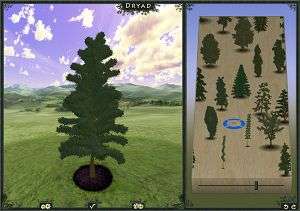
By navigating with a mouse through an infinite number of trees on Dryad, virtual world enthusiasts can create the trees of their dreams. Credit: Stanford University

When Stanford computer scientist Vladlen Koltun decided to build a better virtual world, he began with 3-D trees—millions of them. Now he wants to give them away.

Trees, like almost all objects in virtual worlds, whether in video games or Internet social communities like World of Warcraft or Second Life, are enormously difficult and expensive to build.

"There is a very, very tiny community of people around the world who are skilled at creating three-dimensional objects," Koltun said. "And they are the ones who do it all. Which is one of the reasons why you don't see three-dimensional content on the web; because nobody can create it."

The inability of casual computer users to build 3-D objects—you practically have to be a sculptor, Koltun says-is an anchor holding back the promise of virtual worlds. When the day arrives that anyone can design everyday objects, the three-dimensional environment of virtual worlds will finally live up to its promise as an ideal setting for almost any human interaction: education, business, job training, phobia therapy, gaming, sharing interests with other people (or their avatars) and, of course, flirting with alien creatures.

The virtual world should serve as "a social network that allows you to share space and participate in experiences together," Koltun said. "You can form ad hoc groups that don't require any sort of registration. You can just walk up to a person, walk up to a group of people, and start a conversation."

When Koltun, an assistant professor of computer science, set out with his Stanford Virtual Worlds Group to prove that object construction can be sophisticated without being difficult, they began with trees.

Why trees, instead of buildings, animals or humans? Because, it turns out, botanists have already cataloged and categorized the trees of the real world in great detail. Koltun's group has incorporated that data into a powerful mathematical engine that creates trees using about 100 different tree attributes, all of them almost infinitely variable. How thick is the trunk? How big the leaves? How are the limbs spaced?

The result is a new, intuitive way for individual users to create unique trees by simply using a mouse to seamlessly navigate through the entire "space of trees," changing appearances by changing direction. Koltun's software, Dryad (a tree nymph in Greek mythology,) lets users move through the 100-attribute tree space in a fashion similar to navigating city streets on Google Maps.

"With Dryad, you navigate the space of all trees and simply choose the one you want," Koltun said.

An important feature of Dryad is an information-sharing technique that improves the software every time someone picks a tree.

As in real life, not all trees are equally desirable. Since no single user is capable of mapping out the best parts of the enormous tree space, this mapping of desirability is done collaboratively, leading to continuous refinement of the software. Dryad's mathematical model nudges users toward trees that have some resemblance to trees that have proven popular with other users. Otherwise, Koltun said, with an infinite number of trees, some of the outliers are bound to look more like Jackson Pollock paintings than neighborhood trees.

Dryad trees are truly 3-D; they can be spun around or viewed from any angle. They also can be downloaded in the OBJ format and loaded into any major modeling program.

The Dryad software is available, at no cost, at http://dryad.stanford.edu

Source: Stanford University


print this article email this article download pdf blog this article bookmark this article     Digg this Stumble it share on Facebook share on Reddit add to delicious save to Yahoo! bookmarks
4.4/5 after 24 votes

Rank Filter

Move the slider to adjust rank threshold, so that you can hide some of the comments.


Display comments: newest first

  • Fantasist - Jan 07, 2008
    • Rank: not rated yet
    Wow!! I love landscapes of trees! I think fractals are the key, correct?
  • fredrick - Jan 07, 2008
    • Rank: 2.3 / 5 (3)
    Why trees, instead of buildings, animals or humans? Because, it turns out, botanists have already cataloged and categorized the trees of the real world in great detail. Koltun's group has incorporated that data into a powerful mathematical engine that creates trees using about 100 different tree attributes, all of them almost infinitely variable. How thick is the trunk? How big the leaves? How are the limbs spaced?


    I don't think this one uses fractals, based on the above quote - but I'm not sure. They might be using fractals to generate some of the 100 attributes, but things like trunk width or height wouldn't be.
    I have seen trees being fractally generated before, and they looked quite good (although the branches were wires, it wasn't fleshed out 3D)... although they seemed a little too perfect - like if they'd have lost some branches in some random places it would have been more realistic.
  • gopher65 - Jan 08, 2008
    • Rank: 4 / 5 (1)
    I downloaded this program from their website and it is pretty neat. I don't know what mechanism it uses to randomly generate a tree if you ask it to, but it allows you to manually change every variable of the tree and watch the results in real-time, and then save the model when you are satisfied with it. Unfortunately it doesn't create textures for that model (like bark) and uses flat colours instead, but I guess that's what artists are for:).

    Personally I made a red and purple twisted blighted tree heheh. It certainly didn't look perfect and it was highly asymmetrical, which looks cool.

January 7th, 2008 all stories
Technology / Computer Sciences

Comments: 3
Rank: 4.4/5 after 24 votes

  • Stumble this up

  • Digg this

  • Share it:
  • share on Facebook
  • share on MySpace
  • share on Slashdot
  • rss-newsfeed
  • share on Google
  • share on Reddit
  • add to delicious
  • save to Yahoo! bookmarks
  • share on Windows Live
  • Add to Mixx!
Rating: 4.4/5 after 24 votes


Tags


  • Physicists Demonstrate Quantum Memory with Matter Qubits
    Physicists Demonstrate Quantum Memory with Matter Qubits
    Physics / General Physics
    created Jul 03, 2009 | popularity 4.4 / 5 (17) | comments 1
  • 'Holey' Nanosheets for Wastewater Dye Removal
    Nanotechnology / Nanomaterials
    created Jul 01, 2009 | popularity 5 / 5 (5) | comments 1
  • Jellyfish Robot Swims Like its Biological Counterpart
    Jellyfish Robot Swims Like its Biological Counterpart
    Electronics / Robotics
    created Jun 26, 2009 | popularity 4.4 / 5 (8) | comments 1
  • Could Maxwell's Demon Exist in Nanoscale Systems?
    Could Maxwell's Demon Exist in Nanoscale Systems?
    Physics / General Physics
    created Jun 24, 2009 | popularity 4.4 / 5 (18) | comments 29
  • Living Safely with Robots, Beyond Asimov's Laws
    Living Safely with Robots, Beyond Asimov's Laws
    Electronics / Robotics
    created Jun 22, 2009 | popularity 4.6 / 5 (53) | comments 40
  • Other News

    EMC raises offer for Data Domain

    Technology / Business

    created 1minute ago | popularity not rated yet | comments 0

    Computer storage giant EMC raised its offer to purchase data storage firm Data Domain on Monday in a bid to top a rival offer for the company by data management firm NetApp.


    Translate this: 'cognition-strength interfaces'

    Translate this: 'cognition-strength interfaces'

    Technology / Engineering

    created 1hour ago | popularity 5 / 5 (1) | comments 0

    (PhysOrg.com) -- A highly ambitious European project used basic cognitive function, eye-tracking and keystroke logging as the starting point for the study of human-computer interaction for translation. It ...


    HTC Touch

    Taiwan's HTC earnings edge down in Q2

    Technology / Business

    created 5 hours ago | popularity not rated yet | comments 0

    HTC Corp, Taiwan's leading smartphone maker, said Monday its net profit in the second quarter was down almost two percent from a year earlier.


    Samsung announces earnings estimate (AP)

    Samsung announces earnings estimate

    Technology / Business

    created 5 hours ago | popularity not rated yet | comments 0

    (AP) -- Samsung Electronics Co., the world's biggest manufacturer of memory chips, announced quarterly earnings estimates for the first time Monday, saying it hopes to reduce market confusion and speculation ...


    DoCoMo invests $45.5M in US mobile video firm

    Technology / Business

    created 3 hours ago | popularity not rated yet | comments 0

    (AP) -- NTT DoCoMo, Japan's largest mobile phone operator, said Monday it spent $45.5 million to take a 35 percent share in a U.S. company that makes multimedia technology for its mobile phones.