Sunspot is harbinger of new solar cycle, increasing risk for electrical systems
January 7, 2008 Sunspot is harbinger of new solar cycle, increasing risk for electrical systems

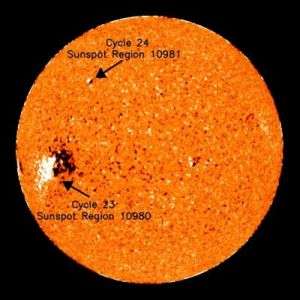
The first official sunspot belonging to the new Solar Cycle 24 is shown in the northeast quadrant of the Sun. The large sunspot region just south of the equator is part of the waning Solar Cycle 23. Credit: NOAA. Original image courtesy of NSO/AURA/NSF

A new 11-year cycle of heightened solar activity, bringing with it increased risks for power grids, critical military, civilian and airline communications, GPS signals and even cell phones and ATM transactions, showed signs it was on its way late Thursday when the cycle’s first sunspot appeared in the sun’s Northern Hemisphere, NOAA scientists said.

“This sunspot is like the first robin of spring,” said solar physicist Douglas Biesecker of NOAA’s Space Weather Prediction Center. “In this case, it’s an early omen of solar storms that will gradually increase over the next few years.”

A sunspot is an area of highly organized magnetic activity on the surface of the sun. The new 11-year cycle, called Solar Cycle 24, is expected to build gradually, with the number of sunspots and solar storms reaching a maximum by 2011 or 2012, though devastating storms can occur at any time.

During a solar storm, highly charged material ejected from the sun may head toward Earth, where it can bring down power grids, disrupt critical communications, and threaten astronauts with harmful radiation. Storms can also knock out commercial communications satellites and swamp Global Positioning System signals. Routine activities such as talking on a cell phone or getting money from an ATM machine could suddenly halt over a large part of the globe.

“Our growing dependence on highly sophisticated, space-based technologies means we are far more vulnerable to space weather today than in the past,” said Vice Admiral Conrad C. Lautenbacher, Jr., under secretary of commerce for oceans and atmosphere and NOAA administrator. “NOAA’s space weather monitoring and forecasts are critical for the nation’s ability to function smoothly during solar disturbances.”

Last April, in coordination with an international panel of solar experts, NOAA issued a forecast that Solar Cycle 24 would start in March 2008, plus or minus six months. The panel was evenly split between those predicting a strong or weak cycle. Both camps agree that the sooner the new cycle takes over the waning previous cycle, the more likely that it will be a strong season with many sunspots and major storms, said Biesecker. Many more sunspots with Solar Cycle 24 traits must emerge before scientists consider the new cycle dominant, with the potential for more frequent storms.

The new sunspot, identified as #10,981, is the latest visible spot to appear since NOAA began numbering them on January 5, 1972. Its high-latitude location at 27 degrees North, and its negative polarity leading to the right in the Northern Hemisphere are clear-cut signs of a new solar cycle, according to NOAA experts. The first active regions and sunspots of a new solar cycle can emerge at high latitudes while those from the previous cycle continue to form closer to the equator.

SWPC is the nation’s first alert for solar activity and its affects on Earth. The center’s space weather forecasters issue outlooks for the next 11-year solar “season” and warn of individual storms occurring on the Sun that could impact Earth. SWPC is one of NOAA’s nine National Centers for Environmental Prediction and is also the warning agency of the International Space Environment Service (ISES), a consortium of 11 member nations.

Solar Cycle forecast: http://www.noaanews.noaa.gov/stories2007/s2847.htm

Source: NOAA Research


print this article email this article download pdf blog this article bookmark this article     Stumble it Digg this share on Facebook retweet share on Reddit add to delicious
Rate this story - 4.8 /5 (17 votes)


January 7, 2008 all stories

Comments: 0

4.8 /5 (17 votes)
  • Stumble this up

  • Digg this

  • share this

  • hide
  • Related Stories

  • NASA on crusade to debunk 2012 apocalypse myths
    created Nov 09, 2009 | popularity not rated yet | comments 0
  • Solar Cycle Driven by More than Sunspots
    created Sep 17, 2009 | popularity not rated yet | comments 0
  • New Transient Radiation Belt Discovered at Saturn
    created Sep 14, 2009 | popularity not rated yet | comments 0
  • Sunspots revealed in striking detail by supercomputers
    created Jun 18, 2009 | popularity not rated yet | comments 0
  • New Solar Cycle Prediction
    created Jun 01, 2009 | popularity not rated yet | comments 0


  • hide
  • Relevant PhysicsForums posts

  • Some help with a X-Ray astronomy question please!
    created 17 hours ago
  • Help with Images and Optical Instrument Question..
    created Nov 26, 2009
  • Redshift as a distance indicator
    created Nov 26, 2009
  • Question about 2-body gravity
    created Nov 24, 2009
  • More from Physics Forums - General Astronomy

Other News

Fermi Telescope Peers Deep into Microquasar

Fermi Telescope Peers Deep into Microquasar (w/ Video)

Space & Earth / Astronomy

created 10 hours ago | popularity 4.5 / 5 (6) | comments 0

(PhysOrg.com) -- NASA's Fermi Gamma-ray Space Telescope has made the first unambiguous detection of high-energy gamma-rays from an enigmatic binary system known as Cygnus X-3. The system pairs a hot, massive ...


The Energy Sources of Ultraluminous Galaxies

The Energy Sources of Ultraluminous Galaxies

Space & Earth / Astronomy

created 11 hours ago | popularity 4.3 / 5 (9) | comments 0

(PhysOrg.com) -- Ultraluminous infrared galaxies ((ULIRGs) are galaxies whose luminosity exceeds that of a trillion suns; for comparison, the Milky Way galaxy has a typical (and much more modest) luminosity ...


Space shuttle Atlantis, 7 astronauts back on Earth (AP)

Space shuttle Atlantis, 7 astronauts back on Earth

Space & Earth / Space Exploration

created 12 hours ago | popularity not rated yet | comments 0

(AP) -- Space shuttle Atlantis and its seven astronauts returned to Earth with a smooth touchdown Friday to end an 11-day flight that resupplied the International Space Station.


China is set to launch its second moon orbiter next October, state media have reported

China to launch second lunar probe: state media

Space & Earth / Space Exploration

created 16 hours ago | popularity 5 / 5 (4) | comments 0

China will launch its second moon orbiter next October, state media reported Friday, as it powers ahead with a space programme that has sparked concerns abroad.


Herschel takes a peek at the ingredients of the galaxies

Herschel takes a peek at the ingredients of the galaxies

Space & Earth / Astronomy

created 9 hours ago | popularity 4.3 / 5 (3) | comments 0

(PhysOrg.com) -- The European Space Agency has today released spectacular new observations from the Herschel Space Observatory, including the UK-led SPIRE instrument. Spectrometers on board all three Hershel ...