Scientists detect lowest frequency radar echo from the moon
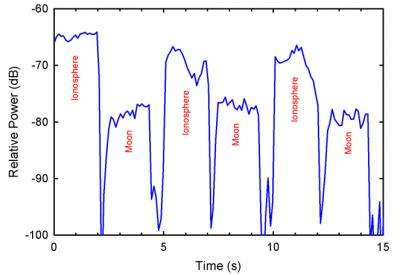
A team of scientists from the Naval Research Laboratory (NRL), the Air Force Research Laboratory’s (AFRL’s) Research Vehicles Directorate, Kirtland Air Force Base, N.M., and the University of New Mexico (UNM) has detected the lowest frequency radar echo from the moon ever seen with earth-based receivers.
In the lunar echo experiment (more properly called a lunar bistatic radar experiment), the Air Force/Navy High Frequency Active Auroral Research Program (HAARP) high power transmitter, located near Gakona, Alaska, launched high power radio waves toward the moon. The reflected signal, weakened because of the long distance to the moon and back, was detected by receiving antennas in New Mexico.
NRL consultant scientist Dr. Paul Rodriguez, of NRL’s Information Technology Division, who conceived and proposed the experiment explains, “Analysis of the echo gives information on the properties of the lunar sub-surface topography, because the low frequency radar waves propagate to varying depths below the visible surface of the moon. It is somewhat like sonar, except that we are using electromagnetic waves rather than sound waves. The experiment also allows us to study the interaction of the echo signal with the earth’s ionosphere along its return path, because the ionosphere is only partially transparent at low frequencies.”
During the experiment, which was carried out on Oct. 28 and 29, 2007, the radar signals from HAARP were at 7.4075 MHz and 9.4075 MHz. Both the transmitted signal and the echo from the moon were detected by NRL Remote Sensing Division scientist, Dr. Kenneth Stewart, and NRL engineer Brian Hicks with antennas built for the Long Wavelength Array (LWA). LWA is a radio interferometer being built in the desert west of Socorro, N.M., by UNM, NRL, the Applied Research Laboratories at the University of Texas at Austin, Virginia Tech, and Los Alamos National Laboratory, for studies of space physics and astrophysics.
The LWA is intended to work below the 88 MHz edge of the FM band, but to get down to the HAARP signal frequencies, the antennas were equipped with digital receivers and specially designed matching networks developed by Stewart, Hicks, and engineer Nagini Paravastu at NRL. “Detecting the very weak radio signals after their round trip to the moon and back was challenging and required careful modification of the LWA antennas to improve their performance at these frequencies,” says Stewart. NRL LWA Project Scientist Dr. Namir Kassim notes, “One of the successful goals of this experiment was to demonstrate that the LWA can work with instruments like HAARP at lower frequencies than its nominal design.”
The HAARP radar antenna array was ”phased” to point about 45 degrees away from the zenith, in order to track and directly illuminate the moon. Its full total power capability, about 3.6 MW, was used to transmit pulses two seconds in length every five seconds over a period of two hours each day, one hour at each frequency. Using such a pulse pattern makes the echo, which arrives back from the moon 2.4 seconds later, immediately recognizable, allowing the scientists to distinguish the moon’s echo signal from the HAARP signal. The HAARP signal reached the receiving antennas in New Mexico by reflecting off the underside of the ionosphere, the region of the Earth’s atmosphere from 50 to 400 km in altitude that is partially ionized by solar radiation.
The lunar echo measurements at 7.4075 MHZ are believed to be the lowest frequency (longest wavelength)at which bistatic radar measurements have been conducted. “Even though lunar echoes have been detected before at higher frequencies, it was really exciting to see them arrive in real time out under the full moon in the New Mexico desert,” says NRL’s Hicks.
Source: Naval Research Laboratory


