Swift, Gemini probe mysterious explosion in the distant past
January 8, 2008 Swift, Gemini probe mysterious explosion in the distant past

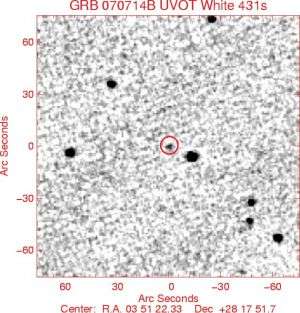
Swift’s Ultraviolet/Optical Telescope captured this image of the afterglow of GRB 070714B, the farthest short gamma-ray burst with a measured distance. Credit: Credit: Swift Team/UVOT/NASA

Using the powerful one-two combo of NASA’s Swift satellite and the Gemini Observatory, astronomers have detected a mysterious type of cosmic explosion farther back in time than ever before. The explosion, known as a short gamma-ray burst (GRB), took place 7.4 billion years ago, more than halfway back to the Big Bang.

"This discovery dramatically moves back the time at which we know short GRBs were exploding. The short burst is almost twice as far as the previous confirmed record holder," says John Graham of the Johns Hopkins University, in Baltimore, Md. Graham is presenting his group’s discovery on Tuesday in a poster at the American Astronomical Society’s 2008 winter meeting in Austin, Texas.

GRBs are among the most powerful explosions in the universe, releasing enormous amounts of energy in the form of X-rays and gamma rays. Most bursts fall in one of two categories: long bursts and short bursts, depending on whether they last longer or shorter than three seconds. Astronomers think that long GRBs are triggered by the collapse and explosion of massive stars. In contrast, a variety of mechanisms have been proposed for short bursts. The most popular model says that most short GRBs occur when two neutron stars smash into each other and collapse into a black hole, ejecting energy in two counterflowing beams.

The record-setting short burst is known as GRB 070714B, since it was the second GRB detected on July 14, 2007. Swift discovered the GRB in the constellation Taurus. The burst’s high energy and 3-second duration firmly place it in the short GRB category. Rapid follow-up observations with the 2-meter Liverpool Telescope and the 4-meter William Herschel Telescope found an optical afterglow in the same location as the burst, which allowed astronomers to identify the GRB’s host galaxy.

Next, Graham and his colleagues, Andrew Fruchter of the Space Telescope Science Institute, in Baltimore, and Andrew Levan of the University of Warwick, U.K., trained the 8-meter Gemini North Telescope in Hawaii on the galaxy. It revealed that the host galaxy has a spectral line from ionized oxygen. The amount that line was shifted toward the red end of the spectrum yields a redshift of 0.92. A redshift of 0.92 translates to a distance of 7.4 billion light-years, meaning the explosion occurred 7.4 billion years ago.

"The fact that this short burst is so far away means this subclass has a broad range of distances, although they still tend to be closer on average than long GRBs," says Swift lead scientist Neil Gehrels of NASA’s Goddard Space Flight Center in Greenbelt, Md.

Gehrels adds that GRB 070714B’s energy is about 100 times higher than average for short bursts, and is more similar to the typical energy of a long GRB. "It is unclear whether another mechanism is needed to explain this explosion, such as a neutron star-black hole merger. Or it could be that there are a wide range of energies for neutron star-neutron star mergers, but that seems unlikely."

Another possibility is that GRB 070714B concentrated its energy in two very narrow beams, and one of the beams happened to be aimed directly at Earth. This would make the burst seem more powerful than it really was. Perhaps most short GRBs eject their energy in wider and less-concentrated beams.

"We now have a good idea of the type of star that produces the brighter long bursts. But how short bursts are formed remains a mystery," says Fruchter.

Source: Goddard Space Flight Center


print this article email this article download pdf blog this article bookmark this article     Stumble it Digg this share on Facebook retweet share on Reddit add to delicious
Rate this story - 4.3 /5 (20 votes)

Rank Filter

Move the slider to adjust rank threshold, so that you can hide some of the comments.


Display comments: newest first

  • brant - Jan 08, 2008
    • Rank: not rated yet
    This paper solves all the problems, doesnt require any dark matter, black holes or neutron stars, and is reproducible in the lab.

    Polarization in Gamma-Ray Bursts Produced by Pinch Discharge
    http://adsabs.har....5...57W&db_key=AST&data_type=HTML&format=&high=42ca922c9c03905

January 8, 2008 all stories

Comments: 1

4.3 /5 (20 votes)
  • Stumble this up

  • Digg this

  • share this

  • hide
  • Related Stories

  • In a Galaxy Far, Far Away...
    created Nov 06, 2009 | popularity not rated yet | comments 0
  • Astronomers explore 'last blank space' on map of the Universe
    created Oct 28, 2009 | popularity not rated yet | comments 0
  • Gamma-ray photon race ends in dead heat; Einstein wins this round
    created Oct 28, 2009 | popularity not rated yet | comments 0
  • Fermi Telescope Caps First Year With Glimpse of Space-Time (w/ Video)
    created Oct 28, 2009 | popularity not rated yet | comments 0
  • A Brief Mystery: What are Short Gamma-ray Bursts?
    created Oct 21, 2008 | popularity not rated yet | comments 0


  • hide
  • Relevant PhysicsForums posts

  • The shape of our solar system's orbits.
    created Nov 07, 2009
  • Above or Below the Line of Nodes
    created Nov 07, 2009
  • Supernova vs. Nova?
    created Nov 07, 2009
  • Supernova's Gamma Rays and Comets
    created Nov 06, 2009
  • More from Physics Forums - General Astronomy

Other News

NASA's GOES Project offers real-time hurricane alley movies

NASA's GOES Project offers real-time hurricane alley movies

Space & Earth / Earth Sciences

created 1hour ago | popularity not rated yet | comments 0

People love to get the big picture of hurricane alleys, and thanks to the GOES Project at NASA's Goddard Space Flight Center in Greenbelt, Md., they can now get real-time satellite animations of the eastern ...


L-R: Chiwetel Ejiofor, Amanda Peet and John Cusack at the premiere of "2012"

NASA on crusade to debunk 2012 apocalypse myths

Space & Earth / Space Exploration

created 1hour ago | popularity not rated yet | comments 0

The world is not coming to an end on December 21, 2012, the US space agency insisted Monday in a rare campaign to dispel widespread rumors fueled by the Internet and a new Hollywood movie.


NASA satellites make a movie and get rainfall, wind info on Ida

NASA satellites make a movie and get rainfall, wind info on Ida (w/ Video)

Space & Earth / Earth Sciences

created 1hour ago | popularity not rated yet | comments 0

NASA satellites are amazing examples of technology. The TRMM satellite peers into tropical cyclones and can tell how much rain is falling per hour and where. QuikScat uses microwave technology to measure Ida's ...


Antarctica glacier retreat creates new carbon dioxide store

Antarctica glacier retreat creates new carbon dioxide store

Space & Earth / Earth Sciences

created 5 hours ago | popularity 5 / 5 (2) | comments 0

Large blooms of tiny marine plants called phytoplankton are flourishing in areas of open water left exposed by the recent and rapid melting of ice shelves and glaciers around the Antarctic Peninsula. This ...


NASA's TRMM Satellite sees most of Ida's heaviest rain stayed off coasts

NASA's TRMM Satellite sees most of Ida's heaviest rain stayed off coasts

Space & Earth / Earth Sciences

created 2 hours ago | popularity not rated yet | comments 0

NASA and the Japanese Space Agency's Tropical Rainfall Measuring Mission (TRMM) satellite flew over Ida and captured her rainfall when she passed by Nicaragua, Honduras and Belize this weekend. TRMM data revealed ...