Humans have caused profound changes in Caribbean coral reefs
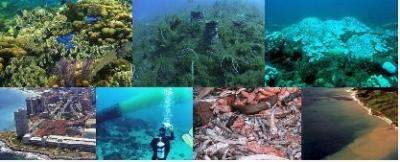
Coral reefs in the Caribbean have suffered significant changes due to the proximal effects of a growing human population, reports a study published in the Proceedings of the Royal Society of London, B.
“It is well acknowledged that coral reefs are declining worldwide but the driving forces remain hotly debated,” said author Camilo Mora at Dalhousie University, Halifax, Canada. “In the Caribbean alone, these losses are endangering a large number of species, from corals to sharks, and jeopardizing over 4 billion dollars in services worth from fisheries, tourism and coastal protection,” he added.
“The continuing degradation of coral reefs may be soon beyond repair, if threats are not identified and rapidly controlled,” Mora said. “This new study moves from the traditional localized study of threats to a region-wide scale, while simultaneously analyzing contrasting socioeconomic and environmental variables,” he added.
The study monitored coral reefs, including corals, fishes and macroalgae, in 322 sites across 13 countries throughout the Caribbean. The study was complemented with a comprehensive set of socioeconomic databases on human population density, coastal development, agricultural land use and environmental and ecological databases, which included temperature, hurricanes, productivity, coral diseases and richness of corals. The data were analyzed with robust statistical approaches to reveal the causes of coral reef degradation in that region.
The study showed clearly that the number of people living in close proximity to coral reefs is the main driver of the mortality of corals, loss of fish biomass and increases in macroalgae abundance. A comparative analysis of different human impacts revealed that coastal development, which increases the amount of sewage and fishing pressure (by facilitating the storage and export of fishing products) was mainly responsible for the mortality of corals and loss of fish biomass. Additionally, the area of cultivated land (a likely surrogate for agrochemical discharges to coral reefs) was the main driver of increases in macroalgae. Coral mortality was further accelerated by warmer temperatures.
“The human expansion in coastal areas inevitably poses severe risks to the maintenance of complex ecosystems such as coral reefs,” Mora said. “On one hand, coral reefs are maintained due to intricate ecological interactions among groups of organisms. For instance, predators prey upon herbivorous, herbivores graze on macroalgae, and macroalgae and corals interact for their use of hard substrata. Given the intensity of these interactions the effects of a threat in anyone group may escalate to the entire ecosystem. On the other hand, the array of human stressors arising from changes in land use, exploitation of natural resources and increases in ocean temperature (and perhaps acidification) due to an increasing demand for energy, are significantly affecting all major groups of coral reef organisms. The simultaneous effect of human threats on coral reef organisms and the potential escalation of their effects to the entire ecosystem highlight the critical situation of coral reefs and the need to adopt an ecosystem-based approach for conservation and an integrated control of multiple human stressors,” he added.
The study also showed that the effective compliance of fishing regulations inside Marine Protected Areas (MPAs) has been successful in protecting fish populations. But coral mortality and macroalgae abundance showed no response to the presence of MPAs. That was explained by the general failure of MPAs in the Caribbean to account for threats such as land runoffs and ocean warming. “Unfortunately, the degradation of the coral reef matrix inside MPAs may, in the long term, defeat their positive effect on fish populations,” Mora said. “This further highlights the need for a holistic control of human stressors,” he added.
“The future of coral reefs in the Caribbean and the services they provide to a growing human population depend on how soon countries in the region become seriously committed to regulating human threats”, Mora said. “Although coral reefs will experience benefits of controlling fishing, agricultural expansion, sewage or ocean warming, it is clear that underlying all these threats is the human population. The expected increase of the world’s human population from 6 billion today to 9 billion for the year 2050 suggests that coral reefs are likely to witness a significant ecological crisis in the coming half century if effective conservation strategies, including policies on population planning, are not implemented soon,” he added.
Source: Census of Marine Life


