Researchers uncover mechanisms of common inherited mental retardation
January 8, 2008
Researchers uncover mechanisms of common inherited mental retardation

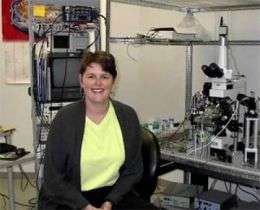
Dr. Kimberly Huber investigated how Fragile X syndrome affects communication between cells in the hippocampus, a region of the brain that is involved in learning and memory. Fragile X syndrome is the most common cause of inherited mental retardation and the most common genetic cause of autism. Credit: UT Southwestern Medical Center

Researchers at UT Southwestern Medical Center are uncovering how brain cells are affected in Fragile X syndrome, the most common cause of inherited mental retardation and the most common genetic cause of autism.

“I think we’ve discovered a core mechanism underlying Fragile X syndrome,” said Dr. Kimberly Huber, assistant professor of neuroscience and senior author of a study appearing in Wednesday’s edition of the Journal of Neuroscience.

Dr. Huber’s research with mice focuses on how Fragile X syndrome affects communication between cells in the hippocampus, a region of the brain that is involved in learning and memory. Her findings show that two different chemical signals go awry in Fragile X syndrome, indicating that drugs that interact with these signals might be a pathway to help treat the syndrome.

“The more we know about how signaling mechanisms in the brain lead to normal memory and learning, the better we can understand what goes wrong in conditions such as Fragile X syndrome,” said Dr. Huber, who is a Southwestern Medical Foundation Scholar in Medical Research. “Our research is laying the groundwork for such understanding and indicates a new area for research.”

Fragile X syndrome got its name because it affects a single gene, Fmr1, on the X chromosome. Under a microscope, the area around the gene looks narrower than normal, or “fragile.” According to the Centers for Disease Control and Prevention, the syndrome, which mostly occurs in males, affects about one in every 4,000 white males in the U.S.

It often causes a distinct physical appearance including an elongated face with protruding ears, hyperflexible joints, and mental deficits ranging from mood disorders to severe mental retardation. Much of the current treatment focuses on behavioral therapy combined with medications to control mood and seizures.

Dr. Huber previously co-discovered that mice genetically engineered to lack Fmr1 have a defective signaling system in the brain that controls learning in the hippocampus. This system relies on a chemical messenger called glutamate, which under normal circumstances causes nerve cells to make proteins and change their electrical firing patterns in response to learning situations. Without a properly working Fmr1 gene, the glutamate signaling system malfunctions.

In 2007 she and colleagues at UT Southwestern found that acetylcholine, another specific signaling chemical, affects the same protein-making factory that glutamate does. This research appeared in the Oct. 24, 2007, issue of the Journal of Neuroscience.

“We suggest that treatment that affects the acetylcholine system might be a supplement or alternative to drugs targeting the glutamate pathway,” Dr. Huber said.

In the current study, she and postdoctoral researcher Dr. Jennifer Ronesi investigated a protein, called Homer, which serves as a kind of structural support for the glutamate system. The Homer–glutamate support system is disconnected in Fragile X syndrome. Dr. Huber’s group discovered that this disconnection results in an inability of brain cells to make the new proteins important for learning and memory.

Source: UT Southwestern Medical Center

4.5 /5 (2 votes)  

Rank 4.5 /5 (2 votes)
Tags

Relevant PhysicsForums posts
  • Is Everyday Technology Killing Us?
    createdFeb 08, 2012
  • Exercise and weight loss
    createdFeb 08, 2012
  • Why do we have head aches? Our brains can't feel anything.
    createdFeb 07, 2012
  • "The end of diseases" by David Agus, interview from Daily Show with Jon Stewart
    createdFeb 04, 2012
  • Oncolytic adenovirus
    createdFeb 04, 2012
  • Nutrition label stuffs and diets
    createdFeb 02, 2012
  • More from Physics Forums - Medical Sciences

More news stories

Injured boomers beware: Know when to see doctor

(AP) -- It happened to nurse Jane Byron years after an in-line skating fall, business owner Haralee Weintraub while doing "men's" push-ups, and avid cyclist Gene Wilberg while lifting a heavy box.

Medicine & Health / Health

created 46 minutes ago | popularity not rated yet | comments 0

FDA-approved drug rapidly clears amyloid from the brain, reverses Alzheimer's symptoms in mice

Neuroscientists at Case Western Reserve University School of Medicine have made a dramatic breakthrough in their efforts to find a cure for Alzheimer's disease. The researchers' findings, published in the journal Science, show t ...

Medicine & Health / Neuroscience

created Feb 09, 2012 | popularity 4.9 / 5 (53) | comments 21 | with audio podcast

Green tea found to reduce disability in the elderly

(Medical Xpress) -- A lot of research has been done over the past several years looking into the health benefits of green tea. As a result, scientists have found that regular consumption of the beverage leads ...

Medicine & Health / Health

created Feb 07, 2012 | popularity 4.4 / 5 (14) | comments 11 | with audio podcast report

Teen school drop-outs three times as likely to be on benefits in later life

Teen school drop-outs are almost three times as likely to be on benefits in later life as their peers who complete their schooling, indicates research published online in the Journal of Epidemiology and Community Health.

Medicine & Health / Health

created Feb 06, 2012 | popularity not rated yet | comments 13

To perform with less effort, practice beyond perfection

Whether you are an athlete, a musician or a stroke patient learning to walk again, practice can make perfect, but more practice may make you more efficient, according to a surprising new University of Colorado Boulder study.

Medicine & Health / Neuroscience

created Feb 09, 2012 | popularity 4.4 / 5 (15) | comments 6 | with audio podcast


Google might launch Drive for cloud storage soon

(PhysOrg.com) -- Google's next big move, according to the Wall Street Journal, is a cloud storage service called Drive. Hardly first to the plate, Google is simply catching up to introducing its cloud reposi ...

Latin America mining boom clashes with conservation

Latin America is experiencing a mining boom as prices rise fuelled by a hike in global demand, but the region is also being hit by a wave of violent protests, strikes and rallies by environmentalists.

Love a click away in Indonesia's Twitter Republic

He was a geeky kid from Yogyakarta, she a glamorous city girl in Jakarta. In a country with one of the world's most vibrant social networking scenes they fell in love on Twitter.

Europeans protest controversial Internet pact

Tens of thousands of people marched in protests in more than a dozen European cities Saturday against a controversial anti-online piracy pact that critics say could curtail Internet freedom.

Walney offshore wind farm is world's biggest (for now)

(PhysOrg.com) -- The Walney wind farm on the Irish Sea--characterized by high tides, waves and windy weather--officially opened this week. The farm is treated in the press as a very big deal as the Walney ...

Navy to begin tests on electromagnetic railgun prototype launcher

The Office of Naval Research (ONR)'s Electromagnetic (EM) Railgun program will take an important step forward in the coming weeks when the first industry railgun prototype launcher is tested at a facility ...