Scientists test spread of life
March 19, 2006 Earth

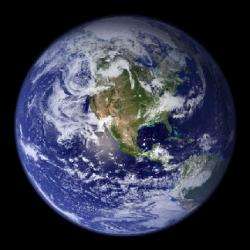
Scientists suggest life on earth could have spread to other planetary bodies in the solar system.

Two groups of researchers have used models to demonstrate the possibility, Nature reports. The researchers talked about their work this week at the Lunar and Planetary Science Conference in League City, Texas.

"Once one planet comes down with life, they all get it," said NASA scientist Jeff Moore, comparing the spread of life to the spread of the common cold.

Two groups of researchers have used computer simulations and models to test the theory. One found that the Jovian moon Europa and Titan, one of Saturn's moons, would receive bits of earth thrown up by the impact of a large meteor -- with up to 100 pieces landing during a 5 million year period -- while the other showed that a few bacteria would survive the meteor strike.

Any earth fragments that head for Europa would be going at such speed because of Jupiter's gravity that they would be sterilized before landing. But bacteria might get to Titan.

The next question is whether they could survive on a moon where the temperature is minus 170 degrees Celsius.

Copyright 2006 by United Press International


print this article email this article download pdf blog this article bookmark this article     Stumble it Digg this share on Facebook retweet share on Reddit add to delicious
Rate this story - 4.2 /5 (22 votes)


March 19, 2006 all stories

Comments: 0

4.2 /5 (22 votes)
  • Stumble this up

  • Digg this

  • share this

  • hide
  • Related Stories

  • Colliding auroras produce an explosion of light
    created Dec 17, 2009 | popularity not rated yet | comments 0
  • World's first skeletal mount of Paluxysaurus jonesi reveals new biology
    created Dec 15, 2009 | popularity not rated yet | comments 0
  • Bacteria offer insights into human decision making
    created Dec 08, 2009 | popularity not rated yet | comments 0
  • Crashing the size barrier
    created Nov 18, 2009 | popularity not rated yet | comments 0
  • Scientists put interactive flu tracking at public's fingertips
    created Nov 16, 2009 | popularity not rated yet | comments 0


Other News

American scriptwriters increasingly incorporating Spanish in their dialogues

Other Sciences / Other

created 4 hours ago | popularity not rated yet | comments 0

Nieves Jiménez Carra, a researcher and lecturer at the Pablo de Olavide (UPO) University in Seville has studied how scripts swap from one language to another in American television series and cinema. One of her conclusions ...


Nobel Physics laureates undeserving, colleagues say: report

Other Sciences / Other

created 20 hours ago | popularity 4.2 / 5 (5) | comments 2

Former colleagues of two American scientists who won the 2009 Nobel physics prize say the winners, Willard Boyle and George Smith, did not deserve the award, Canada's Globe and Mail reported Tuesday.


UNL research aims to understand homelessness among women

Other Sciences / Social Sciences

created 11 hours ago | popularity not rated yet | comments 0

(PhysOrg.com) -- Women make up nearly one-third of the homeless population in the United States. Yet little is known about how they become homeless or how they live. University of Nebraska-Lincoln sociologist Les Whitbeck ...


Christmas Carol Talk

Other Sciences / Other

created 21 hours ago | popularity not rated yet | comments 0

Even without the lyrics, the tunes of some Christmas carols -- such as "Jingle Bells" or "Deck the Halls" -- sound uplifting. But the melodies of other songs like "We Three Kings" have a different, somber sound.


Australian fossil unlocks secrets to the origin of whales

Other Sciences / Archaeology & Fossils

created 23 hours ago | popularity 4.8 / 5 (4) | comments 0

Museum Victoria palaeobiologist Dr Erich Fitzgerald has made new groundbreaking discoveries into the origin of baleen whales, based on a 25 million year old fossil found near Torquay in Victoria.