January 9, 2008 feature
How We Localize Surround Sound
You're walking down a busy street, with cars and buses driving past and bits of conversations reaching your ears, when you hear someone call your name. You turn about 60 degrees to your left and look up to the second floor window of a building about 100 meters away, to exactly the spot where a friend is waving.
The ability of humans and other animals to pinpoint the location of sound sources is remarkably good, scientists say. Since the early 1900s, many studies have been performed on the underlying physical mechanisms of how animals’ ears can determine “directional sound.”
In a recent study and review, scientists Axel Michelsen and Ole Naesbye Larsen from the University of Southern Denmark have offered a quantitative analysis of how animals like insects and small birds can localize the direction to sound sources. These animals are too small to take advantage of the directional cues used by humans (changes with direction of the sound pressure and time of arrival of sound at the ears). However, the results of the study, which is published in a recent issue of Bioinspiration and Biomimetics, could have important implications for humans, as well.
“We now have an understanding of the physics of these hearing systems, and can make quantitative predictions that can be tested in experiments,” Michelsen told PhysOrg.com.
In order to determine where a sound is coming from, animals can use information based on the differences between two ears (called “binaural” cues) or information, such as from the shape, of a single ear (called “monaural” cues). Michelsen and Larsen explain that many smaller non-mammalian animals compute the azimuth (horizontal plane) of sound sources using binaural cues with ears that receive sound at both the outer and inner surface of the eardrum, which is called “pressure difference reception.”
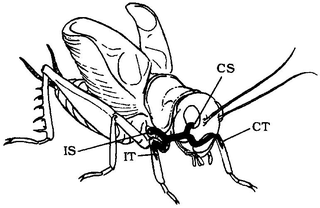
Birds and grasshoppers are some of the small animals that can use pressure difference reception, which is characterized by having two ears that are connected by an air tunnel through the animal’s body. As the sound travels between ears through the animal’s body, each eardrum is activated by different sounds at its outer and inner surface that help the animal determine the source of the sound. For example, the ear facing more toward the sound source vibrates with a larger amplitude than the eardrum facing away. As the researchers emphasize, both sound transmission through the body and binaural cues help the animal localize sound.
Although scientists know the general mechanisms responsible for sound localization, the difficulty of performing experiments with animals in non-interfering environments makes a detailed model elusive. Michelsen and Larsen explain that scientists are still far from understanding certain components of directional hearing, such as the physics of sound transmission through channels in the body, and how an animal’s habitat influences its hearing mechanisms.
“What is needed now is to get a much better understanding of directional hearing in the natural habitats, where thick vegetation, etc., degrade sounds,” Michelsen said.
Humans, on the other hand, use a different type of sound receiver, one that uses simply “pressure reception.” In human ears, only the outer surface is exposed to sound, and an opening (the Eustachian tube) allows an equalization of pressure, but doesn’t allow sound to enter the middle ear. While humans with normal hearing have a surprisingly good ability to determine sound origins, individuals who use hearing aids often have only a very limited ability to localize sounds.
But, as Michelsen and Larsen explain, using techniques from pressure difference reception, like the birds and grasshoppers have, may improve the sound localization ability of human hearing aids. One possibility is to let the hearing aids in the two ears exchange information by means of radio signals, which enhances the binaural and time cues in both ears, and thereby helps a user determine the direction of a sound. As Michelsen explains, the ability to determine the source of sound is not just a luxury, but often a necessary survival skill.
“Praying mantids flying at night can hear the cries of hunting bats, but not determine the direction to the bats,” Michelsen said. “It probably means that more mantids get eaten by bats than would have been the case if their hearing system had been equipped with pressure difference reception.”
Much more information remains to be learned about directional hearing in different animals. From frogs, which hear with their lungs and mouth, to crickets, which have ears on their front legs just below the knee, the ability to hear is complex and can offer a deeper understanding of nature’s remarkable acoustic abilities.
More information: Michelsen, Axel, and Larsen, Ole Naesbye. “Pressure difference receiving ears.” Bioinsp. Biomim. 3 (2008) 011001 (18pp).
Copyright 2007 PhysOrg.com.
All rights reserved. This material may not be published, broadcast, rewritten or redistributed in whole or part without the express written permission of PhysOrg.com.


