Galaxy may hold hundreds of rogue black holes
January 9, 2008
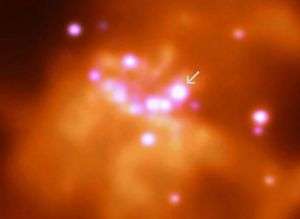
The arrow points to a candidate intermediate mass black hole in a Hubble space telescope image of a globular cluster in the M20 galaxy. Credit: Space Telescope Science Institute
If the latest simulation of what happens when black holes merge is correct, there could be hundreds of rogue black holes, each weighing several thousand times the mass of the sun, roaming around the Milky Way galaxy.
“Rogue black holes like this would be very difficult to spot,” says Vanderbilt astronomer Kelly Holley-Bockelmann, who is presenting the results of the supercomputer simulation at a meeting of the American Astronomical Society on Jan. 9 in Austin, Texas. Much of the research was done at Penn State University in collaboration with Deirdre Shoemaker and Nicolas Yunes before Holley-Bockelmann moved to Vanderbilt. Kayhan Gultekin at the University of Michigan also participated in the study.
“Unless it's swallowing a lot of gas, about the only way to detect the approach of such a black hole would be to observe the way in which its super-strength gravitational field bends the light that passes nearby. This produces an effect called gravitational lensing that would make background stars appear to shift and brighten momentarily,” she says.
The research focused on modeling "intermediate mass" black holes, whose very existence is controversial. Astronomers have ample evidence that small black holes less than 100 solar masses are produced when giant stars explode. There is similar evidence that “super-massive” black holes weighing the equivalent of millions to billions of solar masses sit at the heart of many galaxies, including the Milky Way. In addition, theoreticians have predicted that globular clusters – ancient, gravitationally bound groups of 100,000 to a million stars – should contain a third class of black holes, called intermediate mass black holes, that weigh a few thousand solar masses. But so far there have only been two tentative observations of objects of this sort.
In the past two years, scientists have succeeded in numerically simulating black hole mergers that incorporate Einstein’s theory of relativity. One of the big surprises to come from this effort is the prediction that when two black holes that are rotating at different speeds or are different sizes combine, the newly merged black hole receives a big kick due to conservation of momentum, pushing it away in an arbitrary direction at velocities as high as 4,000 kilometers per second.
“This is much higher than anyone predicted. Even the average kick velocity of 200 kilometers per second is extremely high when compared to the escape velocities of typical astronomical objects,” says Holley-Bockelmann. “We realized that basically any black hole merger would kick the new remnant out of a globular cluster, because the escape velocity is less than 100 kilometers per second.”
Using the facilities of Vanderbilt’s Advanced Center for Computation, Research and Education, Holley-Bockelmann’s team ran a number of simulations of the growth of intermediate mass black holes as they combine with a number of stellar-sized black holes, which are plentiful in globular clusters, paying close attention to the kick they received after each merger.
“We used different assumptions for the initial black hole mass, for the range of stellar black hole masses within a globular cluster, and assumed that the spins and spin orientations were distributed randomly. With our most conservative assumptions, we found that, even if every globular cluster started out with an intermediate-sized black hole, only about 30 percent retain them through the merger epoch. With our least conservative assumptions, less than 2 percent of the globular clusters should contain intermediate mass black holes today,” she says.
If the roughly 200 globular clusters in the Milky Way have indeed spawned intermediate-sized black holes, this means that hundreds of them are probably wandering invisibly around the Milky Way, waiting to engulf the nebulae, stars and planets that are unfortunate enough to cross their paths.
Fortunately, the existence of a few rogue black holes in the neighborhood does not present a major danger. “These rogue black holes are extremely unlikely to do any damage to us in the lifetime of the universe,” Holley-Bockelmann stresses. “Their danger zone, the Schwarzschild radius, is really tiny, only a few hundred kilometers. There are far more dangerous things in our neighborhood!”
Source: Vanderbilt University
-
Fermi's latest gamma-ray census highlights cosmic mysteries
Sep 09, 2011 |
4.8 / 5 (16) |
18
-
Building galaxies
Jul 11, 2011 |
5 / 5 (2) |
10
-
Massive Black Hole Implicated in Stellar Destruction
Jan 04, 2010 |
4.8 / 5 (12) |
9
-
Black Holes in Star Clusters stir up Time and Space (w/ Video)
Dec 16, 2009 |
4.7 / 5 (18) |
6
-
Living fossils hold record of 'supermassive' kick
Jul 09, 2009 |
4.7 / 5 (15) |
9
-
Engineers build first sub-10-nm carbon nanotube transistor
Feb 01, 2012 |
4.9 / 5 (31) |
30
-
Something old, something new: Evolution and the structural divergence of duplicate genes
Jan 31, 2012 |
4.6 / 5 (7) |
1
-
The hidden nanoworld of ice crystals: Revealing the dynamic behavior of quasi-liquid layers
Jan 30, 2012 |
5 / 5 (3) |
1
-
Stock market network reveals investor clustering
Jan 27, 2012 |
3.9 / 5 (23) |
8
-
Of microchemistry and molecules: Electronic microfluidic device synthesizes biocompatible probes
Jan 26, 2012 |
5 / 5 (1) |
0
-
Scale of the Universe
5 hours ago
-
Titan's lack of impact craters
Feb 09, 2012
-
Real pictures of black hole eating a star?
Feb 08, 2012
-
Hypothetical way to travel faster than light, but not technically exceed lightspeed
Feb 06, 2012
-
How do scientists monitor the Sun's activity?
Feb 05, 2012
-
Search patterns in observational studies
Feb 05, 2012
- More from Physics Forums - General Astronomy
More news stories
Humans may have helped the decline of African rainforests 3000 years ago
(PhysOrg.com) -- Large areas of rainforests in Central Africa mysteriously disappeared over three thousand years ago, to be replaced by savannas. The prevailing theory has been that the cause was a change ...
Could Venus be shifting gear?
(PhysOrg.com) -- ESAs Venus Express spacecraft has discovered that our cloud-covered neighbour spins a little slower than previously measured. Peering through the dense atmosphere in the infrared, the ...
Space & Earth / Space Exploration
12 hours ago |
5 / 5 (7) |
7
|
NASA sees wide-eyed cyclone Jasmine
Cyclone Jasmine's eye has opened wider on NASA satellite imagery, as it moves through the Southern Pacific Ocean.
Space & Earth / Earth Sciences
4 hours ago |
2 / 5 (1) |
1
NASA sees Giovanna reach cyclone strength, threaten Madagascar
Tropical Storm 12S built up steam and became a cyclone on February 10, 2012 as NASA's Terra satellite passed overhead. Residents of east-central Madagascar should prepare for this cyclone to make landfall ...
Space & Earth / Earth Sciences
4 hours ago |
not rated yet |
0
Mars Science Laboratory computer issue resolved
(PhysOrg.com) -- Engineers have found the root cause of a computer reset that occurred two months ago on NASA's Mars Science Laboratory and have determined how to correct it.
Space & Earth / Space Exploration
13 hours ago |
4.7 / 5 (6) |
3
|
Google users warned of threat to smartphone wallets
Users of Google smartphone wallets were being warned on Friday that there is a way to crack pass codes intended to thwart thieves from going on illicit shopping sprees.
Anonymous knocks CIA website offline (Update)
The website of the Central Intelligence Agency was inaccessible on Friday after the hacker group Anonymous claimed to have knocked it offline.
Complex wiring of the nervous system may rely on a just a handful of genes and proteins
Researchers at the Salk Institute have discovered a startling feature of early brain development that helps to explain how complex neuron wiring patterns are programmed using just a handful of critical genes. ...
New error-correcting codes guarantee the fastest possible rate of data transmission
Error-correcting codes are one of the triumphs of the digital age. Theyre a way of encoding information so that it can be transmitted across a communication channel such as an optical fiber o ...
The power of estrogen -- male snakes attract other males
A new study has shown that boosting the estrogen levels of male garter snakes causes them to secrete the same pheromones that females use to attract suitors, and turned the males into just about the sexiest ...
Putting the squeeze on planets outside our solar system
(PhysOrg.com) -- Using high-powered lasers, scientists at Lawrence Livermore National Laboratory and collaborators discovered that molten magnesium silicate undergoes a phase change in the liquid state, abruptly ...
Jan 09, 2008
Rank: 5 / 5 (2)
That has got to be a mis-quote. The schwarzchild radius may be where the gravity over powers light itself, but an "intermediate mass" black hole would have a thousand to several thousand solar masses.
Last time I checked standard model, the sun supposedly gravitationally holds earth from a distances of 93 million miles, which is a HELL of a lot more than "a few hundred kilometers". In fact, if an "intermediate" black hole with 1000 solar masses passed within 32 astronomical units of the sun, it would capture and destroy the earth, all planets outside the earth, and possibly the sun itself, as its gravitational effects on the solar system would still be greater than or equal to that of the sun.
Even At 1000 AU, the 1000 solar mass black hole would have more gravitational force on pluto, than the sun itself does, if the black hole approached from the pluto side of the solar system! Pluto ~30-50AU depending on the timing of the flyby. Mass = 1000 solar. So sqrt 1000 < 32. Which means that even if the black hole were 1000 AU from the sun, it would still have stronger gravity on anything which was 32 AU away from the sun (which means it would capture pluto and all the dwarf planets/comets, etc). Even at that distance it would seriously perturb planetary and lunar orbits, and any closer it would start to wreck havoc on the inner solar system.
You can do the math yourself and see. Gravitational acceleration is proportional to mass and inversely proportional to distance squared. If A 1000 solar mass black hole passes anywhere even remotely near the solar system, its gravity WILL destroy the solar system, whether or not it sucks it into the event horizon.
Jan 09, 2008
Rank: 3.5 / 5 (2)
Sounds like the black holes can achieve velocities great enough to escape entire galaxies. Maybe an explanation for dark matter?
Jan 09, 2008
Rank: 1 / 5 (4)
assume.
Jan 09, 2008
Rank: 2.7 / 5 (3)
Exactly as QC said, the gravitational attraction of a black hole doesn't just suddenly stop at the Schwartzchild Radius; heck, if anything the accretion disk is also a 'danger zone', and that extends much further out than the Schwartzchild Radius, and there is still powerful gravitation much, much further out than that... what an odd thing to have said... However, one can still perhaps agree that it is unlikely they will cause us any serious damage any time soon, at least compared to nearby asteroids.
Or maybe he was trying really hard not to sound alarmist. Thats something which people today seem quite fond of calling others.
Jan 10, 2008
Rank: 4 / 5 (2)
I've done enough gravity simulations to know that if something with 1000 solar masses passes near the solar system you're going to notice it in a really bad way.
Jan 10, 2008
Rank: 4 / 5 (3)
Again, keep in mind that these are Halo objects, not things within our galaxy. Also keep in mind that they can be fired in any direction, and that they have escape velocity from our galaxy. That means that even if they should happen to be fired in the direction of our galactic disc they would only make one pass through, quite probably not interacting with any stars along the way, and then whoosh on out the other side. Every one of these black holes probably got booted out of our halo billions of years ago and are long gone by now.
This article isn't alarmist, it is interesting. But I've seen articles on this same story on other sites that say "EARTH COULD BE SWALLOWED BY ROGUE BLACK HOLES AT ANY MOMENT SAY SCIENTISTS!!!111one11!!"
If that isn't alarmist, I don't know what is.
Jan 11, 2008
Rank: not rated yet