Rough times: NIST's new approach to surface profiling
January 9, 2008
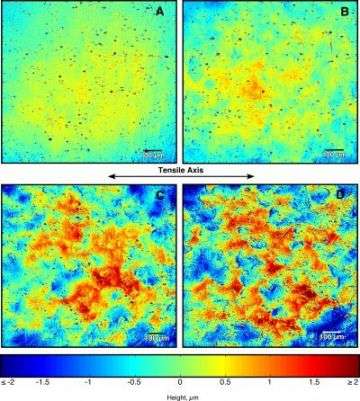
The four images (taken with scanning laser confocal microscopy) show variations in surface roughness of an aluminum alloy as produced by increasing amounts of strain: A-1 percent, B-4 percent, C-8 percent, and D-12 percent. Credit: Mark Stoudt, Joseph Hubbard and Stanley Janet, NIST
Researchers at the National Institute of Standards and Technology have developed a novel technique for measuring the roughness of surfaces that is casting doubt on the accuracy of current procedures. Their results announced in a forthcoming paper could cut development costs for automakers as they design manufacturing tools for new, fuel-efficient, lightweight alloys.
Surface roughness is a key issue for auto manufacturers and other industries that use sheet metal, one that goes far beyond simple cosmetics. Faint striations and other marks that appear when metal is shaped can indicate residual stresses that can cause the part to fail later on. They also lead to extra wear and early retirement for the expensive stamping dies used to form sheet metal into fenders and other body parts (a typical production die can cost $2 million or more.)
And measures of surface roughness feed into models that predict friction and the metal’s “springback”—the amount it will unbend after being stamped. Springback has to be known and controlled to build accurate dies for complex metal shapes. A significant cost in introducing new lightweight alloys for cars is the trial-and-error process needed to develop a new set of dies for each new alloy.
Conventionally, roughness is measured with a profilometer, an instrument with a probe like a high-tech phonograph needle that is tracked in a line across the test surface to record the peaks and valleys. The process is repeated several times at intervals across the test surface, and the results are averaged into a “roughness” figure. (New non-contact instruments use optical probes, but the idea is the same.) But NIST researchers have found that these measures may be misleading—as both measurement uncertainties and statistical errors are compounded when the 2-D lines are extrapolated to the entire surface.
NIST’s approach uses data from a scanning laser confocal microscope (SLCM), an instrument that builds a point-by-point image of a surface in three dimensions. The data from a single SLCM image—representing an area of about 1000 X 800 micrometers by 20 micrometers in depth—are analyzed using mathematical techniques that treat every point in the image simultaneously to produce a roughness measure that effectively considers the entire 3-D surface rather than a collection of 2-D stripes.
One early finding is that the generally accepted linear relationship between surface roughness and material deformation is wrong, at least for the aluminum alloy the group studied. The more accurate data from the 3-D analysis shows that a more complicated relationship was masked by the large uncertainties of the linear profilometers. The NIST researchers hope their new technique will lead to more accurate models of the effects of strain on new alloys and, eventually, lower development and tooling costs for metalworking industries.
Citation: M.R. Stoudt, J.B. Hubbard and S.A. Janet. “Using matrix methods to characterize evolution of deformation induced surface roughness in aluminium sheet,” Materials Science and Technology, In Press.
Source: National Institute of Standards and Technology
-
Ultrafine processing technology continues its evolution
Nov 21, 2011 |
5 / 5 (2) |
0
-
Experts recommend the inclusion of rainwater-collection systems in cities
Oct 24, 2011 |
3 / 5 (1) |
0
-
K-B mirrors harness X-rays for science
Oct 12, 2011 |
3.5 / 5 (2) |
1
-
Laser polishes components to a high-gloss finish
Sep 29, 2011 |
5 / 5 (1) |
0
-
Vibration-assisted milling can lead to higher-quality surfaces
Sep 19, 2011 |
4 / 5 (4) |
1
-
Engineers build first sub-10-nm carbon nanotube transistor
Feb 01, 2012 |
4.9 / 5 (31) |
30
-
Something old, something new: Evolution and the structural divergence of duplicate genes
Jan 31, 2012 |
4.6 / 5 (7) |
1
-
The hidden nanoworld of ice crystals: Revealing the dynamic behavior of quasi-liquid layers
Jan 30, 2012 |
5 / 5 (3) |
1
-
Stock market network reveals investor clustering
Jan 27, 2012 |
3.9 / 5 (23) |
8
-
Of microchemistry and molecules: Electronic microfluidic device synthesizes biocompatible probes
Jan 26, 2012 |
5 / 5 (1) |
0
-
excited U-236 decay time in the U235 fission chain
Feb 09, 2012
-
Polar catastrophe?
Feb 09, 2012
-
Large scale field sonication
Feb 09, 2012
-
states and energy of paired electrons in BCS
Feb 08, 2012
-
difference between longitudinal and transverse refractive indices
Feb 08, 2012
-
Monte Carlo simulation
Feb 07, 2012
- More from Physics Forums - Atomic, Solid State, Comp. Physics
More news stories
Putting the squeeze on planets outside our solar system
(PhysOrg.com) -- Using high-powered lasers, scientists at Lawrence Livermore National Laboratory and collaborators discovered that molten magnesium silicate undergoes a phase change in the liquid state, abruptly ...
6 hours ago |
4.7 / 5 (3) |
0
|
Hovering not hard if you're top-heavy, researchers find
Top-heavy structures are more likely to maintain their balance while hovering in the air than are those that bear a lower center of gravity, researchers at New York University's Courant Institute of Mathematical Sciences ...
7 hours ago |
5 / 5 (1) |
1
|
SLAC, Stanford team focuses on high-energy electrons to treat cancer
Accelerator physicists at SLAC and cancer specialists from Stanford are working on a new technology that could dramatically reduce the time needed for cancer radiation treatments. The team ran an initial experiment ...
10 hours ago |
5 / 5 (1) |
0
Measurements from high-energy collisions lead to better understanding of why meson particles disappear
For several years, physicists at the Relativistic Heavy Ion Collider (RHIC) at Brookhaven National Laboratory (BNL), USA, have studied an unusual state of matter called the quarkgluon plasma, which they ...
10 hours ago |
5 / 5 (1) |
0
Explained: Sigma
It's a question that arises with virtually every major new finding in science or medicine: What makes a result reliable enough to be taken seriously? The answer has to do with statistical significance -- but ...
Feb 09, 2012 |
5 / 5 (16) |
46
Google users warned of threat to smartphone wallets
Users of Google smartphone wallets were being warned on Friday that there is a way to crack pass codes intended to thwart thieves from going on illicit shopping sprees.
Anonymous knocks CIA website offline (Update)
The website of the Central Intelligence Agency was inaccessible on Friday after the hacker group Anonymous claimed to have knocked it offline.
Complex wiring of the nervous system may rely on a just a handful of genes and proteins
Researchers at the Salk Institute have discovered a startling feature of early brain development that helps to explain how complex neuron wiring patterns are programmed using just a handful of critical genes. ...
NASA sees wide-eyed cyclone Jasmine
Cyclone Jasmine's eye has opened wider on NASA satellite imagery, as it moves through the Southern Pacific Ocean.
NASA sees Giovanna reach cyclone strength, threaten Madagascar
Tropical Storm 12S built up steam and became a cyclone on February 10, 2012 as NASA's Terra satellite passed overhead. Residents of east-central Madagascar should prepare for this cyclone to make landfall ...
The power of estrogen -- male snakes attract other males
A new study has shown that boosting the estrogen levels of male garter snakes causes them to secrete the same pheromones that females use to attract suitors, and turned the males into just about the sexiest ...