480 million-year-old fossil sheds light on 150-year-old paleontological mystery
January 9, 2008
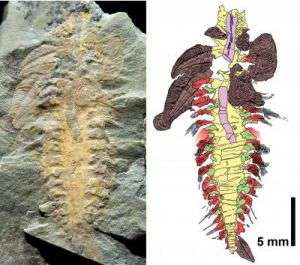
Fossil (left) and depiction (right) of extinct armored machaeridian worm. Colors indicate the trunk (yellow), limb (red), bristles (gray), attachment of shell plates (green), gut (purple) and dorsal linear structure (blue). Credit: Vinther, et al Nature
Discovery of an exceptional fossil specimen in southeastern Morocco that preserves evidence of the animal’s soft tissues has solved a paleontological puzzle about the origins of an extinct group of bizarre slug-like animals with rows of mineralized armor plates on their backs, according to a paper in Nature.
While evolution has produced great diversity in the body designs of animals, over the course of history several highly distinct groups, such as trilobites and ammonites, have become extinct. The new fossil is of an unusual creature known as a machaeridian, an invertebrate, or animal without a backbone, that existed for about 180 million years from 485 to 305 million years ago.
“The new specimen unequivocally identifies machaeridians as annelid worms, an extremely successful and diverse group of animals that includes familiar living animals like the sea mouse, the earthworm and the leech,” said Jakob Vinther, graduate student in the Department of at Yale. The specimen was found in an area that had earlier been identified as a rich source of exceptionally preserved fossils including sponges, trilobites, echinoderms and other less-familiar invertebrates.
First described over 150 years ago, armor plates of these strange animals have been found in marine fossil deposits worldwide covering the time span of their existence, and indicating that they were an important component of ancient seafloor ecosystems. Until now there was little information about their body design or how they might be related to other ancient — or currently living — animals.
“These animals disintegrated quickly after death, so complete fossils of their dorsal armor are rare, and their record until now consisted mostly of isolated armor plates scattered in the sediment,” said Vinther. The dilemma of studying ancient organisms, he notes, is that the soft body parts, including most internal organs, are unavailable for study because they usually decompose before they can become fossilized.
Previous patchy evidence was insufficient to reveal the relationships of the machaeridians to other animals and there was much speculation about their position in the tree of life. Different authors suggested relationships to groups as varied as mollusks (clams and snails), barnacles (crustaceans — including shrimps, crabs and crayfish), echinoderms (starfish and sea urchins) and annelid worms (aquatic bristle worms and garden earthworms).
This inch-long specimen that was recently discovered shows that, below the dorsal armor, the machaeridians had an elongate body with paired, soft, limb-like extensions on each segment, and two bundles of long, stiff bristles on each extension. The segmented nature of the body, and especially the presence of soft “limbs” carrying bristles, unequivocally identified the machaeridians as annelid worms, say the scientists.
According to the authors, although the exact relationship of machaeridians within the annelid worms is still uncertain, the presence of modified scales suggests that they may even belong to a group of marine bristle worms that are still in existence today.
“This exciting discovery has provided important new insights into annelid evolution, showing that some of these worms, which first appeared during the Cambrian radiation, evolved a highly distinctive dorsal, mineralised armor early in their history,” said senior author Derek Briggs, the Frederick William Beinecke Professor of Geology and Geophysics at Yale University. “It also highlights the great importance of the study of exceptional fossil sites, and of palaeobiology in general, for a better understanding of the evolution of our biosphere.” Briggs, the director of the Yale Institute for Biospheric Studies, will assume the directorship of the Yale Peabody Museum of Natural History in July.
Source: Yale University
-
Ancient shrimp monster not so fierce after all
Nov 04, 2010 |
4.8 / 5 (6) |
1
-
Size did matter -- evidence of giant sperm found in microfossils
Jun 18, 2009 |
4.9 / 5 (8) |
1
-
'Buckyballs' have high potential to accumulate in living tissue
Sep 18, 2008 |
4.3 / 5 (21) |
0
-
Uncovering Secrets Of Abalone Body Armor
Jan 14, 2005 |
3.5 / 5 (6) |
0
-
Engineers find inspiration for new materials in Piranha-proof armor
38 minutes ago |
not rated yet |
1
-
Engineers build first sub-10-nm carbon nanotube transistor
Feb 01, 2012 |
4.9 / 5 (32) |
30
-
Something old, something new: Evolution and the structural divergence of duplicate genes
Jan 31, 2012 |
4.6 / 5 (7) |
1
-
The hidden nanoworld of ice crystals: Revealing the dynamic behavior of quasi-liquid layers
Jan 30, 2012 |
5 / 5 (4) |
1
-
Stock market network reveals investor clustering
Jan 27, 2012 |
3.9 / 5 (23) |
8
-
Of microchemistry and molecules: Electronic microfluidic device synthesizes biocompatible probes
Jan 26, 2012 |
5 / 5 (2) |
0
-
Factors affecting beet root cell membrane
6 hours ago
-
Stem cell question.
Feb 10, 2012
-
Protease cleavage
Feb 10, 2012
-
Pertubance in a model
Feb 10, 2012
-
Cancer drugs and Alzheimer's, Oh my!
Feb 09, 2012
-
Squishing cells
Feb 09, 2012
- More from Physics Forums - Biology
More news stories
Employers feel no love for unscrupulous practice of 'service sweethearting'
A new study led by two Florida State University marketing professors finds that some frontline service employees who are rewarded for hikes in customer loyalty and satisfaction also may engage in "service ...
Other Sciences / Economics & Business
Feb 10, 2012 |
3.3 / 5 (3) |
11
A frank discussion of the power law and linking correlation to causation
(PhysOrg.com) -- Michael Stumpf a mathematics professor at Imperial College in London, and Mason Porter a lecturer at Oxford have teamed together to write and publish a perspective piece in Science regarding the in ...
US workers are 'giving away the store,' costing firms billions
Nearly 70 percent of the nation's service employees give away free goods and services from hamburgers to cable TV costing companies billions of dollars a year, according to a groundbreaking study.
Other Sciences / Economics & Business
Feb 09, 2012 |
3.5 / 5 (4) |
10
New insights into how to correct false knowledge
The abundance of false information available on the Internet, in movies and on TV has created a big challenge for educators.
Other Sciences / Social Sciences
Feb 07, 2012 |
4.9 / 5 (7) |
9
|
Neanderthal demise due to many influences, including cultural changes: study
As an ice age crept upon them thousands of years ago, Neanderthals and modern human ancestors expanded their territory ranges across Asia and Europe to adapt to the changing environment.
Other Sciences / Archaeology & Fossils
Feb 07, 2012 |
4.4 / 5 (5) |
8
|
Scientists discover molecular secrets of 2,000-year-old Chinese herbal remedy
For roughly two thousand years, Chinese herbalists have treated Malaria using a root extract, commonly known as Chang Shan, from a type of hydrangea that grows in Tibet and Nepal. More recent studies suggest that halofuginone, ...
New method to examine batteries -- MRI from the inside
There is an ever-increasing need for advanced batteries for portable electronics, such as phones, cameras, and music players, but also to power electric vehicles and to facilitate the distribution and storage of energy derived ...
Google might launch Drive for cloud storage soon
(PhysOrg.com) -- Google's next big move, according to the Wall Street Journal, is a cloud storage service called Drive. Hardly first to the plate, Google is simply catching up to introducing its cloud reposi ...
Lab study raises questions over nano-particle impact
Tests involving chickens have raised questions about the impact on health from engineered nano-particles, the ultra-fine grains commonly used in drugs and processed foods, scientists said on Sunday.
A mitosis mystery solved: How chromosomes align perfectly in a dividing cell
Although the process of mitotic cell division has been studied intensely for more than 50 years, Whitehead Institute researchers have only now solved the mystery of how cells correctly align their chromosomes during symmetric ...
Starve a virus, feed a cure? Findings show how some cells protect themselves against HIV
A protein that protects some of our immune cells from the most common and virulent form of HIV works by starving the virus of the molecular building blocks that it needs to replicate, according to research published online ...
Jan 10, 2008
Rank: 2.8 / 5 (6)
"Previous patchy evidence was insufficient to reveal the relationships of the machaeridians to other animals and there was much speculation about their position in the tree of life. Different authors suggested relationships to groups as varied as mollusks (clams and snails), barnacles (crustaceans - including shrimps, crabs and crayfish), echinoderms (starfish and sea urchins) and annelid worms (aquatic bristle worms and garden earthworms)."
This inch-long specimen that was recently discovered shows that, below the dorsal armor, the machaeridians had an elongate body with paired, soft, limb-like extensions on each segment, and two bundles of long, stiff bristles on each extension. The segmented nature of the body, and especially the presence of soft limbs carrying bristles, unequivocally identified the machaeridians as annelid worms, say the scientists. The presence of modified scales suggests that they may even belong to a group of marine bristle worms that are still in existence today. This exciting discovery has provided important new insights into annelid evolution, showing that some of these worms, which first appeared during the Cambrian radiation, evolved a highly distinctive dorsal, mineralised armor early in their history, said senior author Derek Briggs, the Frederick William Beinecke Professor of Geology and Geophysics at Yale University. It also highlights the great importance of the study of exceptional fossil sites, and of palaeobiology in general, for a better understanding of the evolution of our biosphere. From the article.
A more perfect and beautiful example of new fossil discoveries supporting Darwin's theory with overwhelming evidence and precision could hardly be imagined! Thank you Derek Briggs. :D
Feb 07, 2008
Rank: 2 / 5 (6)
Evolution can be impersonal or personal depending on who's telling the strange story of macroevolution. Anyway, Thank You, Physorg for using the 'D' word and showing free-thinking readers that design means a Designer.
Meanwhile we find according to atheists Hickman, Roberts & Larson (1997), echinoderms have always been echinoderms, annelids have always been annelids, and trilobites have always been trilobites - just as the creation model states.
This story describes a unique (and extinct) kind of segmented worm. OK, so machaeridians are annelid worms. So? Annelids have always been annelids - all the way back to the "Cambrian radiation event" (a PC way of referring to the UN-darwinian Cambrian explosion). Please show skeptics such as myself how annelids 'turned into' arthropods.
Photojack seems to think if he can just cut and paste part of the story, then the case for macroevolution will be made. OK, I'll play that game -
"According to the authors, although the exact relationship of machaeridians within the annelid worms is still UNCERTAIN, the presence of modified scales SUGGESTS that they MAY even belong to a group of marine bristle worms that are still in existence today."
Mar 25, 2008
Rank: 3 / 5 (3)
"The segmented nature of the body, and especially the presence of soft limbs carrying bristles, unequivocally identified the machaeridians as annelid worms, say the scientists." THESE ANNELIDS COME FROM A LINE THAT STILL EXISTS, BUT THEY HAVE A COMMON ANCESTOR WITH OTHER INVERTEBRATES. Read and comprehend the science before you misinterpret any other articles of this nature!