Earth: A Borderline Planet for Life?
January 9th, 2008 Earth: A Borderline Planet for Life?

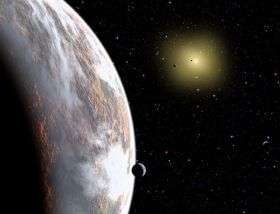
A super-Earth like the one in this artist's conception can grow twice as large as Earth with up to 10 times the mass. Super-Earths are likely to be more life-friendly than our world because they would be more geologically active. Credit: David A. Aguilar (Harvard-Smithsonian CfA)

Our planet is changing before our eyes, and as a result, many species are living on the edge. Yet Earth has been on the edge of habitability from the beginning. New work by astronomers at the Harvard-Smithsonian Center for Astrophysics shows that if Earth had been slightly smaller and less massive, it would not have plate tectonics - the forces that move continents and build mountains. And without plate tectonics, life might never have gained a foothold on our world.

"Plate tectonics are essential to life as we know it," said Diana Valencia of Harvard University. "Our calculations show that bigger is better when it comes to the habitability of rocky planets."

This research was the subject of a press conference at the 211th meeting of the American Astronomical Society.

Plate tectonics involve the movement of huge chunks, or plates, of a planet's surface. Plates spread apart from each other, slide under one another, and even crash into each other, lifting gigantic mountain ranges like the Himalayas. Plate tectonics are powered by magma boiling beneath the surface, much like a bubbling pot of chocolate. The chocolate on top cools and forms a skin or crust, just as magma cools to form the planet's crust.

Plate tectonics are crucial to a planet's habitability because they enable complex chemistry and recycle substances like carbon dioxide, which acts as a thermostat and keeps Earth balmy. Carbon dioxide that was locked into rocks is released when those rocks melt, returning to the atmosphere from volcanoes and oceanic ridges.

"Recycling is important even on a planetary scale," Valencia explained.

Valencia and her colleagues, Richard O'Connell and Dimitar Sasselov (Harvard University), examined the extremes to determine whether plate tectonics would be more or less likely on different-sized rocky worlds. In particular, they studied so-called "super-Earths"-planets more than twice the size of Earth and up to 10 times as massive. (Any larger, and the planet would gather gas as it forms, becoming like Neptune or even Jupiter.)

The team found that super-Earths would be more geologically active than our planet, experiencing more vigorous plate tectonics due to thinner plates under more stress. Earth itself was found to be a borderline case, not surprisingly since the slightly smaller planet Venus is tectonically inactive.

"It might not be a coincidence that Earth is the largest rocky planet in our solar system, and also the only one with life," said Valencia.

Exoplanet searches have turned up five super-Earths already, although none have life-friendly temperatures. If super-Earths are as common as observations suggest, then it is inevitable that some will enjoy Earth-like orbits, making them excellent havens for life.

"There are not only more potentially habitable planets, but MANY more," stated Sasselov, who is director of the Harvard Origins of Life Initiative.

In fact, a super-Earth could prove to be a popular vacation destination to our far-future descendants. Volcanic "rings of fire" could span the globe while the equivalent of Yellowstone Park would bubble with hot springs and burst with hundreds of geysers. Even better, an Earth-like atmosphere would be possible, while the surface gravity would be up to three times that of Earth on the biggest super-Earths.

"If a human were to visit a super-Earth, they might experience a bit more back pain, but it would be worth it to visit such a great tourist spot," Sasselov suggested with a laugh.

He added that although a super-Earth would be twice the size of our home planet, it would have similar geography. Rapid plate tectonics would provide less time for mountains and ocean trenches to form before the surface was recycled, yielding mountains no taller and trenches no deeper than those on Earth. Even the weather might be comparable for a world in an Earth-like orbit.

"The landscape would be familiar. A super-Earth would feel very much like home," said Sasselov.

Source: Harvard-Smithsonian Center for Astrophysics


print this article email this article download pdf blog this article bookmark this article     Digg this Stumble it share on Facebook share on Reddit add to delicious save to Yahoo! bookmarks
4.4/5 after 36 votes

Rank Filter

Move the slider to adjust rank threshold, so that you can hide some of the comments.


Display comments: newest first

  • Nikola - Jan 09, 2008
    • Rank: 2.6 / 5 (5)
    Time to abandon ship. Oh wait, we don't have money for that because we're still fighting over fossil fuel resources like cosmic children.
  • Quantum_Conundrum - Jan 09, 2008
    • Rank: 3 / 5 (4)
    Ok, someone stop and think for a minute. You could not live for very long a planet with 10x earth mass even if it was similar composition. The gravity of 2.5-3 x earth gravity would make your WEIGHT too much for you to carry, and you would literally pass out from exhaustion from your own body weight and atmospheric pressure. a person who weighs 180lbs on earth would weigh 450-540lbs on one of these "super earths".

    Then you need shelter. Construction materials will be inferior. Larger planet = stronger weather. Higher gravity means more weight in the roof, etc, for the walls to support. So conventional materials won't be strong enough to support their own weight, much less the force of the weather.

    Good luck ever getting a manned spacecraft back into orbit once you land. Ten times the mass means you need a hell of a lot more powerful rocket than anything NASA has right now.
  • mrlewish - Jan 09, 2008
    • Rank: 2.7 / 5 (3)
    Who says Venus is tetonically inactive?
  • gopher65 - Jan 09, 2008
    • Rank: 3.5 / 5 (4)
    errr... Venus IS tectonically inactive. Who says it isn't? Just because a planet or moon doesn't have plate tectonics doesn't mean it doesn't have volcanoes. Just look at Mars and Io.

    (Why does volcanoes end in an "es" instead of just "s"?)
  • Ashibayai - Jan 09, 2008
    • Rank: 4.5 / 5 (4)
    Well, it may be a good thing for microbial life, but larger life would struggle to obtain the energy necessary to overcome the gravity of the planet and move even relatively insignificant distances. Imagine how long it would take evolution or even life itself to spread across the surface of a planet without species that are capable of self motivated migration, or possibly even lack the excess energy to support any cognitive abilities.
  • Quantum_Conundrum - Jan 09, 2008
    • Rank: 3.5 / 5 (4)
    Ashibayai:

    Yeah, that's sort of like what I was talking about. It sad that all these people with PHD or PHD candicy don't stop to actually think before they write these articles or do the interviews.

    Molds or algae, or something like that, just MIGHT be able to live on a 10 earth mass planet, but if you actually check the numbers and apply some critical thinking, you will find that human civilization even remotely like we know it could not exist on a planet above 2 earth masses, and macroscopic life simply could not survive on any lengthy basis on a 10 earth mass planet.

    On a 2 earth mass planet of similar composition to the earth, the surface gravity would be ~1.26 x earth surface gravity. That does not appear catastrophic, but try to imagine the change in efficiency of biomechanical functions. Water and nutrient transport inside your cells and bloodstream, etc, would be greatly hindered, reducing the amount of energy available to do work before you even breathe or think. your bone and muscle structure would simply be too weak for prolonged exposure to that. Broken bones and severe bruising would occur with even the slightest of slips or accidents. Engines would not run properly.
  • TheJ3ss3 - Jan 09, 2008
    • Rank: 1 / 5 (1)
    Well the thing is that life evolved here and appears the way we know it due to all the different circumstance. Perhaps life is dependant on water, perhaps not. But just because a planet has much more gravity on it doesn't mean life couldn't or wouldn't evolve. Who's to say what other mutations microorganisms would undergo in order to increase efficiency and survivability. Sure we as humans in our skin might not be able to visit it due to extreme gravity, but if we managed to have the technology to get there I'm sure we could engineer metal supports to run laterally alongside our legs with flat pads on the bottom to help support our mass. I guess the biggest thing this article says, is that as long as there is liquid water, the right CO2 and O2 (plus traces) balance, and plate techtonics, means that there is the potential for life as we know it. As for visiting there I'm sure they were joking, but as long as we have the technology to get past the speed of light (or puncture wormholes in the timespace continuum) I'm sure we'de have the technology and know how to survive and create colonies on any planet that is hospitable enough.
  • out7x - Jan 10, 2008
    • Rank: 1 / 5 (3)
    Plate tectonics slowly destroys continents. It does not create or destroy life.
  • Nimbus - Jan 10, 2008
    • Rank: 5 / 5 (2)
    Plate tectonics is part of the picture, but it is not necessarily essential for life--at least as we know it.

    A more massive earth-like planet in the habitable zone of a distant sun-like star might host life, but its atmosphere might be quite different. With SO2 in abundance from continuous volcanic activity, it might be a planet where exotic ecosystems are built on sulfur-metabolizing bacteria, like those of Earth's deep ocean thermal vents.

    Who knows? A sulfur-based astronomer on such a world may have just scanned Earth and concluded, "Hmmm...no chance of life here. This place is flooded with toxic O2!"
  • KB6 - Jan 10, 2008
    • Rank: 5 / 5 (2)
    We know that Venus is tectonically inactive mainly because of the Magelllan mission, which radar mapped 84 percent of the surface. It found no trace of plate tectonics on Venus, present or past.
    For an explanation of the link between plate tectonics, the carbon cycle and climate look here:

    http://dilu.bol.ucla.edu/
  • Ashibayai - Jan 11, 2008
    • Rank: 2.5 / 5 (2)
    Well the thing is that life evolved here and appears the way we know it due to all the different circumstance. Perhaps life is dependant on water, perhaps not. But just because a planet has much more gravity on it doesn't mean life couldn't or wouldn't evolve. Who's to say what other mutations microorganisms would undergo in order to increase efficiency and survivability.


    Sure, many more things could be evolved to overcome the gravity, but the energies of the chemical reactions remain the same as do many other things that might limit any species. Consider how long it would take for evolution to either leap from microbes to organisms large enough to harness tons of energy for small amounts of transportation, or how long it would take a stationary species to evolve the need for a brain with such energy input ratios. In the end, it's just more difficult anyway you look at it. It would probably take forever for any intelligent species to evolve, and that alone makes it extremely unlikely for a planet like this to house any sort of intelligent life.
  • vlam67 - Jan 12, 2008
    • Rank: 1 / 5 (3)
    All talks of suitability for human life on this and that planet is academic and irrelevant as:
    1- Humans still arguing whether they are destroying the planet's climate or not (and demanding incontrovertible evidence-perhaps when half the population is dead??!!)
    2-Humans have not mastered and utilized the energy resources even on the national scale, let alone planetary scale. Without the latter, humans will be stuck on earth and live or go extinct there.
    3-God made the earth for human...:-) it did not say anywhere others planets are God-blessed...but, you all know, religious fanatics can twist and turn words and justify themselves until kingdom come as it is required of their faiths...!
  • barakn - Jan 12, 2008
    • Rank: 4.7 / 5 (3)
    This link http://www.hse.go...3-09.pdf
    says that the max survivable g force during a parachute drop is 12g, so many of your comments about macroscopic life not being possible in 2.5-3g is laughable, especially considering how evolution would come up with different body plans to cope. 1g is so weak it allowed creatures as big as 240 tons to walk around.
    http://en.wikiped...yosaurus
    And life in oceans would be largely unaffected by the force of gravity due to the bouyant force of water.
  • Ashibayai - Jan 12, 2008
    • Rank: not rated yet
    The 12 g's mentioned in that report are only momentary and aren't very relevant to living on a planet. I'm not saying it's impossible for life to adapt, but it's very unlikely if you consider that all the upward work normally done by organisms on earth would be a 3 times more. Part of the reason such large creatures existed was because they had large amounts of food around to fuel their energy needs, and part of the reason they didn't die out too fast was because the Earth's gravity wasn't enough to attract large amounts of asteroids onto the planet surface.

    Also, you have to consider for any life in the ocean that the force of gravity still applies. In fact, it applies even more so, because the weight of the water is almost uniformly distributed and this creates pressures on any underwater object in 3-dimensions. If you consider how surface area is proportional to volume you'll find that the amount of water any organism can displace becomes very limited without extreme materials. Remember, the buoyant force of water comes from gravity itself.
  • p_lucio2000 - Jan 13, 2008
    • Rank: 4.5 / 5 (2)
    The pressure is no problem. The trouble is when you go to a different pressure.
    Look at the abyssal fish.
    Their internal pressure is roughly the same as the enviromental, just as our pressure is roughly the same as our atmosphere.

January 9th, 2008 all stories
Space & Earth / Astronomy

Comments: 15
Rank: 4.4/5 after 36 votes

  • Stumble this up

  • Digg this

  • Share it:
  • share on Facebook
  • share on MySpace
  • share on Slashdot
  • rss-newsfeed
  • share on Google
  • share on Reddit
  • add to delicious
  • save to Yahoo! bookmarks
  • share on Windows Live
  • Add to Mixx!
Rating: 4.4/5 after 36 votes

  • Related Stories

  • New definition could further limit habitable zones around distant suns
    created Jun 10, 2009 | popularity not rated yet | comments 0
  • Asteroid Attack 4 Billion Years Ago May Have Accelerated Life on Earth
    created May 20, 2009 | popularity not rated yet | comments 0
  • Researchers use multispectral images to reveal origin and evolution of Mercury
    created Apr 30, 2009 | popularity not rated yet | comments 0
  • Mountain spine is a quake hotspot
    created Apr 06, 2009 | popularity not rated yet | comments 0
  • Bent tectonics: How Hawaii was bumped off
    created Apr 03, 2009 | popularity not rated yet | comments 0

Tags


  • Physicists Demonstrate Quantum Memory with Matter Qubits
    Physicists Demonstrate Quantum Memory with Matter Qubits
    Physics / General Physics
    created 14 hours ago | popularity 4.8 / 5 (8) | comments 1
  • 'Holey' Nanosheets for Wastewater Dye Removal
    Nanotechnology / Nanomaterials
    created Jul 01, 2009 | popularity 5 / 5 (5) | comments 1
  • Jellyfish Robot Swims Like its Biological Counterpart
    Jellyfish Robot Swims Like its Biological Counterpart
    Electronics / Robotics
    created Jun 26, 2009 | popularity 4.4 / 5 (7) | comments 1
  • Could Maxwell's Demon Exist in Nanoscale Systems?
    Could Maxwell's Demon Exist in Nanoscale Systems?
    Physics / General Physics
    created Jun 24, 2009 | popularity 4.4 / 5 (18) | comments 29
  • Living Safely with Robots, Beyond Asimov's Laws
    Living Safely with Robots, Beyond Asimov's Laws
    Electronics / Robotics
    created Jun 22, 2009 | popularity 4.6 / 5 (50) | comments 39
  • Other News

    Global warming tactic cools climate but won’t help corals, say researchers

    Space & Earth / Earth Sciences

    created 11 hours ago | popularity 3 / 5 (2) | comments 5

    (PhysOrg.com) -- “Geoengineering” experiments proposed to reduce global warming by blocking sunlight with atmosphere-injected particles may cool the world but still leave carbon dioxide levels dangerously high, Stanford scientists ...


    Coolest spacecraft ever in orbit around L2

    Coolest spacecraft ever in orbit around L2

    Space & Earth / Space Exploration

    created 14 hours ago | popularity 4.5 / 5 (2) | comments 3

    (PhysOrg.com) -- Last night, the detectors of Planck's High Frequency Instrument reached their amazingly low operational temperature of -273°C, making them the coldest known objects in space. The spacecraft ...


    Senator may have won fight over private rocket manufacturing

    Space & Earth / Space Exploration

    created 14 hours ago | popularity 4.5 / 5 (2) | comments 2

    For months, a powerful Republican senator from Alabama has fought the Obama administration to block $150 million that the White House wanted to spend to help private companies build rockets capable of reaching the international ...


    The least sea ice in 800 years

    The least sea ice in 800 years

    Space & Earth / Earth Sciences

    created Jul 01, 2009 | popularity 4.4 / 5 (56) | comments 42

    New research, which reconstructs the extent of ice in the sea between Greenland and Svalbard from the 13th century to the present indicates that there has never been so little sea ice as there is now. The ...


    Gas around young galaxy

    Intense heat killed the Universe's would-be galaxies, researchers say

    Space & Earth / Astronomy

    created Jul 01, 2009 | popularity 3.2 / 5 (17) | comments 23

    (PhysOrg.com) -- Our Milky Way galaxy only survived because it was already immersed in a large clump of dark matter which trapped gases inside it, scientists led by Durham University's Institute for Computational ...