When Worlds Collide: Have Astronomers Observed the Aftermath of a Distant Planetary Collision?
January 9, 2008
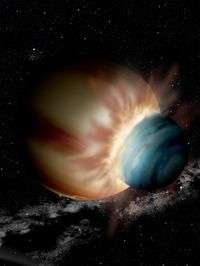
Illustrated here in this artist´s concept, astronomers may have observed the aftermath of a collision between two protoplanets, one Jupiter-sized and one Neptune-sized, in the system 2M1207. Credit: David A. Aguilar (Harvard-Smithsonian CfA)
Astronomers announced today that a mystery object orbiting a star 170 light-years from Earth might have formed from the collision and merger of two protoplanets. The object, known as 2M1207B, has puzzled astronomers since its discovery because it seems to fall outside the spectrum of physical possibility. Its temperature, luminosity, age, and location do not match up with any theory.
"This is a strange enough object that it needs a strange explanation," said Eric Mamajek of the Harvard-Smithsonian Center for Astrophysics (CfA).
The announcement was made in a press conference at the 211th meeting of the American Astronomical Society.
2M1207B orbits a 25-Jupiter-mass brown dwarf called 2M1207A seen in the direction of the constellation Centaurus. Computer models show that 2M1207A is very young, only about 8 million years old; therefore its companion should also be 8 million years old. At that age, it should have cooled to a temperature of less than 1300 degrees Fahrenheit (1000 Kelvin). However, observations show that 2M1207B is actually about 2400 degrees F (1600 K). The extra heat might be the result of a protoplanetary collision.
"Most, if not all, planets in our solar system were hit early in their history. A collision created Earth's moon and knocked Uranus on its side," explained Mamajek. "It's quite likely that major collisions happen in other young planetary systems, too."
Given its temperature, astronomers would expect a certain luminosity for 2M1207B, but it is 10 times fainter than expected. In 2006, astronomers suggested that it is obscured by a dusty, edge-on disk. Mamajek and his colleague, Michael Meyer of the University of Arizona, propose an alternative explanation: 2M1207B is small, only about the size of Saturn, and therefore has a smaller-than-expected surface area radiating energy.
They derive a radius of 31,000 miles (50,000 km) for 2M1207B, compared to 37,000 miles (60,000 km) for Saturn. Given typical densities for giant planets, this would give 2M1207B a mass about 80 times Earth (or one-fourth Jupiter). The only plausible way for such a small object to be so hot millions of years after it formed is if it suffered a recent, titanic collision that heated it.
The planets in our solar system assembled from dust, rock, and gas, gradually growing larger over millions of years. But sometimes, two planet-sized objects collided catastrophically. For example, the Moon formed when an object about half the size of Mars hit the proto-Earth. If planet formation works the same way in other star systems, then 2M1207B might be the product of a collision between a Saturn-sized gas giant and a planet about three times the size of Earth. The two smacked into each other and stuck, forming one larger world still boiling from the heat generated in the collision.
"The Earth was hit by something one-tenth its mass, and it's likely that other planets in our solar system were too, including Venus and Uranus," explained Meyer. "If that one-tenth scale holds in other planetary systems, then we could be seeing the aftermath of a collision between a 72 Earth-mass gas giant and an 8 Earth-mass planet, even though such collisions are very unlikely."
Mamajek also points out that the collision theory is reasonable from a timescale point of view. A 2400-degree, Saturn-sized object would radiate its heat away over about 100,000 years. If the system were billions of years old, it is unlikely that we would be looking at the right time, but since the system is young, the chances are much better that we would catch it shortly after the collision while the hot aftermath is still observable.
The collision hypothesis makes several predictions that astronomers can test. Chief among them is a low surface gravity (which depends on a planet's mass and radius). To check this prediction, astronomers will need to get a better spectrum of 2M1207B -- a challenge since it is very faint and very close to the brown dwarf 2M1207A. Others are checking the dusty disk theory by looking for signs of polarization in the light from 2M1207B. More answers should be forthcoming within a year or two.
Mamajek emphasized that while a planet collision may not be the correct explanation for the weirdness of 2M1207B, examples of colliding planets are likely to be found by the next generation of ground-based telescopes.
"Hot, post-collision planets might be a whole new class of objects we will see with the Giant Magellan Telescope."
"Even if we're wrong, I wouldn't be surprised if someone finds a clear-cut case in the next 10 years," Mamajek added.
Source: Harvard-Smithsonian Center for Astrophysics
-
Jupiter's 'Big Brother' Has Moon-Forming Dust Disk
Jun 05, 2006 |
4.5 / 5 (23) |
0
-
Many, perhaps most, nearby sun-like stars may form rocky planets
Feb 17, 2008 |
4.8 / 5 (38) |
1
-
Amasia: As next supercontinent forms, Arctic Ocean, Caribbean will vanish first
15 hours ago |
4.1 / 5 (11) |
4
-
Padded headgear, boxing gloves may offer some protection for fighters
Feb 07, 2012 |
not rated yet |
0
-
Warning! Collision imminent! The brain's quick interceptions help you navigate the world
Feb 07, 2012 |
5 / 5 (5) |
1
-
Engineers build first sub-10-nm carbon nanotube transistor
Feb 01, 2012 |
4.9 / 5 (33) |
30
-
Something old, something new: Evolution and the structural divergence of duplicate genes
Jan 31, 2012 |
4.6 / 5 (7) |
1
-
The hidden nanoworld of ice crystals: Revealing the dynamic behavior of quasi-liquid layers
Jan 30, 2012 |
5 / 5 (4) |
1
-
Stock market network reveals investor clustering
Jan 27, 2012 |
3.9 / 5 (23) |
8
-
Of microchemistry and molecules: Electronic microfluidic device synthesizes biocompatible probes
Jan 26, 2012 |
5 / 5 (2) |
0
-
Never ending outer space.....
22 hours ago
-
Neutron Star fragments?
Feb 11, 2012
-
stationary or not?
Feb 11, 2012
-
Scale of the Universe
Feb 10, 2012
-
Titan's lack of impact craters
Feb 09, 2012
-
Real pictures of black hole eating a star?
Feb 08, 2012
- More from Physics Forums - General Astronomy
More news stories
Salvage workers begin pumping fuel from Italian shipwreck
Salvage workers Sunday began pumping fuel from the shipwrecked Italian cruise liner Costa Concordia, a day ahead of schedule, officials said.
7 hours ago |
5 / 5 (1) |
0
Latin America mining boom clashes with conservation
Latin America is experiencing a mining boom as prices rise fuelled by a hike in global demand, but the region is also being hit by a wave of violent protests, strikes and rallies by environmentalists.
15 hours ago |
5 / 5 (1) |
1
Political leaders play key role in how worried Americans are by climate change: study
More than extreme weather events and the work of scientists, it is national political leaders who influence how much Americans worry about the threat of climate change, new research finds.
Feb 06, 2012 |
5 / 5 (7) |
73
NASA budget will axe Mars deal with Europe: scientists
US President Barack Obama's budget proposal to be submitted next week for 2013 will cut NASA's budget by 20 percent and eliminate a major partnership with Europe on Mars exploration, scientists said Thursday.
Space & Earth / Space Exploration
Feb 10, 2012 |
5 / 5 (3) |
58
Humans may have helped the decline of African rainforests 3000 years ago
(PhysOrg.com) -- Large areas of rainforests in Central Africa mysteriously disappeared over three thousand years ago, to be replaced by savannas. The prevailing theory has been that the cause was a change ...
Scientists discover molecular secrets of 2,000-year-old Chinese herbal remedy
For roughly two thousand years, Chinese herbalists have treated Malaria using a root extract, commonly known as Chang Shan, from a type of hydrangea that grows in Tibet and Nepal. More recent studies suggest that halofuginone, ...
New method to examine batteries -- MRI from the inside
There is an ever-increasing need for advanced batteries for portable electronics, such as phones, cameras, and music players, but also to power electric vehicles and to facilitate the distribution and storage of energy derived ...
A mitosis mystery solved: How chromosomes align perfectly in a dividing cell
Although the process of mitotic cell division has been studied intensely for more than 50 years, Whitehead Institute researchers have only now solved the mystery of how cells correctly align their chromosomes during symmetric ...
Google might launch Drive for cloud storage soon
(PhysOrg.com) -- Google's next big move, according to the Wall Street Journal, is a cloud storage service called Drive. Hardly first to the plate, Google is simply catching up to introducing its cloud reposi ...
Lab study raises questions over nano-particle impact
Tests involving chickens have raised questions about the impact on health from engineered nano-particles, the ultra-fine grains commonly used in drugs and processed foods, scientists said on Sunday.
Overeating may double risk of memory loss
New research suggests that consuming between 2,100 and 6,000 calories per day may double the risk of memory loss, or mild cognitive impairment (MCI), among people age 70 and older. The study was released today and will be ...
Jul 03, 2008
Rank: not rated yet
"planets in our solar system assembled from dust, rock, and gas, gradually growing larger over millions of years"
"the Moon formed when an object about half the size of Mars hit the proto-Earth"
"The Earth was hit by something one-tenth its mass"
"A collision created Earth's moon and knocked Uranus on its side"
All speculation but give as fact. very bad story, IMHO.