The leading 'edge': plastic fibre slashes network costs
Plans in the 1990s to bring ultra-high speed telecom lines into every home foundered because the optical fibre infrastructure was just too expensive. But a new European project using plastic fibre and off-the-shelf components could make optical networking so cheap and simple that anyone could install it.
What happened to the dream of optical fibre in every home? While the core of the telecoms network, the long-distance trunk routes, use optical fibre, the links from the exchange to individual homes remain almost entirely copper wire. Telecoms companies have been creative in pushing copper to its limit with ADSL broadband technology and leveraging existing TV cable infrastructure (especially France and the Benelux), but only by taking optical fibre right into the home can they meet the demands for ever-faster connections.
The truth is, it’s too expensive. Ambitious plans to rip out the copper and lay optical fibre were largely abandoned in 2001 when telecoms companies realised that they could not afford the mounting costs. Only a few countries, notably Japan, have pushed ahead on any scale.
“The cost was way too high to be sustainable,” says Alessandro Nocivelli, the founder and CEO of Luceat SpA, one of the partners in the EU-funded POF-ALL project. “There was no business model to support such an investment.”
The object of POF-ALL is to find a technical solution to this rising cost. The partners decided to focus on the cabling inside buildings, which would typically account for 30% of the cost of laying an optical fibre from the exchange into the home. This last hundred metres or so is known as the ‘edge’ network.
“We realised that we could lower the cost of this edge installation by using a simpler technology,” says Nocivelli. “If we could employ a technology which is so simple to use that anyone can install it, that would relieve telecom companies of 30% of the cost of the access network, which means up to several billion euro if you consider the European Union as a whole.”
Safety concerns
The key to a simpler, cheaper edge network is optical fibre made of plastic rather than the more usual glass. It has several advantages. First of all, glass fibres use infrared laser light to transmit the signal. The light is invisible to the eye yet can cause permanent damage or even blindness if someone looks down a live fibre.
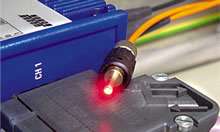
“I have a two-year-old child,” says Nocivelli, “and I would never install a glass optical fibre in my own home, even though I have been working with glass optical fibres for many years.” In contrast, plastic fibres use harmless green or red light that is easily visible to the eye. Plastic fibres can be safely installed in a home without risk to inquisitive children.
A second advantage is their robustness. Plastic fibres are much thicker than glass fibres, a millimetre or more, and can be handled without special tools or techniques. “You don’t need to be trained to handle and install it. You just cut it with scissors, plug it in and it works. It’s as easy as that.”
Of course there are drawbacks. Plastic fibres absorb light more than glass, which limits their useful length to a few hundred metres. They also have a lower data capacity than glass fibres. But that is fine for the cable that runs from a conventional glass fibre in the street into a house, or even for laying a network within a block of flats.
With six months of the project to run, POF-ALL is already producing results. The partners have built a system that uses green light to transmit 100 megabits a second over a distance of 300 metres, which is the speed telecom companies hope to offer their customers five to ten years from now, and 50 times as fast as a typical adsl broadband connection.
Future-proof for 30 years
The second achievement, using red light, is to transmit ten times faster still – one gigabit per second – over a 30m fibre. By the end of the project, in June 2008, they expect to have extended that to 100m.
“Then, of course, we will try to focus on longer distances,” says Nocivelli. “We have already demonstrated that plastic fibre would be future-proof not only for the next ten years but for the next 30 years. With that speed in your home you could download a full DVD in thirty seconds.”
Remarkably, the POF-ALL members have not had to develop any novel technologies. They have built their systems using the latest off-the-shelf components and the ingenuity and skill of the ten academic and industrial partners.
Two products are already coming to the market. Luceat is commercialising an optical Ethernet switch (a router) using plastic fibre technology and the Fraunhofer Institute is looking for partners to market an integrated optical transceiver to work at one gigabit a second with plastic fibre.
Home and office networks could be rewired with plastic optical fibre so simply and cheaply it could be a do-it-yourself job.“It’s future-proof,” confirms Nocivelli. You run at 100 Mbit/s today, 1 Gbit/s tomorrow and maybe 10 Gbit/s in the future.”
A follow-up project, POF-PLUS, is intended to further develop optoelectronic components for plastic fibre and is awaiting a final decision on EU funding.
The benefits for Europe of plastic optical fibre could be immense. Today, the market for optical network technology is dominated by US and Japanese firms, but Nocivelli sees an opportunity for European companies to seize the initiative in the same way as they did for mobile phones.
“The GSM standard, which was developed in Europe, has been adopted almost worldwide. And, of course, this is the kind of success we are looking forward to.”
Source: ICT Results


