Crash warning for connected cars?
January 9, 2008
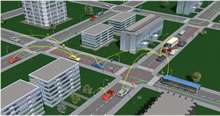
European researchers have demonstrated in the lab a collision warning system for cars that could alert the driver several seconds in advance of an imminent impact. The device could save thousands of lives and usher in the first steps towards the ‘connected car’.
It knows its location, can talk to other cars and can tell the future. Are we entering the era of truly automated cars? The Collision Warning System (CWS) is the brainchild of the Reposit project, and they recently fired up a fully working prototype of their system.
The prototype can find its position using GPS, and find the position, speed and trajectory of neighbouring and oncoming traffic using an emerging car communication protocol called Vehicle2Vehicle (V2V).
It can use that information to calculate the relative position of other cars, and then extrapolate where they will be in a few seconds’ time. If the data predicts a collision, it warns the driver.
“So far, we’ve got predictions about 1 to 3 seconds ahead of a collision… but anything from 2 seconds up gives drivers time to react. It works better at medium-to-high speeds, above 50km/h,” reveals Jose Ignacio Herrero Zarzosa, coordinator of the Reposit ‘relative position for collision avoidance systems’ project.
High-performance GPS systems, that can locate a car within a metre or so, perform far better than low-performance GPS systems, but even with poor GPS technology Reposit has managed to get warning times to 1.5 seconds in a simulator, not too far from the useful minimum of 2 seconds. Zarzosa believes the system can do even better, with further work using vehicles’ available sensors.
But the system does work, at least in a simulator, and that is a concrete result. The team has also perfected a simulator that other projects can use to model car collisions, another useful output. But will it be a success?
Unforgiving economics
It is possible, in time. Crucially, the system uses technologies, such as GPS and V2V, which are already becoming common or are emerging as a feature of modern cars. More and more cars come with GPS already installed, explains Zarzosa, and many owners are self-installing a GPS system, so for these cars Reposit takes advantage of the installed base.
V2V is an emerging standard for communication between vehicles, and so it will become more common as time goes by. The Rosetta stone of the system, the programme that ties all the devices together, is just software and so relatively cheap.
That is very important. Keeping cost down is essential for any new car technology. The economics of the motor industry are unforgiving. “New car devices must be cheap if they are to be commercialised,” notes Zarzosa.
The Reposit team discovered that the rules for automobile innovation are unforgiving, too. Right now, there is no standard for integrating new functions into an existing car system. Every manufacturer uses different system integration methods. This significantly pushes up the cost of third-party technologies like Reposit,” warns Zarzosa.
Although the European Commission reports that it is working hard on this.
So far, the car industry finds Reposit’s work interesting, but remains unconvinced of the commercial application. The car industry is... very price sensitive, notes Zarzosa.
Even so, the popularity of GPS, and the emergence of V2V as a standard, means that the system will become more attractive over time. Before long, drivers might take the first, tentative steps into the era of connected cars.
Source: ICT Results
-
Wireless power could revolutionize highway transportation, researchers say
Feb 01, 2012 |
4.3 / 5 (27) |
66
-
Survival app aims to help drivers in winter storms
Jan 06, 2012 |
not rated yet |
1
-
'Green routing' can cut car emissions without significantly slowing travel time
Dec 14, 2011 |
2.3 / 5 (3) |
8
-
High court troubled by warrantless GPS tracking (Update)
Nov 08, 2011 |
4.9 / 5 (13) |
17
-
IROS gets earful on Google's self-driving cars (w/ video)
Oct 19, 2011 |
5 / 5 (9) |
12
-
Engineers build first sub-10-nm carbon nanotube transistor
Feb 01, 2012 |
4.9 / 5 (31) |
30
-
Something old, something new: Evolution and the structural divergence of duplicate genes
Jan 31, 2012 |
4.6 / 5 (7) |
1
-
The hidden nanoworld of ice crystals: Revealing the dynamic behavior of quasi-liquid layers
Jan 30, 2012 |
5 / 5 (3) |
1
-
Stock market network reveals investor clustering
Jan 27, 2012 |
3.9 / 5 (23) |
8
-
Of microchemistry and molecules: Electronic microfluidic device synthesizes biocompatible probes
Jan 26, 2012 |
5 / 5 (1) |
0
-
Calling function with no input argument
19 hours ago
-
Force free body diagram problem on gym equipment
19 hours ago
-
Empirical data regarding shower heads and water
Feb 10, 2012
-
feed hold button on CNC lathe
Feb 09, 2012
-
RFAC in Fortran
Feb 09, 2012
-
dynamics 2/32
Feb 08, 2012
- More from Physics Forums - General Engineering
More news stories
Google users warned of threat to smartphone wallets
Users of Google smartphone wallets were being warned on Friday that there is a way to crack pass codes intended to thwart thieves from going on illicit shopping sprees.
12 hours ago |
5 / 5 (3) |
0
New error-correcting codes guarantee the fastest possible rate of data transmission
Error-correcting codes are one of the triumphs of the digital age. Theyre a way of encoding information so that it can be transmitted across a communication channel such as an optical fiber o ...
Technology / Computer Sciences
22 hours ago |
4.9 / 5 (8) |
6
|
Anonymous knocks CIA website offline (Update)
The website of the Central Intelligence Agency was inaccessible on Friday after the hacker group Anonymous claimed to have knocked it offline.
13 hours ago |
4.7 / 5 (13) |
21
New power source discovered
(PhysOrg.com) -- Researchers at the Massachusetts Institute of Technology (MIT) and RMIT University have made a breakthrough in energy storage and power generation.
Technology / Energy & Green Tech
21 hours ago |
4.7 / 5 (32) |
8
|
Small modular reactor design could be a 'SUPERSTAR'
(PhysOrg.com) -- Though most of today's nuclear reactors are cooled by water, we've long known that there are alternatives; in fact, the world's first nuclear-powered electricity in 1951 came from a reactor ...
Technology / Energy & Green Tech
21 hours ago |
4.4 / 5 (14) |
27
|
The power of estrogen -- male snakes attract other males
A new study has shown that boosting the estrogen levels of male garter snakes causes them to secrete the same pheromones that females use to attract suitors, and turned the males into just about the sexiest ...
Humans may have helped the decline of African rainforests 3000 years ago
(PhysOrg.com) -- Large areas of rainforests in Central Africa mysteriously disappeared over three thousand years ago, to be replaced by savannas. The prevailing theory has been that the cause was a change ...
Complex wiring of the nervous system may rely on a just a handful of genes and proteins
Researchers at the Salk Institute have discovered a startling feature of early brain development that helps to explain how complex neuron wiring patterns are programmed using just a handful of critical genes. ...
Putting the squeeze on planets outside our solar system
(PhysOrg.com) -- Using high-powered lasers, scientists at Lawrence Livermore National Laboratory and collaborators discovered that molten magnesium silicate undergoes a phase change in the liquid state, abruptly ...
Hovering not hard if you're top-heavy, researchers find
Top-heavy structures are more likely to maintain their balance while hovering in the air than are those that bear a lower center of gravity, researchers at New York University's Courant Institute of Mathematical Sciences ...
Grass to gas: Researchers' genome map speeds biofuel development
Researchers at the University of Georgia have taken a major step in the ongoing effort to find sources of cleaner, renewable energy by mapping the genomes of two originator cells of Miscanthus x giganteus, a large perenn ...