Two unusual older stars giving birth to second wave of planets
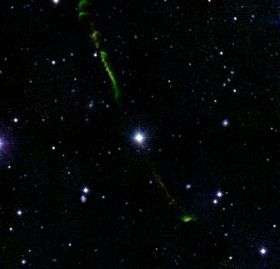
Hundreds of millions — or even billions — of years after planets would have initially formed around two unusual stars, a second wave of planetesimal and planet formation appears to be taking place, UCLA astronomers and colleagues believe.
"This is a new class of stars, ones that display conditions now ripe for formation of a second generation of planets, long, long after the stars themselves formed," said UCLA astronomy graduate student Carl Melis, who reported the findings today at the American Astronomical Society meeting in Austin, Texas.
"If we took a rocket to one of these stars and discovered there were two totally distinct ages for their planets and more minor bodies like asteroids, that would blow scientists' minds away," said Benjamin Zuckerman, UCLA professor of physics and astronomy and co-author of the research, which has not yet been published. "We're seeing stars with characteristics that have never been seen before."
The stars, which Melis says possess "amazing" properties for their age, are known as BP Piscium, in the constellation Pisces, and TYCHO 4144 329 2, in the constellation Ursa Major.
These two stars have many characteristics of very young stars, Melis said, including rapid accretion of gas, extended orbiting disks of dust and gas, a large infrared excess emission and, in the case of BP Piscium, jets of gas that are being shot into space. Planetesimals, like comets and asteroids, along with planets, form from the gas and dust particles that orbit young stars; planetesimals are small masses of rock or ice that merge to form larger bodies.
"With all these characteristics that match so closely with young stars, we would expect that our two stars would also be young," Melis said. "As we gathered more data, however, things just did not add up." For example, because stars burn lithium as they get older, young stars should have large quantities of lithium. The astronomers found, however, that the spectroscopic signature of lithium in BP Piscium is seven times weaker than expected for a young star of its mass.
"There is no known way to account for this small amount of lithium if BP Piscium is a young star," Melis said. "Rather, lithium has been heavily processed, as appropriate for old stars. Other spectral measurements also indicate it is a much older star."
As seen from Earth, some 75 percent of BP Piscium's radiant energy is being converted by the dust particles into infrared light, and about 12 percent of TYCHO 4144 329 2's. These are unusually high amounts, which Melis described as "spectacular" in comparison to other stars that are known to be not-young.
TYCHO 4144 329 2 orbits a companion star that has a mass similar to that of our sun; a second generation of planets is not forming around this companion, which appears to be an ordinary old star in all respects. By studying this companion star, the astronomers have deduced that TYCHO 4144 329 2 is just 200 light-years from Earth — very close by astronomical standards. They do not know precise age of TYCHO 4144 329 2, or BP Piscium's age or distance from Earth.
The astronomers are continuing to study these stars with a variety of ground-based telescopes and with space-based observatories, including NASA's Hubble Space Telescope and Chandra X-ray Observatory, and they are searching for additional similar stars.
Source: University of California - Los Angeles


