Astronomers produce first detailed map of dark matter in a supercluster
January 10, 2008
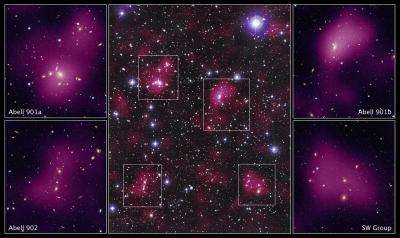
These images reveal the distribution of dark matter in the supercluster Abell 901/902, composed of hundreds of galaxies. The image in the center shows the entire supercluster. Astronomers assembled this photo by combining a visible-light image of the supercluster taken with the MPG/ESO 2.2-meter telescope in La Silla, Chile, with a dark matter map derived from observations with the NASA/ESA Hubble Space Telescope. The magenta-tinted clumps represent a map of the dark matter in the cluster. Dark matter is an invisible form of matter that accounts for most of the Universe's mass. The image shows that the supercluster galaxies lie within the clumps of dark matter.Credit for the Hubble images: NASA, ESA, C. Heymans (University of British Columbia, Vancouver), M. Gray (University of Nottingham, U.K.), M. Barden (Innsbruck), and the STAGES collaboration Credit for the ground-based image: ESO, C. Wolf (Oxford University, U.K.), K. Meisenheimer (Max-Planck Institute for Astronomy, Heidelberg), and the COMBO-17 collaboration
For the first time astronomers are able to see indirect evidence of dark matter and how this invisible force impacts on the crowded and violent lives of galaxies. University of British Columbia researcher Catherine Heymans has produced the highest resolution map of dark matter ever captured before.
Scientists believe that dark matter is the invisible web that houses galaxies. And as the universe evolves, the gravitational pull of this unseen matter causes galaxies to collide and swirl into superclusters.
Heymans and the University of Nottingham’s Meghan Gray led an international team to test this theory that dark matter determines the location of galaxies.
“For the first time we are clearly detecting irregular clumps of dark matter in a supercluster,” says Heymans, a postdoctoral fellow in the Dept. of Astronomy and Physics.
“Previous studies were only able to detect fuzzy, circular clumps, but we’re able to resolve detailed shapes that match the distribution of galaxies.”
Using NASA’s Hubble Space Telescope, Heymans and her team viewed an area of sky approximately the size of the full moon. They mapped the invisible dark matter scaffolding of the massive supercluster Abell 901/902 and the detailed structure of the individual galaxies embedded in it.
Abell 901/902 resides 2.6 billion light-years from Earth and measures more than 16 million light-years across.
“It is to the universe what New York is to America - a huge, fascinating but frightening place,” says Heymans.
“Dark matter leaves a signature in distant galaxies” explains study co-author Ludovic Van Waerbeke, an assistant professor in the Department of Physics and Astronomy. “For example, a circular galaxy will become more distorted to resemble the shape of a banana if its light passes near a dense region of dark matter.”
By observing this effect, astronomers can then infer the presence of dark matter. Heymans constructed a dark matter map by measuring the distorted shapes of more than 60,000 faraway galaxies located behind the Abell 901/902 supercluster. To reach Earth, these galaxies’ light traveled through the dark matter that surrounds the Abell 901/902 supercluster of galaxies and was bent by its massive gravitational field.
The Hubble study pinpointed four main areas in the supercluster where dark matter has pooled into dense clumps, totaling 10 trillion times the Sun’s mass. These areas match the known location of hundreds of old galaxies that have experienced a violent history in their passage from the outskirts of the supercluster into these dense regions.
Gray and Heymans will present their findings on Jan. 10 at the 211th meeting of the American Astronomical Society in Austin, Texas. The results are also scheduled to appear in the Monthly Notices of the Royal Astronomical Society.
Source: University of British Columbia
-
Astronomy team discovers nearby dwarf galaxy
Feb 08, 2012 |
4.2 / 5 (6) |
5
-
Repulsive gravity as an alternative to dark energy (Part 1: In voids)
Jan 31, 2012 |
4.6 / 5 (49) |
118
-
The wild early lives of today's most massive galaxies
Jan 25, 2012 |
4.4 / 5 (5) |
2
-
NASA's NuSTAR ships to Vandenberg for March 14 launch
Jan 25, 2012 |
5 / 5 (1) |
0
-
UA makes mirrors for world's largest telescope
Jan 18, 2012 |
4.8 / 5 (5) |
1
-
Engineers build first sub-10-nm carbon nanotube transistor
Feb 01, 2012 |
4.9 / 5 (32) |
30
-
Something old, something new: Evolution and the structural divergence of duplicate genes
Jan 31, 2012 |
4.6 / 5 (7) |
1
-
The hidden nanoworld of ice crystals: Revealing the dynamic behavior of quasi-liquid layers
Jan 30, 2012 |
5 / 5 (4) |
1
-
Stock market network reveals investor clustering
Jan 27, 2012 |
3.9 / 5 (23) |
8
-
Of microchemistry and molecules: Electronic microfluidic device synthesizes biocompatible probes
Jan 26, 2012 |
5 / 5 (2) |
0
-
Never ending outer space.....
15 hours ago
-
Neutron Star fragments?
17 hours ago
-
stationary or not?
21 hours ago
-
Scale of the Universe
Feb 10, 2012
-
Titan's lack of impact craters
Feb 09, 2012
-
Real pictures of black hole eating a star?
Feb 08, 2012
- More from Physics Forums - General Astronomy
More news stories
Salvage workers begin pumping fuel from Italian shipwreck
Salvage workers Sunday began pumping fuel from the shipwrecked Italian cruise liner Costa Concordia, a day ahead of schedule, officials said.
2 minutes ago |
not rated yet |
0
Latin America mining boom clashes with conservation
Latin America is experiencing a mining boom as prices rise fuelled by a hike in global demand, but the region is also being hit by a wave of violent protests, strikes and rallies by environmentalists.
8 hours ago |
not rated yet |
0
Political leaders play key role in how worried Americans are by climate change: study
More than extreme weather events and the work of scientists, it is national political leaders who influence how much Americans worry about the threat of climate change, new research finds.
Feb 06, 2012 |
5 / 5 (6) |
73
NASA budget will axe Mars deal with Europe: scientists
US President Barack Obama's budget proposal to be submitted next week for 2013 will cut NASA's budget by 20 percent and eliminate a major partnership with Europe on Mars exploration, scientists said Thursday.
Space & Earth / Space Exploration
Feb 10, 2012 |
5 / 5 (3) |
55
Humans may have helped the decline of African rainforests 3000 years ago
(PhysOrg.com) -- Large areas of rainforests in Central Africa mysteriously disappeared over three thousand years ago, to be replaced by savannas. The prevailing theory has been that the cause was a change ...
Scientists discover molecular secrets of 2,000-year-old Chinese herbal remedy
For roughly two thousand years, Chinese herbalists have treated Malaria using a root extract, commonly known as Chang Shan, from a type of hydrangea that grows in Tibet and Nepal. More recent studies suggest that halofuginone, ...
New method to examine batteries -- MRI from the inside
There is an ever-increasing need for advanced batteries for portable electronics, such as phones, cameras, and music players, but also to power electric vehicles and to facilitate the distribution and storage of energy derived ...
A mitosis mystery solved: How chromosomes align perfectly in a dividing cell
Although the process of mitotic cell division has been studied intensely for more than 50 years, Whitehead Institute researchers have only now solved the mystery of how cells correctly align their chromosomes during symmetric ...
Starve a virus, feed a cure? Findings show how some cells protect themselves against HIV
A protein that protects some of our immune cells from the most common and virulent form of HIV works by starving the virus of the molecular building blocks that it needs to replicate, according to research published online ...
Researchers find extensive RNA editing in human transcriptome
In a new study published online in Nature Biotechnology, researchers from BGI, the world's largest genomics organization, reported the evidence of extensive RNA editing in a human cell line by analysis of RNA-seq data, demons ...
The proteins ensuring genome protection
Researchers from the University of Geneva (UNIGE), Switzerland, have discovered the crucial role of two proteins in developing a cell 'anti-enzyme shield'. This protection system, which operates at the level of molecular ...
Jan 11, 2008
Rank: 1 / 5 (1)
http://www.presto...ndex.htm