Fighting pollution the poplar way: Trees to clean up Indiana site
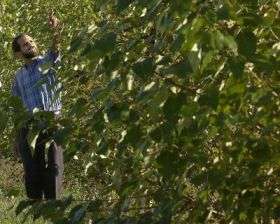
Purdue University researchers are collaborating with Chrysler LLC in a project to use poplar trees to eliminate pollutants from a contaminated site in north-central Indiana.
The researchers plan to plant transgenic poplars at the site, a former oil storage facility near Kokomo, Ind., this summer. In a laboratory setting, the transgenic trees have been shown to be capable of absorbing trichloroethylene, or TCE, and other pollutants before processing them into harmless byproducts.
Richard Meilan, a Purdue associate professor, is currently at work to transform one variety of poplar suited to Indiana's climate; cold-hardy poplars are generally more difficult to alter than the variety used in a laboratory setting.
"This site presents the perfect opportunity to prove that poplars can get rid of pollution in the real world," Meilan said.
In a study Meilan co-authored, published last October in Proceedings of the National Academy of Sciences, poplar cuttings removed 90 percent of the TCE within a hydroponic solution in one week. The engineered trees also took up and metabolized the chemical 100 times faster than unaltered hybrid poplars, which have a limited ability to remove and degrade the contaminant on their own, he said.
The transgenic poplars contain an inserted gene that encodes an enzyme capable of breaking down TCE and a variety of other environmental pollutants, including chloroform, benzene, vinyl chloride and carbon tetrachloride.
Meilan said he believes the transgenic poplars will be able to remove the TCE from the site, named Peter's Pond, which was contaminated by tainted oil stored there in the 1960s. The chemical, used as an industrial solvent and degreaser, lies within 10 feet of the surface, making it accessible to poplar roots, he said.
TCE, the most common groundwater pollutant on Superfund sites, is a probable human carcinogen and causes various health problems when present in sufficiently high levels in water or air.
Meilan said planting transgenic trees in the field remains controversial, primarily due to concerns that inserted genes, or transgenes, might escape and incorporate into natural tree populations.
"It is legitimate to be concerned about transgenic plants, but we are taking comprehensive steps to ensure that our transgenes don't escape into the environment," Meilan said.
Meilan has applied for a permit to grow transgenic poplars in a field, or non-laboratory, setting from the Animal and Plant Health Inspection Service, the government organization responsible for regulating such research activities, he said.
In order to comply with permit guidelines and to protect the environment, Meilan's team will take measures to prevent any plant material from leaving the site and will remove the trees after three years, short of the five it takes for poplars to reach sexual maturity, he said.
"Three years should be enough time for them to grow up, send down roots to suck the pollutants up and break them down," Meilan said. "Then we'll cut them down before they have the chance to pass on their genes to the environment."
Besides their utility in phytoremediation, or pollution removal, poplars have promise as a feedstock for cellulosic ethanol. To investigate their potential in this area, the U.S. Department of Energy awarded a $1.3 million grant to Meilan and two colleagues, professors Michael Ladisch, agricultural and biological engineering, and lead researcher Clint Chapple, biochemistry.
They are currently investigating ways to alter the composition of poplar lignin, which provides rigidity to the plant cell wall by binding to strands of cellulose, a complex sugar that can be converted into ethanol.
Chrysler will fund the Kokomo project and said that the TCE is contained within an isolated water table at Peter's Pond and presents no public hazard.
The original study, led by University of Washington professors Stuart Strand and Sharon Doty, revealed that the transgenic poplars also were able to absorb TCE vapors through their leaves before metabolizing the chemical. Tree cuttings removed 79 percent of the airborne TCE from a chamber within one week. This suggests poplars could one day help mitigate air as well as water pollution.
If the project succeeds, poplars may be used for phytoremediation elsewhere. Poplars grow across a wide geographic range and in many different climates, Meilan said.
Source: Purdue University


