Forces out of nothing
When a machine jams, it’s the fault of the engineer - or of physics. The latter is true at least for the first simple nanomachines which are slowed down by the Casimir effect. This force only works on the scale of a few millionths of a centimeter and makes tiny machine parts cling together.
Scientists from the Max Planck Institute of Metals Research and the University of Stuttgart have now observed a similar force in a mixture of two liquids. They have also found a way to reverse the effect of the force so that blockages might be avoided in future nanomachines. This will make it possible to miniaturize machines even further and produce nano-scale mechanical switches or sensors.
Nothing comes from nothing. Only in physics is this not always true. For example, two metal plates placed about half a micrometer apart in a vacuum and at a temperature of absolute zero exert a mysterious attraction on each other. The force pushing the plates together comes from the quantum mechanical fluctuations of the vacuum - so from nothing. This fluctuation represents variations in electromagnetic waves. These need to have a node on the surfaces of the two electrically conductive plates, which considerably limits the number of waves permitted between the plates. Outside of the plates they can spread without restriction. This results in the attraction between the plates.
Physicist Hendrik Casimir predicted this effect in theory as early as 1948; today it is the reason why the components in nanomachines adhere to each other. Clemens Bechinger, Professor at the University of Stuttgart and a Max Planck Fellow since the beginning of the year, Christopher Hertlein and other staff members have now observed a very similar force in experiments with a mixture of water and the oily liquid lutidine: the critical Casimir force. "This force is so weak that it is very difficult to detect it," says Clemens Bechinger. The results nevertheless agree very well with the values that Siegfried Dietrich, Director at the Max Planck Institute of Metal Research in Stuttgart and his team had predicted in theory. The scientists have now published the results jointly.
The critical Casimir force gets its name from the fact that it occurs close to a critical point, such as that in a mixture of water and lutidine. At low temperatures it forms a clear solution. However, if the solution is heated to around 34 degrees Celsius, it becomes two separate mixtures; physicists refer to these as two phases: one with a high water content and the other with a high lutidine content.
The temperature at which this happens is called the critical temperature. The two phases do not come into being abruptly at this critical point, like water solidifying into ice. It is more the case that below the critical temperature areas form in the mixture that contain more water or more lutidine. The closer the temperature gets to the critical point, the larger these fluctuating areas grow and the longer they remain intact. "The way the concentration of water and lutidine fluctuates in different parts of the mixture is similar to the quantum mechanical fluctuations in the vacuum," says Siegfried Dietrich. The fluctuations in concentration should create an attraction between surfaces in a similar way. The researchers have now proven that this is exactly what they do.
"We observed a plastic sphere with a diameter of a micrometer floating in a glass with lutidine and water," says Christopher Hertlein. The temperature of the solution was initially much lower than the critical point. The researchers then heated it up gradually. When the temperature was only 0.2 degrees away from the critical point, the plastic sphere moved towards the glass surface.
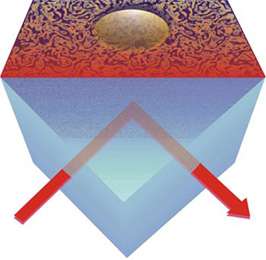
The physicists used evanescent optical fields to determine the distance of the sphere to the glass surface by scattering them at the plastic sphere. They shined light towards the glass in a sharp angle so that it was reflected almost completely. Only a tiny part of the light leaked into the liquid. How much reaches the plastic sphere and how much this part is scattered depends very much on the distance of the sphere to the glass surface.
The researchers succeeded in using the distance of the sphere to calculate the force working on it. It was tricky: the tiny sphere moved very rapidly because it was constantly colliding with the heated molecules of the liquid. The critical Casimir force therefore only manifests itself in the form of statistical blips towards the glass surface.
"We can only detect these statistical blips because our measuring method is several thousand times more sensitive than atomic force microscopy," says Clemens Bechinger: "That means we can measure in the range of one femtonewton". Atomic Force Microscopy measures the attraction which a surface exerts on a fine measuring arm. Using the optical measuring method, the physicists in Stuttgart have now established that the critical Casimir force only amounts to 600 femtonewtons, which is less than a millionth of the weight of a flea.
However, this force pushes the plastic sphere to the glass surface only when the glass and the sphere both prefer water or both prefer oil. If the two surfaces are coated so that only one of the two surfaces favors oil, the critical Casimir force pushes the sphere away from the glass surface. Then areas with a lot of water form on one surface and some with a lot of oil on the other. However, since it takes energy to make contact between the water and the oil phases, the sphere is repelled.
"This is the effect that our theoretical calculations led us to expect," says Dietrich. The researchers expect that this experimental proof may offer the possibility of stopping blockages in nanomachines. These machines, on a scale of a few millionths of a centimeter, could one day be used as actuators in medicine, for example. They could allow less invasive operations or medication to be transported directly to a focus of disease.
However, one of the reasons machines like this have failed up to now is partly due to the Casimir force of the quantum mechanical vacuum fluctuation, which brings them to a standstill. "If these machines would work not in a vacuum, but in a liquid mixture close to the critical point, that could be changed," says Siegfried Dietrich. Then the machine parts could be coated so that the Casimir force has a repelling effect, meaning that the machine runs smoothly. This is one of the objectives that Dietrich’s theoretical group and Bechinger’s experimental group want to pursue in the future.
Citation: Christopher Hertlein, Laurent Helden, Andrea Gambassi, Siegfried Dietrich, Clemens Bechinger, Direct measurement of critical Casimir forces, Nature, January 10, 2008 (DOI: 10.1038/nature06443)
Source: Max Planck Institute for Metals Research


