NASA Scientists Predict Black Hole Light Echo Show
It’s well known that black holes can slow time to a crawl and tidally stretch large objects into spaghetti-like strands. But according to new theoretical research from two NASA astrophysicists, the wrenching gravity just outside the outer boundary of a black hole can produce yet another bizarre effect: light echoes.
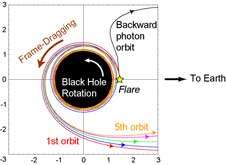
"The light echoes come about because of the severe warping of spacetime predicted by Einstein," says Keigo Fukumura of NASA’s Goddard Space Flight Center in Greenbelt, Md. "If the black hole is spinning fast, it can literally drag the surrounding space, and this can produce some wild special effects."
Fukumura and his NASA Goddard colleague Demosthenes Kazanas are presenting their research this Wednesday in a poster session at the American Astronomical Society’s 2008 winter meeting in Austin, Texas.
Many black holes are surrounded by disks of searing hot gas that whirl around at nearly the speed of light. Hot spots within these disks sometimes emit random bursts of X-rays, which have been detected by orbiting X-ray observatories. But according to Fukumura and Kazanas, things get more interesting when they take into account Einstein’s general theory of relativity, which describes how extremely massive objects like black holes can actually warp and drag the surrounding space-time.
Many of these X-ray photons travel to Earth by taking different paths around the black hole. Because the black hole’s extreme gravity warps the surrounding spacetime, it bends the trajectories of the photons so they arrive here with a delay that depends on the relative positions of the X-ray flare, the black hole, and Earth.
But if the black hole rotates very fast, then according to Fukumura and Kazanas’ calculations, the delay between the photons is constant, independent of the source’s position. They discovered that for rapidly spinning black holes, about 75 percent of the X-ray photons arrive at the observer after completing a fraction of one orbit around the black hole, while the remaining photons travel the exact same fraction plus one or more full orbits.
"For each X-ray burst from a hot spot, the observer will receive two or more flashes separated by a constant interval, so even a signal made up from a totally random collection of bursts from hot spots at different positions will contain an echo of itself," says Kazanas.
Though difficult to discern in the raw data, astronomers can use a Fourier analysis, or other statistical methods, to pick up these hidden echoes. Among other things, a Fourier analysis is a mathematical tool for extracting periodic behavior in a signal that might otherwise seem totally random. The echoes would appear as quasi-periodic oscillations (QPOs). An example of a QPO with a period of 10 seconds might exhibit peaks at 9, 21, 30, 39, 51, and 61 seconds.
If one considers a 10-solar-mass black hole that formed from a dying star, and if the black hole is spinning more than 95 percent of its maximum possible speed, the period of its QPOs would be about 0.7 milliseconds, corresponding to about 1,400 peaks per second, which is three times higher than any QPOs that have been detected around black holes. NASA’s Rossi X-ray Timing Explorer satellite could measure such high-frequency QPOs, but the signal would have to be very strong.
Detecting these high-frequency QPOs would do more than just confirm another prediction of Einstein’s theory. It would also provide a gold mine of information about the black hole itself. The frequency of the QPOs depends on the black hole’s mass, so detecting this echo effect would give astronomers an accurate way to measure the masses of black holes. In addition, notes Kazanas, "This echoes occur only if a black hole is spinning near its maximum possible speed, so it would tell astronomers that the black hole is spinning really fast."
Source: by Robert Naeye, Goddard Space Flight Center


