New Hydrogen Clouds in the M81 Group of Galaxies
January 10, 2008 New Hydrogen Clouds in the M81 Group of Galaxies

Credit: Chynoweth et al., NRAO/AUI/NSF, Digital Sky Survey

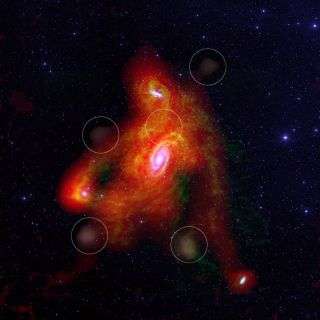
A composite radio-optical image shows five new clouds of hydrogen gas discovered using the National Science Foundation's Robert C. Byrd Green Bank Telescope (GBT). The spiral galaxy M81 and its satellite, M82, are seen in visible light (white); intergalactic hydrogen gas revealed by the GBT is shown in red; and additional hydrogen gas earlier detected by the Very Large Array is shown in green.

The M81 Group of galaxies, 11.8 million light-years from Earth, are interacting gravitationally with each other, as shown clearly by the gas streaming among them.

The newly-discovered gas clouds, each containing from 14 to 57 million times the mass of our Sun, are similar to gas clouds also found near our own Milky Way Galaxy. Astronomers analyzing these M81 Group clouds conclude that they are likely remnants of earlier interactions among the galaxies and that this indicates that their analogs near the Milky Way had a similar origin.

The research team is: Katie Chynoweth, a graduate student at Vanderbilt University; Glen Langston of the National Radio Astronomy Observatory (NRAO); Min Yun of the University of Massachusetts; Felix J. Lockman of NRAO; Kate Rubin of Lick Observatory; and Sarah Scoles of Cornell University. The astronomers presented their findings to the American Astronomical Society's meeting in Austin, Texas.

Source: NRAO


print this article email this article download pdf blog this article bookmark this article     Stumble it Digg this share on Facebook retweet share on Reddit add to delicious
Rate this story - 3.9 /5 (9 votes)


January 10, 2008 all stories

Comments: 0

3.9 /5 (9 votes)
  • Stumble this up

  • Digg this

  • share this

  • hide
  • Related Stories


  • hide
  • Relevant PhysicsForums posts

  • Some help with a X-Ray astronomy question please!
    created 12 hours ago
  • Help with Images and Optical Instrument Question..
    created Nov 26, 2009
  • Redshift as a distance indicator
    created Nov 26, 2009
  • Question about 2-body gravity
    created Nov 24, 2009
  • More from Physics Forums - General Astronomy

Other News

Fermi Telescope Peers Deep into Microquasar

Fermi Telescope Peers Deep into Microquasar (w/ Video)

Space & Earth / Astronomy

created 6 hours ago | popularity 4.3 / 5 (3) | comments 0

(PhysOrg.com) -- NASA's Fermi Gamma-ray Space Telescope has made the first unambiguous detection of high-energy gamma-rays from an enigmatic binary system known as Cygnus X-3. The system pairs a hot, massive ...


The Energy Sources of Ultraluminous Galaxies

The Energy Sources of Ultraluminous Galaxies

Space & Earth / Astronomy

created 7 hours ago | popularity 4.3 / 5 (7) | comments 0

(PhysOrg.com) -- Ultraluminous infrared galaxies ((ULIRGs) are galaxies whose luminosity exceeds that of a trillion suns; for comparison, the Milky Way galaxy has a typical (and much more modest) luminosity ...


Space shuttle Atlantis, 7 astronauts back on Earth (AP)

Space shuttle Atlantis, 7 astronauts back on Earth

Space & Earth / Space Exploration

created 7 hours ago | popularity not rated yet | comments 0

(AP) -- Space shuttle Atlantis and its seven astronauts returned to Earth with a smooth touchdown Friday to end an 11-day flight that resupplied the International Space Station.


Herschel takes a peek at the ingredients of the galaxies

Herschel takes a peek at the ingredients of the galaxies

Space & Earth / Astronomy

created 5 hours ago | popularity 5 / 5 (1) | comments 0

(PhysOrg.com) -- The European Space Agency has today released spectacular new observations from the Herschel Space Observatory, including the UK-led SPIRE instrument. Spectrometers on board all three Hershel ...


New radar helps monitor site of century-old tragedy

New radar helps monitor site of century-old tragedy

Space & Earth / Earth Sciences

created 6 hours ago | popularity not rated yet | comments 0

(PhysOrg.com) -- A University of Alberta researcher has turned the site of a southern Alberta rockslide tragedy into the proving ground for new equipment meant to avert such a disaster in the future.