Culture influences brain function
January 11, 2008
Culture influences brain function

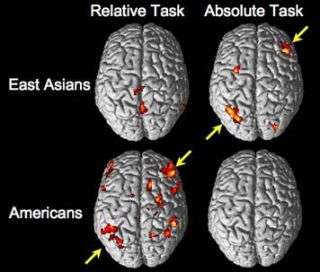
Brain activity in East Asians and Americans as they make relative and absolute judgments. The arrows point to brain regions involved in attention that are engaged by more demanding tasks. Americans show more activity during relative judgments than absolute judgments, presumably because the former task is less familiar and hence more demanding for them. East Asians show the opposite pattern. Image courtesy / Trey Hedden

People from different cultures use their brains differently to solve the same visual perceptual tasks, MIT researchers and colleagues report in the first brain imaging study of its kind.

Psychological research has established that American culture, which values the individual, emphasizes the independence of objects from their contexts, while East Asian societies emphasize the collective and the contextual interdependence of objects. Behavioral studies have shown that these cultural differences can influence memory and even perception. But are they reflected in brain activity patterns"

To find out, a team led by John Gabrieli, a professor at the McGovern Institute for Brain Research at MIT, asked 10 East Asians recently arrived in the United States and 10 Americans to make quick perceptual judgments while in a functional magnetic resonance imaging (fMRI) scanner--a technology that maps blood flow changes in the brain that correspond to mental operations.

The results are reported in the January issue of Psychological Science. Gabrieli's colleagues on the work were Trey Hedden, lead author of the paper and a research scientist at McGovern; Sarah Ketay and Arthur Aron of State University of New York at Stony Brook; and Hazel Rose Markus of Stanford University.

Subjects were shown a sequence of stimuli consisting of lines within squares and were asked to compare each stimulus with the previous one. In some trials, they judged whether the lines were the same length regardless of the surrounding squares (an absolute judgment of individual objects independent of context). In other trials, they decided whether the lines were in the same proportion to the squares, regardless of absolute size (a relative judgment of interdependent objects).

In previous behavioral studies of similar tasks, Americans were more accurate on absolute judgments, and East Asians on relative judgments. In the current study, the tasks were easy enough that there were no differences in performance between the two groups.

However, the two groups showed different patterns of brain activation when performing these tasks. Americans, when making relative judgments that are typically harder for them, activated brain regions involved in attention-demanding mental tasks. They showed much less activation of these regions when making the more culturally familiar absolute judgments. East Asians showed the opposite tendency, engaging the brain's attention system more for absolute judgments than for relative judgments.

“We were surprised at the magnitude of the difference between the two cultural groups, and also at how widespread the engagement of the brain's attention system became when making judgments outside the cultural comfort zone,” says Hedden.

The researchers went on to show that the effect was greater in those individuals who identified more closely with their culture. They used questionnaires of preferences and values in social relations, such as whether an individual is responsible for the failure of a family member, to gauge cultural identification. Within both groups, stronger identification with their respective cultures was associated with a stronger culture-specific pattern of brain-activation.

How do these differences come about" “Everyone uses the same attention machinery for more difficult cognitive tasks, but they are trained to use it in different ways, and it's the culture that does the training,” Gabrieli says. “It's fascinating that the way in which the brain responds to these simple drawings reflects, in a predictable way, how the individual thinks about independent or interdependent social relationships.”

Source: Massachusetts Institute of Technology

Filter


Move the slider to adjust rank threshold, so that you can hide some of the comments.


Display comments: newest first

nilbud
Jan 11, 2008

Rank: 2.3 / 5 (3)
Now that's some high quality racism. The jobs or religions aren't factored in, nor the different shapes of letters in the languages. The assumption of individuality rather than hive mind is presumed to be the factor at work. Perhaps the drawings should have been made by a non yank. The US is the last place in the world to have 4:3 TV screens, the non US types are probably used to flat widescreen TV.
Nikola
Jan 11, 2008

Rank: 3 / 5 (3)
Al Sharpton will be protesting at MIT.
gopher65
Jan 11, 2008

Rank: 4 / 5 (2)
nilbud,

All this article is saying (albeit in an obtuse and americo-centrific way) is that your culture has an effect on your experiences, and your experiences affect how you think. That's it.

What is amazing to me is that such stupidly obvious research managed to get funding. I can only assume that they dazzeled the funding body with big words and technobabble Rodney McKay style.
nilbud
Jan 12, 2008

Rank: 3.5 / 5 (2)
gopher,

I'm just saying there could be many reasons for the differences, even assuming that "culture" is the factor in question it's still a huge leap to say it's individuality which is the determinant. Which American culture are they talking about anyway? University students, truck drivers, NAACP members or NRA members?
gopher65
Jan 12, 2008

Rank: 4 / 5 (2)
Yeah that's true. That "individuality is the key" part made me go 0_o. That is one heck of a conclusion to draw. That's why I said it was an americo-centrific article. They set out to prove that America was great, and shocker, that's the conclusion they came to.

But the core idea, that culture and, more importantly, your experiences in your culture affect your thinking process can't be disputed.
Wicked
Jan 15, 2008

Rank: not rated yet
10 and 10. Kinda small sample sizes, methinks. The study implies that harder activities require more blood flow. Maybe these tasks are equally hard for anyone, but bloodflow reflects genetic differences. Hard to say on such small sample sizes.
hibiscus
Jan 16, 2008

Rank: 1 / 5 (1)
Maybe these Asians eat different food?

I guess that MacDonald's and mad cow disease have a bigger influence on brain function.

What is culture huh?

MIT assholes!
Rank 4 /5 (24 votes)
Tags

Relevant PhysicsForums posts
  • Is Everyday Technology Killing Us?
    createdFeb 08, 2012
  • Exercise and weight loss
    createdFeb 08, 2012
  • Why do we have head aches? Our brains can't feel anything.
    createdFeb 07, 2012
  • "The end of diseases" by David Agus, interview from Daily Show with Jon Stewart
    createdFeb 04, 2012
  • Oncolytic adenovirus
    createdFeb 04, 2012
  • Nutrition label stuffs and diets
    createdFeb 02, 2012
  • More from Physics Forums - Medical Sciences

More news stories

Curry spice component may help slow prostate tumor growth

Curcumin, an active component of the Indian curry spice turmeric, may help slow down tumor growth in castration-resistant prostate cancer patients on androgen deprivation therapy (ADT), a study from researchers ...

Medicine & Health / Cancer

created 4 hours ago | popularity 5 / 5 (3) | comments 0 | with audio podcast

Team isolates nerve cells involved in storing long term memory and gene proteins associated with them

(Medical Xpress) -- A research team in Taiwan has succeeded in isolating two nerve cells in fruit fly brains that are believed to be the major players in allowing for the formation of long term memories. Furthermore, ...

Medicine & Health / Neuroscience

created 5 hours ago | popularity 5 / 5 (4) | comments 1 | with audio podcast report

Both maternal and paternal age linked to autism

Older maternal and paternal age are jointly associated with having a child with autism, according to a recently published study led by researchers at The University of Texas Health Science Center at Houston (UTHealth).

Medicine & Health / Psychology & Psychiatry

created 3 hours ago | popularity not rated yet | comments 0 | with audio podcast

Seeing colors in music, tasting flavors in shapes may happen in life's early months

Famed violinist Itzhak Perlman sees a deep forest green whenever he plays a B-flat on his Stradivarius' G string. The A on the E string is red.

Medicine & Health / Psychology & Psychiatry

created 6 hours ago | popularity 5 / 5 (1) | comments 0 | with audio podcast

Antidepressants and pregnancy: Women must consider the impact of drugs on baby, and of depression on baby, themselves

Upon learning they are pregnant, most women dutifully nix the alcohol, sushi and caffeine. But what about antidepressants?

Medicine & Health / Medications

created 3 hours ago | popularity not rated yet | comments 0


Putting the squeeze on planets outside our solar system

(PhysOrg.com) -- Using high-powered lasers, scientists at Lawrence Livermore National Laboratory and collaborators discovered that molten magnesium silicate undergoes a phase change in the liquid state, abruptly ...

Employers feel no love for unscrupulous practice of 'service sweethearting'

A new study led by two Florida State University marketing professors finds that some frontline service employees who are rewarded for hikes in customer loyalty and satisfaction also may engage in "service ...

Expat French get Internet vote for first time

French citizens will for the first time this year be able to vote in a parliamentary election over the Internet, an experiment that could be extended to other elections if successful.

"Twisted Metal" gamers get shot at real gunplay

Fans of "Twisted Metal" will get to welcome a long-awaited sequel of the car-battle videogame with a real-world bang by blasting an ice cream truck to bits with a machine gun.

The power of estrogen -- male snakes attract other males

A new study has shown that boosting the estrogen levels of male garter snakes causes them to secrete the same pheromones that females use to attract suitors, and turned the males into just about the sexiest ...

New error-correcting codes guarantee the fastest possible rate of data transmission

Error-correcting codes are one of the triumphs of the digital age. They’re a way of encoding information so that it can be transmitted across a communication channel — such as an optical fiber o ...