New gas sensor is tiny, quick
January 11, 2008 New gas sensor is tiny, quick

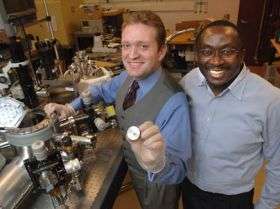
MIT research scientist Luis Velasquez-Garcia, left, and Akintunde Ibitayo Akinwande, professor of electrical engineering and computer science, are developing a tiny sensor that can detect hazardous gases, including biochemical warfare agents. Photo / Donna Coveney

Engineers at MIT are developing a tiny sensor that could be used to detect minute quantities of hazardous gases, including toxic industrial chemicals and chemical warfare agents, much more quickly than current devices.

The researchers have taken the common techniques of gas chromatography and mass spectrometry and shrunk them to fit in a device the size of a computer mouse. Eventually, the team, led by MIT Professor Akintunde Ibitayo Akinwande, plans to build a detector about the size of a matchbox.

"Everything we're doing has been done on a macro scale. We are just scaling it down," said Akinwande, a professor of electrical engineering and computer science and member of MIT's Microsystems Technology Laboratories (MTL).

Akinwande and MIT research scientist Luis Velasquez-Garcia plan to present their work at the Micro Electro Mechanical Systems (MEMS) 2008 conference this week. In December, they presented at the International Electronic Devices Meeting.

Scaling down gas detectors makes them much easier to use in a real-world environment, where they could be dispersed in a building or outdoor area. Making the devices small also reduces the amount of power they consume and enhances their sensitivity to trace amounts of gases, Akinwande said.

He is leading an international team that includes scientists from the University of Cambridge, the University of Texas at Dallas, Clean Earth Technology and Raytheon, as well as MIT.

Their detector uses gas chromatography and mass spectrometry (GC-MS) to identify gas molecules by their telltale electronic signatures. Current versions of portable GC-MS machines, which take about 15 minutes to produce results, are around 40,000 cubic centimeters, about the size of a full paper grocery bag, and use 10,000 joules of energy.

The new, smaller version consumes about four joules and produces results in about four seconds.

The device, which the researchers plan to have completed within two years, could be used to help protect water supplies or for medical diagnostics, as well as to detect hazardous gases in the air.

The analyzer works by breaking gas molecules into ionized fragments, which can be detected by their specific charge (ratio of charge to molecular weight).

Gas molecules are broken apart either by stripping electrons off the molecules, or by bombarding them with electrons stripped from carbon nanotubes. The fragments are then sent through a long, narrow electric field. At the end of the field, the ions' charges are converted to voltage and measured by an electrometer, yielding the molecules' distinctive electronic signature.

Shrinking the device greatly reduces the energy needed to power it, in part because much of the energy is dedicated to creating a vacuum in the chamber where the electric field is located.

Another advantage of the small size is that smaller systems can be precisely built using microfabrication. Also, batch-fabrication will allow the detectors to be produced inexpensively.

Source: MIT


print this article email this article download pdf blog this article bookmark this article     Stumble it Digg this share on Facebook retweet share on Reddit add to delicious
Rate this story - 4 /5 (5 votes)


January 11, 2008 all stories

Comments: 0

4 /5 (5 votes)
  • Stumble this up

  • Digg this

  • share this

  • hide
  • Related Stories

  • 3 Questions: Sara Seager on searching for Earth-like planets
    created Nov 23, 2009 | popularity not rated yet | comments 0
  • Dinosaur-Killer was Soft on Algae
    created Oct 02, 2009 | popularity not rated yet | comments 0
  • The hunt for dark matter
    created Sep 17, 2009 | popularity not rated yet | comments 0
  • New robots mimic fish's swimming (w/ Video)
    created Aug 24, 2009 | popularity not rated yet | comments 0
  • Odd discovery may help refine theories about how planets form
    created Jun 17, 2009 | popularity not rated yet | comments 0


  • hide
  • Relevant PhysicsForums posts

  • Laser plasma emission
    created Nov 26, 2009
  • Achromat lens - magnifying LCD
    created Nov 25, 2009
  • Control System
    created Nov 24, 2009
  • Base Isolation Systems in Skyscrapers?
    created Nov 23, 2009
  • More from Physics Forums - General Engineering

Other News

Government delays new ban on Internet gambling

Technology / Internet

created 14 hours ago | popularity 3 / 5 (2) | comments 0

(AP) -- The Treasury Department and the Federal Reserve are giving U.S. financial institutions an additional six months to comply with regulations designed to ban Internet gambling.


Fujitsu Develops Technology for Low-Temperature Full-Service Direct Formation of Graphene Transistors on Large-Scale Substrates

Fujitsu Develops Technology for Low-Temperature Full-Service Direct Formation of Graphene Transistors on Large-Scale Sub

Technology / Semiconductors

created 14 hours ago | popularity 5 / 5 (7) | comments 1

Fujitsu Laboratories today announced, as a world first, the development of a novel technology for forming graphene transistors directly on the entire surface of large-scale insulating substrates at low temperatures ...


Teachers begin using cell phones for class lessons

Technology / Hi Tech

created 11 hours ago | popularity 2 / 5 (2) | comments 0

(AP) -- Ariana Leonard's high school students shuffled in their seats, eagerly awaiting a cue from their Spanish teacher that the assignment would begin. "Take out your cell phones," she said in Spanish.


Semantic research sets world standards

Semantic research sets world standards

Technology / Computer Sciences

created 21 hours ago | popularity 3.3 / 5 (3) | comments 1

(PhysOrg.com) -- European researchers have created new tools for semantic technology development which are helping to set the next generation of official standards. The tools also unblock some key bottlenecks ...


National Taiwan University logo

Cellphone powers back pain chip in Taiwan

Technology / Engineering

created 22 hours ago | popularity 4.3 / 5 (3) | comments 0

Taiwanese researchers have developed a chip to treat backpain that is powered by mobile phone, a member of the team said Friday.