NASA Satellites Capture Start of New Solar Cycle
January 11th, 2008 NASA Satellites Capture Start of New Solar Cycle

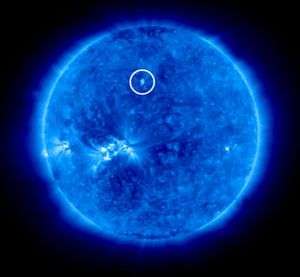
The first official active region of solar cycle 24 as it appeared to the STEREO behind spacecraft observing in ultraviolet light on Jan. 4, 2008. Click image for enlargement. Credit: NASA / STEREO

NASA scientists say a new solar cycle is beginning, and this could have important repercussions for space-based technology ranging from GPS navigation to weather satellites.

On January 4, a reversed-polarity sunspot appeared, signaling the start of Solar Cycle 24. A sunspot is an area of magnetic activity on the surface of the sun that appears as a dark spot on its surface. Solar activity waxes and wanes in 11-year cycles and the previous solar cycle, Solar Cycle 23, peaked in 2000-2002 with many furious solar storms.

Lately, the sun has been experiencing very few flares, sunspots, or activity of any kind -- a period of quiet called solar minimum. Now, the sun’s seasons are changing again. David Hathaway, solar physicist at NASA’s Marshall Space Flight Center in Huntsville, Ala., says, “New solar cycles always begin with a high-latitude, reversed polarity sunspot."

"Reversed polarity" means a sunspot with opposite magnetic polarity compared to sunspots from the previous solar cycle. "High-latitude" refers to the sun's grid of latitude and longitude. Old cycle spots congregate near the sun's equator. New cycle spots appear higher, around 25 or 30 degrees latitude.

The sunspot that appeared January 4 fits both these criteria. It is high latitude (30 degrees N) and magnetically reversed. The National Oceanic and Atmospheric Administration (NOAA) has named the spot AR10,981, or “sunspot 981” for short. Sunspot 981 was small -- only about as wide as Earth, which counts as small on the grand scale of the Sun -- and it has already faded away. But its three-day appearance January 4 through January 6 was enough to convince most solar physicists that Solar Cycle 24 is underway. The onset of a new solar cycle is significant because of our increasingly space-based technological society.

“Solar storms can disable satellites that we depend on for weather forecasts and GPS navigation,” says Hathaway. Radio bursts from solar flares can directly interfere with cell phone reception while coronal mass ejections (CMEs) hitting Earth can cause actual power outages.

Air travel can be affected, too. When airplanes fly over the poles during solar storms, they can experience radio blackouts, navigation errors and computer reboots all caused by space radiation. Avoiding the poles during solar storms solves the problem, but it costs extra time, money and fuel to take the longer route.

NASA is gearing up to study the active sun during Cycle 24 with the launch of a new spacecraft, the Solar Dynamics Observatory. “SDO is a very special observatory,” says project scientist Dean Pesnell at NASA's Goddard Space Flight Center in Greenbelt, Md. “Using a technique called helioseismic imaging, the spacecraft will be able to look inside the sun where solar activity begins. SDO will join SOHO, the Solar Terrestrial Relations Observatory (STEREO), Hinode and other missions already in orbit to improve our understanding of solar storms and lay the groundwork for better space weather forecasts.”

"The beginning of the new solar cycle occurs just as the STEREO Mission is completing its first year of operation," says Mike Kaiser, STEREO Project Scientist at NASA Goddard. "The twin STEREO spacecraft are now 45 degrees apart and are in good position to triangulate on solar activity from the new cycle to provide better understanding of solar storms that can disrupt our electronic lives. Ultimately, the research done by STEREO and other solar missions will lead to more accurate predictions of when solar storms will impact Earth."

“Intense solar activity won't begin immediately,” notes Hathaway. “Solar cycles usually take a few years to build from solar minimum (where we are now) to Solar max, expected in 2011 or 2012.”

Source: by Jennifer Morcone and Rob Gutro, NASA's Marshall and Goddard space flight centers


print this article email this article download pdf blog this article bookmark this article     Digg this Stumble it share on Facebook share on Reddit add to delicious save to Yahoo! bookmarks
3.9/5 after 42 votes

Rank Filter

Move the slider to adjust rank threshold, so that you can hide some of the comments.


Display comments: newest first

  • Piquant - Jan 13, 2008
    • Rank: not rated yet
    Regarding NASA's long range forecasts on the Solar Cycles; they show cycle 24 as being the last, more active one for some time.
    http://science.na...ange.htm

    Following Cycle 24, the sun moves into a "minimum" due to slowing of the Sun's plasma convection currents. The sun does go through cycles of it's "Great Conveyor Belt" (NASA's term).

    Could cycle #25 herald a period of dangerous cold? A return of the "Dalton Minimum"?

    John Casey, a consultant to NASA, has spoken of a "Relational Cycle Theory" that speaks of this.

    I am wondering as this is the start of Cycle #24, should we consider or look into past solor studies, and corroborate them with cold periods? Advance the possibility of a coming cold minimum?

    I feel science should examine ALL possibilities vs. espousing the most popular mantras to perhaps preserve tenures or get press time. I hear so little about the possibility of Relational Cycles on the Sun in news.

January 11th, 2008 all stories
Space & Earth / Astronomy

Comments: 1
Rank: 3.9/5 after 42 votes

  • Stumble this up

  • Digg this

  • Share it:
  • share on Facebook
  • share on MySpace
  • share on Slashdot
  • rss-newsfeed
  • share on Google
  • share on Reddit
  • add to delicious
  • save to Yahoo! bookmarks
  • share on Windows Live
  • Add to Mixx!
Rating: 3.9/5 after 42 votes

  • Related Stories

  • Sunspots revealed in striking detail by supercomputers
    created Jun 18, 2009 | popularity not rated yet | comments 0
  • Mystery of the Missing Sunspots, Solved?
    created Jun 18, 2009 | popularity not rated yet | comments 0
  • New Solar Cycle Prediction
    created Jun 01, 2009 | popularity not rated yet | comments 0
  • Meteorite bombardment may have made Earth more habitable
    created Jun 01, 2009 | popularity not rated yet | comments 0
  • New Solar Cycle Prediction: Fewer Sunspots, But Not Necessarily Less Activity
    created May 27, 2009 | popularity not rated yet | comments 0

Tags


  • Physicists Demonstrate Quantum Memory with Matter Qubits
    Physicists Demonstrate Quantum Memory with Matter Qubits
    Physics / General Physics
    created Jul 03, 2009 | popularity 4.4 / 5 (17) | comments 1
  • 'Holey' Nanosheets for Wastewater Dye Removal
    Nanotechnology / Nanomaterials
    created Jul 01, 2009 | popularity 5 / 5 (5) | comments 1
  • Jellyfish Robot Swims Like its Biological Counterpart
    Jellyfish Robot Swims Like its Biological Counterpart
    Electronics / Robotics
    created Jun 26, 2009 | popularity 4.4 / 5 (8) | comments 1
  • Could Maxwell's Demon Exist in Nanoscale Systems?
    Could Maxwell's Demon Exist in Nanoscale Systems?
    Physics / General Physics
    created Jun 24, 2009 | popularity 4.4 / 5 (18) | comments 29
  • Living Safely with Robots, Beyond Asimov's Laws
    Living Safely with Robots, Beyond Asimov's Laws
    Electronics / Robotics
    created Jun 22, 2009 | popularity 4.6 / 5 (52) | comments 40
  • Other News

    Forty years ago man first walked on the moon

    Space & Earth / Space Exploration

    created 9 hours ago | popularity 5 / 5 (2) | comments 0

    Forty years ago on July 20, 1969, American astronaut Neil Armstrong realized the oldest dream of human civilizations when he became the first man to walk on the moon.


    The least sea ice in 800 years

    The least sea ice in 800 years

    Space & Earth / Earth Sciences

    created Jul 01, 2009 | popularity 4.3 / 5 (59) | comments 52

    New research, which reconstructs the extent of ice in the sea between Greenland and Svalbard from the 13th century to the present indicates that there has never been so little sea ice as there is now. The ...


    Gas around young galaxy

    Intense heat killed the Universe's would-be galaxies, researchers say

    Space & Earth / Astronomy

    created Jul 01, 2009 | popularity 3.2 / 5 (19) | comments 25

    (PhysOrg.com) -- Our Milky Way galaxy only survived because it was already immersed in a large clump of dark matter which trapped gases inside it, scientists led by Durham University's Institute for Computational ...


    Scientists' Drill Hits Magma: Only Third Time on Record

    Scientists' Drill Hits Magma: Only Third Time on Record

    Space & Earth / Earth Sciences

    created Jun 29, 2009 | popularity 4.7 / 5 (20) | comments 19

    (PhysOrg.com) -- Scientists drilling a borehole deep into Iceland’s rocky crust to explore new methods of using geothermal energy hit a major roadblock on Thursday: Their drill ran into molten rock at a depth ...


    NASA manager pitches a cheaper return-to-moon plan

    Space & Earth / Space Exploration

    created Jun 30, 2009 | popularity 4 / 5 (7) | comments 18

    (AP) -- Like a car salesman pushing a luxury vehicle that the customer no longer can afford, NASA has pulled out of its back pocket a deal for a cheaper ride to the moon.