Massive Gas Cloud Speeding Toward Collision With Milky Way
January 11, 2008
Massive Gas Cloud Speeding Toward Collision With Milky Way

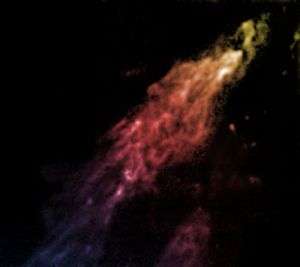
GBT image of Smith's Cloud, which is headed toward a collision with the Milky Way. Cedit: Bill Saxton, NRAO/AUI/NSF

A giant cloud of hydrogen gas is speeding toward a collision with our Milky Way Galaxy, and when it hits -- in less than 40 million years -- it may set off a spectacular burst of stellar fireworks.

"The leading edge of this cloud is already interacting with gas from our Galaxy," said Felix J. Lockman, of the National Radio Astronomy Observatory (NRAO), leader of a team of astronomers who used the National Science Foundation's Robert C. Byrd Green Bank Telescope (GBT) to study the object. The scientists presented their findings to the American Astronomical Society's meeting in Austin, Texas.

The cloud, called Smith's Cloud, after the astronomer who discovered it in 1963, contains enough hydrogen to make a million stars like the Sun. Eleven thousand light-years long and 2,500 light-years wide, it is only 8,000 light-years from our Galaxy's disk. It is careening toward our Galaxy at more than 150 miles per second, aimed to strike the Milky Way's disk at an angle of about 45 degrees.

"This is most likely a gas cloud left over from the formation of the Milky Way or gas stripped from a neighbor galaxy. When it hits, it could set off a tremendous burst of star formation. Many of those stars will be very massive, rushing through their lives quickly and exploding as supernovae. Over a few million years, it'll look like a celestial New Year's celebration, with huge firecrackers going off in that region of the Galaxy," Lockman said.

When Smith's Cloud was first discovered, and for decades after, the available images did not have enough detail to show whether the cloud was part of the Milky Way, something being blown out of the Milky Way, or something falling in.

Lockman and his colleagues used the GBT to make an extremely detailed study of hydrogen in Smith's Cloud. Their observations included nearly 40,000 individual pointings of the giant telescope to cover the cloud with unprecedented sensitivity and resolution. Smith's Cloud is about 15 degrees long in the sky, 30 times the width of the full moon.

"If you could see this cloud with your eyes, it would be a very impressive sight in the night sky," Lockman said. "From tip to tail it would cover almost as much sky as the Orion constellation. But as far as we know it is made entirely of gas -- no one has found a single star in it."

The detailed GBT study dramatically changed the astronomers' understanding of the cloud. Its velocity shows that it is falling into the Milky Way, not leaving it, and the new data show that it is plowing up Milky Way gas before it as it falls.

"Its shape, somewhat similar to that of a comet, indicates that it's already hitting gas in our Galaxy's outskirts," Lockman said. "It is also feeling a tidal force from the gravity of the Milky Way and may be in the process of being torn apart. Our Galaxy will get a rain of gas from this cloud, then in about 20 to 40 million years, the cloud's core will smash into the Milky Way's plane," Lockman explained.

The cloud will likely strike a region somewhat farther from the Galactic center than our Solar System and about 90 degrees ahead of us in the Milky Way disk. The collision may trigger a period of rapid star formation fueled by the new gas and the shock from the collision. Some theories say that the ring of bright stars near the Sun, called Gould's Belt, was created by just such a collision event.

Lockman worked with Robert A. Benjamin and A.J. Heroux of the University of Wisconsin-Whitewater and Glen I. Langston of NRAO.

Source: National Radio Astronomy Observatory

4.7 /5 (45 votes)  

Filter


Move the slider to adjust rank threshold, so that you can hide some of the comments.


Display comments: newest first

Quantum_Conundrum
Jan 11, 2008

Rank: 1.5 / 5 (2)
Its highly unlikely there will be any humans around to be incinerated in the ensuing explosions and gravitational imbalances caused by this collision.
KB6
Jan 12, 2008

Rank: 1.5 / 5 (2)
True: By that time we will either be extinct (by nature or our through our own bungling) or we will have descendants that will be quite differernt from what we think of as "human."
CactusCritter
Jan 13, 2008

Rank: not rated yet
Ho-hum!
TimESimmons
Jan 14, 2008

Rank: 1 / 5 (1)
Another deep space object has a tail. Wonder why.

http:\\www.preston.u-net...ndex.htm
Rank 4.7 /5 (45 votes)
Tags

Relevant PhysicsForums posts
  • Titan's lack of impact craters
    createdFeb 09, 2012
  • Real pictures of black hole eating a star?
    createdFeb 08, 2012
  • Hypothetical way to travel faster than light, but not technically exceed lightspeed
    createdFeb 06, 2012
  • How do scientists monitor the Sun's activity?
    createdFeb 05, 2012
  • Search patterns in observational studies
    createdFeb 05, 2012
  • Derivation of Pogson's law
    createdFeb 03, 2012
  • More from Physics Forums - General Astronomy

More news stories

Could Venus be shifting gear?

(PhysOrg.com) -- ESA’s Venus Express spacecraft has discovered that our cloud-covered neighbour spins a little slower than previously measured. Peering through the dense atmosphere in the infrared, the ...

Space & Earth / Space Exploration

created 4 hours ago | popularity 5 / 5 (5) | comments 7 | with audio podcast

Humans may have helped the decline of African rainforests 3000 years ago

(PhysOrg.com) -- Large areas of rainforests in Central Africa mysteriously disappeared over three thousand years ago, to be replaced by savannas. The prevailing theory has been that the cause was a change ...

Space & Earth / Environment

created 8 hours ago | popularity 5 / 5 (3) | comments 8 | with audio podcast report

Mars Science Laboratory computer issue resolved

(PhysOrg.com) -- Engineers have found the root cause of a computer reset that occurred two months ago on NASA's Mars Science Laboratory and have determined how to correct it.

Space & Earth / Space Exploration

created 5 hours ago | popularity 5 / 5 (5) | comments 3 | with audio podcast

Clam fields found at deep, low-temperature Mariana vents

(PhysOrg.com) -- Scientists have marveled at the unusual life forms thriving at high temperature hydrothermal vents of the deep ocean.

Space & Earth / Earth Sciences

created 5 hours ago | popularity not rated yet | comments 0 | with audio podcast

Two new moons for Jupiter

Advances in technology have lead to the discovery of new planets outside of our Solar System, and now even new moons in our own backyard.

Space & Earth / Space Exploration

created 4 hours ago | popularity not rated yet | comments 2


Putting the squeeze on planets outside our solar system

(PhysOrg.com) -- Using high-powered lasers, scientists at Lawrence Livermore National Laboratory and collaborators discovered that molten magnesium silicate undergoes a phase change in the liquid state, abruptly ...

India probes Google over 'forex transactions'

Indian authorities are probing whether online giant Google broke domestic foreign-exchange transactions rules while shifting funds abroad, the Press Trust of India reported on Friday.

Germany freezes signing of disputed Internet pact

Germany on Friday halted the signing of a controversial international accord billed as a way to beat online piracy that has sparked angry protests, saying it needed more time to consider it.

Health experts, scientists to discuss bird flu studies

The World Health Organization said Friday it will meet next week to determine whether scientists can publish research on a bird flu virus that may be easily passed among humans.

Employers feel no love for unscrupulous practice of 'service sweethearting'

A new study led by two Florida State University marketing professors finds that some frontline service employees who are rewarded for hikes in customer loyalty and satisfaction also may engage in "service ...

Obama forges compromise birth control plan

US President Barack Obama Friday announced a compromise to defuse a row over access to birth control which prompted election-year Republican critics to claim he was waging a war on religion.