Winter Ice on Lakes, Rivers, Ponds: A Thing of the Past?
January 11, 2008 Winter Ice on Lakes, Rivers, Ponds: A Thing of the Past?

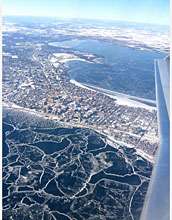
Ice cover on lakes around Madison, Wisc., and throughout the northern U.S. has formed later each winter. Credit: Peter W. Schmitz, Madison, Wisconsin

If you're planning to ice skate on a local lake or river this winter, you may need to think twice, according to scientists John Magnuson, Olaf Jensen and Barbara Benson of the University of Wisconsin at Madison. Their research is funded by the National Science Foundation (NSF).

From sources as diverse as newspaper archives, transportation ledgers and religious observances, the researchers have amassed 150 years of lake and river ice records spanning the Northern Hemisphere. All show a steady trend of fewer days of ice cover.

If the pattern continues, only in Currier and Ives prints will ice skaters twirl across frozen rivers.

The records show that later freezing and earlier ice breakup occurred on lakes and rivers across the Northern Hemisphere from 1846 to 1995. Over those 150 years, said Magnuson, changes in freeze dates averaged 5.8 days per 100 years later, and changes in ice breakup dates averaged 6.5 days per 100 years earlier. The findings translate to increasing air temperatures of about 1.2 degrees Celsius each century.

Now the scientists have looked at more specifically at trends in ice duration in 65 waterbodies across what might be called the last bastion of winter in the U.S.--the Great Lakes region (Minnesota, Wisconsin, Michigan, Ontario and New York)--during a period of rapid climate warming (1975-2004).

Average rates of change in ice freeze and breakup dates were 5.8 and 3.3 times faster, respectively, than historical rates from 1846 to 1995 for the Northern Hemisphere. Average ice duration decreased by 5.3 days per decade.

Over the same time period, average temperatures from fall through spring in this region increased by 0.7 degrees Celsius. The average number of days with snow decreased by 5.0 days per decade, and the average snow depth on those days decreased by 1.7 centimeters per decade.

"The formation and breakup of ice are important seasonal events in mid- to high-latitude lakes and rivers," said Magnuson. "The timing of these events--ice phenology--is sensitive to the characteristics of individual waterbodies and to broader-scale weather patterns and climate variability."

Changes in ice phenology have important consequences for fish and zooplankton communities, said Jensen. Earlier ice breakup has created a temporal mismatch, for example, between the peak spring phytoplankton bloom and the population dynamics of some species of zooplankton. Fewer days of ice cover are also likely to reduce or eliminate winter-kill in shallow eutrophic lakes.

In contrast to the observation that climate changes are occurring more rapidly at higher latitudes, said Benson, the greatest rate of change in ice breakup dates in the Great Lakes region is happening at lower latitudes, near the southern boundary of the area in which lakes are routinely ice-covered during winter.

During the late 1980s and early 1990s, for example, ice breakup occasionally occurred in mid-winter on two lakes in southern Michigan. These lakes previously hadn't seen open water until spring. By the end of the Great Lakes study period, from 1998 through 2002, several southerly lakes did not freeze over.

In lakes from Big Green in Wisconsin to Cranberry in New York, from Minnetonka in Minnesota to Gull in Michigan, winter--at least in the form of ice--is fast melting around the edges.

Source: by Cheryl Dybas, NSF


print this article email this article download pdf blog this article bookmark this article     Stumble it Digg this share on Facebook retweet share on Reddit add to delicious
Rate this story - 3.7 /5 (13 votes)

Rank Filter

Move the slider to adjust rank threshold, so that you can hide some of the comments.


Display comments: newest first

  • NotParker - Jan 12, 2008
    • Rank: 2.3 / 5 (3)
    Most rivers and lakes get warm water from human sewage systems. Its time to shut down the cities so people can skate on ponds.
    -- Al


January 11, 2008 all stories

Comments: 1

3.7 /5 (13 votes)
  • Stumble this up

  • Digg this

  • share this

  • hide
  • Related Stories

  • Scientists prepare for large-scale glacial floods (w/ Video)
    created Nov 04, 2009 | popularity not rated yet | comments 0
  • Alfalfa sprouts hold the line on meandering streams (w/ Video)
    created Oct 05, 2009 | popularity not rated yet | comments 0
  • Shaken and Stirred: Lab Studies Ice From Frigid Worlds
    created Jun 17, 2009 | popularity not rated yet | comments 0
  • Lifestyle melts away with Uganda peak snow cap
    created Jun 15, 2009 | popularity not rated yet | comments 0
  • Not so windy: Research suggests winds dying down
    created Jun 10, 2009 | popularity not rated yet | comments 0


  • hide
  • Relevant PhysicsForums posts

  • cycles
    created Nov 08, 2009
  • The Origin of the term 'fossil' fuels
    created Nov 05, 2009
  • co2
    created Nov 03, 2009
  • Early Earths Sulfidic Ocean Conditions
    created Oct 30, 2009
  • More from Physics Forums - Earth

Other News

L-R: Chiwetel Ejiofor, Amanda Peet and John Cusack at the premiere of "2012"

NASA on crusade to debunk 2012 apocalypse myths

Space & Earth / Space Exploration

created 1hour ago | popularity not rated yet | comments 0

The world is not coming to an end on December 21, 2012, the US space agency insisted Monday in a rare campaign to dispel widespread rumors fueled by the Internet and a new Hollywood movie.


Antarctica glacier retreat creates new carbon dioxide store

Antarctica glacier retreat creates new carbon dioxide store

Space & Earth / Earth Sciences

created 6 hours ago | popularity 4.3 / 5 (3) | comments 0

Large blooms of tiny marine plants called phytoplankton are flourishing in areas of open water left exposed by the recent and rapid melting of ice shelves and glaciers around the Antarctic Peninsula. This ...


NASA satellites make a movie and get rainfall, wind info on Ida

NASA satellites make a movie and get rainfall, wind info on Ida (w/ Video)

Space & Earth / Earth Sciences

created 1hour ago | popularity not rated yet | comments 0

NASA satellites are amazing examples of technology. The TRMM satellite peers into tropical cyclones and can tell how much rain is falling per hour and where. QuikScat uses microwave technology to measure Ida's ...


NASA's GOES Project offers real-time hurricane alley movies

NASA's GOES Project offers real-time hurricane alley movies

Space & Earth / Earth Sciences

created 1hour ago | popularity not rated yet | comments 0

People love to get the big picture of hurricane alleys, and thanks to the GOES Project at NASA's Goddard Space Flight Center in Greenbelt, Md., they can now get real-time satellite animations of the eastern ...


NASA's TRMM Satellite sees most of Ida's heaviest rain stayed off coasts

NASA's TRMM Satellite sees most of Ida's heaviest rain stayed off coasts

Space & Earth / Earth Sciences

created 2 hours ago | popularity not rated yet | comments 0

NASA and the Japanese Space Agency's Tropical Rainfall Measuring Mission (TRMM) satellite flew over Ida and captured her rainfall when she passed by Nicaragua, Honduras and Belize this weekend. TRMM data revealed ...