MESSENGER set for historic Mercury flyby
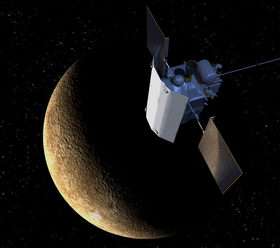
NASA will return to Mercury for the first time in almost 33 years on Monday, Jan. 14, 2008, when the MESSENGER spacecraft makes its first flyby of the Sun’s closest neighbor, capturing images of large portions of the planet never before seen.
The probe will make its closest approach to Mercury at 2:04 p.m. EST that day, skimming 200 kilometers (124 miles) above its surface. This encounter will provide a critical gravity assist needed to keep the spacecraft on track for its 2011 orbit insertion around Mercury.
“The MESSENGER Science Team is extremely excited about this flyby,” says Dr. Sean C. Solomon, MESSENGER principal investigator, from the Carnegie Institution of Washington. “ We are about to enjoy our first close-up view of Mercury in more than three decades, and a successful gravity assist will ensure that MESSENGER remains on the trajectory needed to place it into orbit around the innermost planet for the first time.”
During the flyby, the probe’s instruments will make the first up-close measurements of the planet since Mariner 10’s third and final flyby of Mercury on March 16, 1975, and will gather data essential to planning the MESSENGER mission’s orbital phase. MESSENGER’s seven scientific instruments will begin to address the mission goals of:
-- mapping the elemental and mineralogical composition of Mercury’s surface;
-- imaging globally the surface at a resolution of hundreds of meters or better;
-- determining the structure of the planet’s magnetic field;
-- measuring the planet’s gravitational field structure; and
-- characterizing exospheric neutral particles and magnetospheric ions and electrons.
A Close-up of Mercury
The cameras onboard MESSENGER will take more than 1,200 images of Mercury from approach through encounter and departure. “When the Mariner 10 spacecraft did its flybys in the mid-1970s, it saw only one hemisphere – a little less than half the planet,” notes Dr. L. M. Prockter, instrument scientist for the Mercury Dual Imaging System, and a scientist at the Johns Hopkins University Applied Physics Laboratory (APL) in Laurel, Md. “During this flyby we will begin to image the hemisphere that has never been seen by a spacecraft and at resolutions that are comparable to or better than those acquired by Mariner 10 and in a number of different color filters so that we can start to get an idea of the composition of the surface.”
One site of great interest is the Caloris basin, an impact feature about 1,300 kilometers (808 miles) in diameter and one of the largest impact basins in the solar system. “Caloris is huge, about a quarter of the diameter of Mercury, with rings of mountains within it that are up to 3 kilometers high,” says Prockter. “Mariner 10 saw a little less than half of it. During this first flyby, we will image the other side of Caloris. These impact basins act like giant natural drills, pulling up material from underneath the surface and spreading it out around the crater. By looking through different color filters, we can start to understand what the composition of the Caloris basin may be and learn something about the subsurface of Mercury.”
MESSENGER instruments will provide the first spacecraft measurements of the mineralogical and chemical composition of Mercury’s surface. The visible-near infrared and ultraviolet-visible spectrometers will measure surface reflectance spectra that will reveal important mineral species. Gamma-ray, X-ray, and neutron spectrometer measurements will provide insight into elemental composition.
During the flyby, Doppler measurements will provide the first glimpse of Mercury’s gravity field structure since Mariner 10. The long-wavelength components of the gravity field will yield key information on the planet’s internal structure, particularly the size of Mercury’s core.
The encounter provides an opportunity to examine Mercury’s environment in ways not possible from orbit because of operational constraints. The flyby will yield low-altitude measurements of Mercury’s magnetic field near the planet’s equator. These observations will complement measurements that will be obtained during the later orbital phase.
The flyby is an opportunity to get a jump start on mapping the exosphere with ultraviolet observations and documenting the energetic particle and plasma population of Mercury’s magnetosphere. In addition, the flyby trajectory enables measurements of the particle and plasma characteristics of Mercury’s magnetotail, which will not be possible from Mercury orbit.
MESSENGER is slightly more than halfway through a 4.9-billion mile (7.9-billion kilometer) journey to Mercury orbit that includes more than 15 trips around the Sun. It has already flown past Earth once (August 2, 2005) and Venus twice (October 24, 2006, and June 5, 2007). Three passes of Mercury, in January 2008, October 2008, and September 2009, will use the pull of the planet’s gravity to guide MESSENGER progressively closer to Mercury’s orbit, so that orbit insertion can be accomplished at the fourth Mercury encounter in March 2011.
“The complexity of this mission, with its numerous flybys and multitude of maneuvers, requires close and constant attention,” says MESSENGER project manager P. D. Bedini, of APL. “MESSENGER is being driven by a team of extremely talented and dedicated engineers and scientists who are fully engaged and excited by the discoveries before them.”
The MESSENGER project is the seventh in NASA’s Discovery Program of low-cost, scientifically focused space missions. Solomon leads the mission as principal investigator; APL manages the mission for NASA’s Science Mission Directorate and designed, built, and operates the MESSENGER spacecraft. MESSENGER’s science instruments were built by APL; NASA Goddard Space Flight Center, Greenbelt, Md.; University of Michigan, Ann Arbor; and the Laboratory for Atmospheric and Space Physics at the University of Colorado, Boulder; with the support of subcontractors across the United States and Europe. GenCorp Aerojet, Sacramento, Calif., and Composite Optics Inc., San Diego, Calif., respectively, provided MESSENGER’s propulsion system and composite structure.
Source: Johns Hopkins University


