'Executive' Monkeys Influenced By Other Executives, Not Subordinates
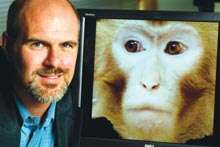
When high-ranking monkeys are shown images of other monkeys glancing one way or the other, they more readily follow the gaze of other high-ranking monkeys, Duke University Medical Center neurobiologists have discovered. By contrast, they tend to ignore glance cues from low-status monkeys; while low-status monkeys assiduously follow the gaze of all other monkeys.
The discovery represents more than a confirmation of what most people believe about their bosses, said the researchers. The findings reveal that gaze-following is more than a reflex action; that it also involves lightning-fast social perception.
Such a discovery in monkeys gives the researchers an invaluable animal model that enables them to tease apart the reflexive-versus-social mechanisms that govern behavior, they said.
In particular, they can begin to understand the physiology and neural machinery of status, they said. Further animal studies will enable them to use drugs and genetic analysis to figure out what hormonal and/or genetic influences determine who becomes the monkey or human equivalent of Donald Trump, and who becomes a Woody Allen.
The researchers -- graduate student Stephen Shepherd, postdoctoral fellow Robert Deaner and Assistant Professor of Neurobiology Michael Platt -- published their findings in the Feb. 21, 2006, issue of Current Biology. The research was supported by the Cure Autism Now Foundation and the National Institute of Mental Health.
"By and large, most studies of gaze-following in humans supported the idea that it was a reflexive attention mechanism," said Platt. "People in those studies would tend to shift their attention where they saw another person looking, even if it wasn't predictive of some event happening around them. And people didn't seem able to inhibit or control their reaction." However, he said, there were hints that gaze-following didn't have all the features of a purely reflexive action, but these were only hints.
Such hints -- as well as previous studies in the Platt laboratory -- led Shepherd and Platt to explore whether social stimuli might also play a role in such decisions. Those previous studies showed both that monkeys will follow the gaze of other monkeys and that they will forego a juice reward to look at high-status monkeys.
Said Shepherd, "It seemed reasonable to me that in the natural environment monkeys would preferentially follow some individuals’ gaze and not others. High-status monkeys, for example, do more to determine where the group is going to go. So there’s more information to be gleaned by finding out where high-status individuals are looking. Also, it’s fairly important, if you’re a low-ranking macaque, not to compete with a high-ranking individual, so you want to know where they're paying attention."
In the experiments, Shepherd showed macaque monkeys images of monkeys known to be of higher or lower status than themselves. The images depicted the monkeys looking left or right. Immediately after each image, a target was flashed onto the screen, randomly in the direction the monkey image was looking or in the opposite direction. The monkeys were given juice rewards for their participation in each trial.
After a large number of trials, the researchers statistically analyzed whether status played a role in the monkeys' tendency to follow the gaze on the screen. They found that the high-status monkeys were significantly more likely to follow the gaze of other high-status monkeys than low-status monkeys; while the low-status monkeys tended to follow the gaze of all the other monkeys.
However, noted, Shepherd and Platt, it was entirely possible that low-ranking monkeys might be too anxious at seeing images of high-ranking images, and would avoid eye contract altogether.
"But our results were pretty striking," said Shepherd. "Low-ranking macaques are extremely fast to follow gaze, while the high-ranking monkeys were pretty blasé about it, being slower to respond."
Said Platt, "So, now we have an excellent model of how temperament or status can modulate the strength of these two seemingly independent attention systems -- cognitive and reflexive -- in the brain. We can begin to trace the neural pathways by which social information feeds into the structures that control the eyes. And, we can explore whether such influences as hormonal levels, particularly testosterone, influence ranking. For example, we can manipulate testosterone levels, or give anxiety-reducing drugs, to determine an effect on social status, using gaze-following as a measure."
The neurobiologists' basic studies could also have application to understanding the origins of autism, said Platt. One theory, for example, holds that high levels of testosterone in utero cause "hypermasculinization" of the brain, which suppresses the reflexive ability to orient socially -- a characteristic of autism, he noted. Also, he said, such studies could aid understanding a wide range of disorders such as social anxiety.
More broadly, said Shepherd, such studies in monkeys will enable greater insight into the basic machinery of social interaction.
"Thanks to a combination of molecular and behavioral studies, we're starting to be able to investigate the neural machinery that allows humans to empathize, to form strong social bonds, to do things like share food and to cooperate," he said. "Besides suggesting ways of diagnosing or assisting people with autism and other disorders, such studies are also a means of understanding what enables us to be social."
Source: Duke University


