Unusual fish-eating dinosaur had crocodile-like skull
January 14, 2008
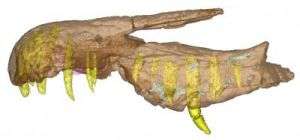
This image shows the results of the CT scan reconstruction. The Baryonyx snout bone is transparent brown. This shows us that the teeth (yellow) had extremely deep roots and that Baryonyx had independently evolved a bony palate (the pink structure), also seen in crocodilians -- another feature that makes this dinosaur even more 'crocodile-like'. Credit: Emily Rayfield
An unusual dinosaur has been shown to have a skull that functioned like a fish-eating crocodile, despite looking like a dinosaur. It also possessed two huge hand claws, perhaps used as grappling hooks to lift fish from the water.
Dr Emily Rayfield at the University of Bristol, UK, used computer modelling techniques – more commonly used to discover how a car bonnet buckles during a crash – to show that while Baryonyx was eating, its skull bent and stretched in the same way as the skull of the Indian fish-eating gharial – a crocodile with long, narrow jaws.
Dr Rayfield said: “On excavation, partially digested fish scales and teeth, and a dinosaur bone were found in the stomach region of the animal, demonstrating that at least some of the time this dinosaur ate fish. Moreover, it had a very unusual skull that looked part-dinosaur and part-crocodile, so we wanted to establish which it was more similar to, structurally and functionally – a dinosaur or a crocodile.
“We used an engineering technique called finite element analysis that reconstructs stress and strain in a structure when loaded. The Baryonyx skull bones were CT-scanned by a colleague at Ohio University, USA, and digitally reconstructed so we could view the internal anatomy of the skull. We then analysed digital models of the snouts of a Baryonyx, a theropod dinosaur, an alligator, and a fish-eating gharial, to see how each snout stressed during feeding. We then compared them to each other.”
The results showed that the eating behaviour of Baryonyx was markedly different from that of a typical meat-eating theropod dinosaur or an alligator, and most similar to the fish-eating gharial. Since the bulk of the gharial diet consists of fish, Rayfield’s study suggests that this was also the case for Baryonyx back in the Cretaceous.
Dr Angela Milner from the Natural History Museum, who first described the dinosaur and is co-author on the paper, said: “I thought originally it might be a fish-eater and Emily’s analysis, which was done at the Natural History Museum, has demonstrated that to be the case.
“The CT-data revealed that although Baryonyx and the gharial have independently evolved to feed in a similar manner, through quirks of their evolutionary history their skulls are shaped in a slightly different way in order to achieve the same function. This shows us that in some cases there is more than one evolutionary solution to the same problem.”
The unusual skull of Baryonyx is very elongate, with a curved or sinuous jaw margin as seen in large crocodiles and alligators. It also had stout conical teeth, rather than the blade-like serrated ones in meat-eating dinosaurs, and a striking bulbous jaw tip (or ‘nose’) that bore a rosette of teeth, more commonly seen today in slender-jawed fish eating crocodilians such as the Indian fish-eating gharial.
The dinosaur in question, Baryonyx walkeri, was discovered near Dorking in Surrey, UK in 1983 by an amateur collector, William Walker, and named after him in 1986 by Alan Charig and Angela Milner. It is an early Cretaceous dinosaur, around 125 million years old, and belongs to a family called spinosaurs.
Source: University of Bristol
-
The Ichthyosaurs survived longer than was thought
Jan 05, 2012 |
4.7 / 5 (6) |
3
-
Rebuilding the head of an armoured dinosaur (w/ video)
Sep 29, 2011 |
5 / 5 (4) |
2
-
Newborn dinosaur discovered in Maryland
Sep 14, 2011 |
5 / 5 (5) |
0
-
'Pregnant plesiosaur' examined
Aug 11, 2011 |
5 / 5 (7) |
0
-
New duck-billed dinosaur gives scientists clues to evolution of head ornamentation and provinciality
Jul 20, 2011 |
3.6 / 5 (5) |
1
-
Engineers build first sub-10-nm carbon nanotube transistor
Feb 01, 2012 |
4.9 / 5 (33) |
30
-
Something old, something new: Evolution and the structural divergence of duplicate genes
Jan 31, 2012 |
4.6 / 5 (7) |
1
-
The hidden nanoworld of ice crystals: Revealing the dynamic behavior of quasi-liquid layers
Jan 30, 2012 |
5 / 5 (4) |
1
-
Stock market network reveals investor clustering
Jan 27, 2012 |
3.9 / 5 (23) |
8
-
Of microchemistry and molecules: Electronic microfluidic device synthesizes biocompatible probes
Jan 26, 2012 |
5 / 5 (2) |
0
-
Factors affecting beet root cell membrane
7 hours ago
-
Stem cell question.
Feb 10, 2012
-
Protease cleavage
Feb 10, 2012
-
Pertubance in a model
Feb 10, 2012
-
Cancer drugs and Alzheimer's, Oh my!
Feb 09, 2012
-
Squishing cells
Feb 09, 2012
- More from Physics Forums - Biology
More news stories
A frank discussion of the power law and linking correlation to causation
(PhysOrg.com) -- Michael Stumpf a mathematics professor at Imperial College in London, and Mason Porter a lecturer at Oxford have teamed together to write and publish a perspective piece in Science regarding the in ...
Employers feel no love for unscrupulous practice of 'service sweethearting'
A new study led by two Florida State University marketing professors finds that some frontline service employees who are rewarded for hikes in customer loyalty and satisfaction also may engage in "service ...
Other Sciences / Economics & Business
Feb 10, 2012 |
3.3 / 5 (3) |
10
US workers are 'giving away the store,' costing firms billions
Nearly 70 percent of the nation's service employees give away free goods and services from hamburgers to cable TV costing companies billions of dollars a year, according to a groundbreaking study.
Other Sciences / Economics & Business
Feb 09, 2012 |
3.5 / 5 (4) |
10
New insights into how to correct false knowledge
The abundance of false information available on the Internet, in movies and on TV has created a big challenge for educators.
Other Sciences / Social Sciences
Feb 07, 2012 |
4.9 / 5 (7) |
9
|
Neanderthal demise due to many influences, including cultural changes: study
As an ice age crept upon them thousands of years ago, Neanderthals and modern human ancestors expanded their territory ranges across Asia and Europe to adapt to the changing environment.
Other Sciences / Archaeology & Fossils
Feb 07, 2012 |
4.4 / 5 (5) |
8
|
Scientists discover molecular secrets of 2,000-year-old Chinese herbal remedy
For roughly two thousand years, Chinese herbalists have treated Malaria using a root extract, commonly known as Chang Shan, from a type of hydrangea that grows in Tibet and Nepal. More recent studies suggest that halofuginone, ...
New method to examine batteries -- MRI from the inside
There is an ever-increasing need for advanced batteries for portable electronics, such as phones, cameras, and music players, but also to power electric vehicles and to facilitate the distribution and storage of energy derived ...
Google might launch Drive for cloud storage soon
(PhysOrg.com) -- Google's next big move, according to the Wall Street Journal, is a cloud storage service called Drive. Hardly first to the plate, Google is simply catching up to introducing its cloud reposi ...
Lab study raises questions over nano-particle impact
Tests involving chickens have raised questions about the impact on health from engineered nano-particles, the ultra-fine grains commonly used in drugs and processed foods, scientists said on Sunday.
A mitosis mystery solved: How chromosomes align perfectly in a dividing cell
Although the process of mitotic cell division has been studied intensely for more than 50 years, Whitehead Institute researchers have only now solved the mystery of how cells correctly align their chromosomes during symmetric ...
Starve a virus, feed a cure? Findings show how some cells protect themselves against HIV
A protein that protects some of our immune cells from the most common and virulent form of HIV works by starving the virus of the molecular building blocks that it needs to replicate, according to research published online ...
Jan 14, 2008
Rank: 5 / 5 (2)