First images of flowing nano ripples
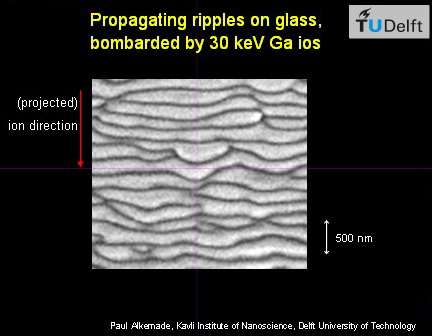
Delft University of Technology (Holland) researchers have shed new light on the formation of nanoscale surface features, such as nano ripples. These features are important because they could be useful as templates for growing other nanostructures.
The scientific journal Physical Review Letters published an article this week on the research in Delft.
Some remarkable geometrical features may appear for instance on a glass surface when it is bombarded with ions, such as triangular patterns and ripples. Scientists study nano ripples and other geometrical features created by bombarding a surface with a beam of ions because of their potential as a template for growing other specific nanostructures. If they want to exploit this potential, they will first need a thorough understanding of the creation and evolution of geometrical features of this kind.
A scientific explanation of the ripples was given fifteen years ago. It was already known that surfaces wear quickly when they are bombarded. The erosion is stronger in the valleys of the ripples than in other places, so the valleys get deeper as time passes.
But the nano ripples do not continue to grow indefinitely. The bombardment liquefies the upper layer of the material, so that it flows from the peaks into the valleys.
No one has ever seen this actual flow until now, only the final result: the partly-filled ripple patterns. Dr Paul Alkemade, a researcher at the Kavli Institute of Nanoscience of Delft University of Technology became the first person to watch this flow using an electron microscope incorporating an ion beam.
After observing the process, Dr Alkemade also realised that the theory of the formation of nano ripples needed revision. It was commonly thought that the ripples moved against the obliquely incident ion beam, but now we know that the waves flow in the same direction as the incoming ions.
At first glance, the observation seems to make sense: the situation resembles waves on water that are propelled by the wind. The comparison does not stand up to scrutiny, though, because the force of the incoming ions is minute relative to the surface tension in the glass.
Alkemade said: "My explanation is that the slopes that are oriented towards the incoming ion beam absorb more energy than those in the shadow. Pressure then builds up in the first type of slope causing material to flow away over the peak or through the valley to the opposite slope. In the end, the ripple pattern moves slightly in the direction of the incident beam."
Source: Delft University of Technology


