Edible 'antifreeze' prevents unwanted ice crystals in ice cream and frozen foods
January 14, 2008 Edible 'antifreeze' prevents unwanted ice crystals in ice cream and frozen foods

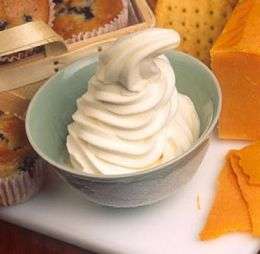
Researchers have developed an edible "antifreeze" that shows promise for preventing the formation of ice crystals in ice cream. Credit: Courtesy of USDA-ARS, Keith Weller

A scientist in Wisconsin reports development of an edible and tasteless “antifreeze” that prevents the formation of ice crystals that can spoil the smooth, silky texture of ice cream and interfere with the palatability of other frozen foods. The study is scheduled for the Jan. 9 issue of ACS’ Journal of Agricultural and Food Chemistry, a bi-weekly publication.

In the new report, Srinivasan Damodaran explains that preventing the formation of large ice crystals is a major challenge for frozen food manufacturers and consumers who store packages in home freezers. Although several different substances have been added to frozen foods to prevent ice crystal growth, none is really effective, the researcher says.

Damodaran’s solution is gelatin hydrolysate, a protein known to act as a natural antifreeze. In a controlled study using batches of ice cream prepared with and without the non-toxic compound, ice cream containing the antifreeze developed significantly smaller and fewer ice crystals than batches prepared without the compound, the researcher says.

Source: ACS


print this article email this article download pdf blog this article bookmark this article     Stumble it Digg this share on Facebook retweet share on Reddit add to delicious
Rate this story - 3.5 /5 (10 votes)


January 14, 2008 all stories

Comments: 0

3.5 /5 (10 votes)
  • Stumble this up

  • Digg this

  • share this

  • hide
  • Related Stories

  • Freezing: a phenomenon that 'jumps'
    created Nov 16, 2009 | popularity not rated yet | comments 0
  • Climate trouble may be bubbling up in far north
    created Aug 30, 2009 | popularity not rated yet | comments 0
  • Shaken and Stirred: Lab Studies Ice From Frigid Worlds
    created Jun 17, 2009 | popularity not rated yet | comments 0
  • A tiny frozen microbe may hold clues to extraterrestrial life
    created Jun 15, 2009 | popularity not rated yet | comments 0
  • Cousin of the 'ice that burns' emerges as greener new way to fight fires
    created Apr 23, 2009 | popularity not rated yet | comments 0


Other News

Sandia CR5

Machine Converts CO2 into Gasoline, Diesel, and Jet Fuel

Chemistry / Biochemistry

created 6 hours ago | popularity 4.2 / 5 (6) | comments 7

(PhysOrg.com) -- Researchers at Sandia National Laboratories have built a machine that uses the sun's energy to convert carbon dioxide waste from power plants into transportation fuels such as gasoline, diesel, ...


Rescuing male turkey chicks

Chemistry / Biochemistry

created 2 hours ago | popularity not rated yet | comments 0

A novel approach to classify the gender of six-week-old turkey poults could save millions of male chicks from being killed shortly after birth, according to Dr. Gerald Steiner from the Dresden University of Technology in ...


New hydrogen-storage method discovered

New hydrogen-storage method discovered

Chemistry / Materials Science

created Nov 22, 2009 | popularity 4.4 / 5 (37) | comments 11

Scientists at the Carnegie Institution have found for the first time that high pressure can be used to make a unique hydrogen-storage material. The discovery paves the way for an entirely new way to approach ...


Accidental discovery produces durable new blue pigment for multiple applications

Accidental discovery produces durable new blue pigment for multiple applications

Chemistry / Biochemistry

created Nov 16, 2009 | popularity 4.5 / 5 (32) | comments 6

An accidental discovery in a laboratory at Oregon State University has apparently solved a quest that over thousands of years has absorbed the energies of ancient Egyptians, the Han dynasty in China, Mayan ...


One word: bioplastics

One word: bioplastics

Chemistry / Materials Science

created Nov 17, 2009 | popularity 4.6 / 5 (13) | comments 4

(PhysOrg.com) -- Every year, more than 250 billion pounds of plastic are produced worldwide. Much of it ends up in the world's oceans, a fact that troubles MIT biology professor Anthony Sinskey.