Solving the mystery of the metallic sheen of fish
January 14, 2008 Solving the mystery of the metallic sheen of fish

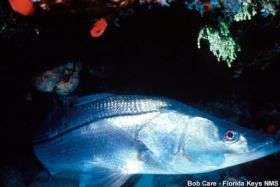
The bright, metallic sheen of fish skin is due to a sophisticated system of crystals, Israeli scientists report. Courtesy of Florida Keys NMS; Photo by Bob Care

The bright, metallic sheen of fish skin — source of endless fascination for fishermen and aquarium owners — is due to a sophisticated system of crystals that enhance light reflection and may help fish hide from predators in the wild, scientists in Israel are reporting. Their study is scheduled for the current issue of ACS’ Crystal Growth & Design.

In the new study, Lia Addadi and colleagues note that researchers have known for years that guanine crystals in the skin underneath the scales of fish reflect light to produce a mirror-like sheen.

This silvery reflectance acts as a form of camouflage that helps protect fish from predators as fish swim near the water’s surface. However, the exact shape of these guanine crystals and how they work remained a mystery.

The researchers extracted guanine crystals from the skin of the Japanese Koi fish and analyzed the crystals using X-ray diffraction and an electron microscope. They compared the results to guanine crystals made in the laboratory.

The researchers found that the biogenic crystals develop in an unexpected direction that differs from the lab-made crystals and that their unique shape improves light reflectivity. The arrangement represents a “strategy evolved by fish to produce more efficient photonic crystals,” the article states.

Source: ACS


print this article email this article download pdf blog this article bookmark this article     Stumble it Digg this share on Facebook retweet share on Reddit add to delicious
Rate this story - 4.1 /5 (15 votes)

Rank Filter

Move the slider to adjust rank threshold, so that you can hide some of the comments.


Display comments: newest first

  • 290163 - Aug 06, 2009
    • Rank: not rated yet
    I can't think of a better way for a fish to hide from predators than to be more shiny and visible, can you? Perhaps fish, which, until the advent of chips, were extremely abundant, were designed to be more visible and easier to catch. Has anybody thought of that?

January 14, 2008 all stories

Comments: 1

4.1 /5 (15 votes)
  • Stumble this up

  • Digg this

  • share this

  • hide
  • Related Stories

  • Spookfish uses mirrors for eyes
    created Jan 07, 2009 | popularity not rated yet | comments 0
  • New Book Uses Physical Reasoning to Solve Mathematical Problems
    created Apr 22, 2009 | popularity not rated yet | comments 0
  • Chameleon-like camouflage: 'Nano-camo' for fashionistas and environmentalists
    created Apr 17, 2009 | popularity not rated yet | comments 0
  • Scientists Find First Creature With Eyes That Use Both Refractive and Reflective Optics
    created Jan 27, 2009 | popularity not rated yet | comments 0
  • A crystal clear view of chalk formation
    created Jan 23, 2009 | popularity not rated yet | comments 0


Other News

H1N1 Virus Can Be Killed by Acidic Ozone Water

H1N1 Virus Can Be Killed by Acidic Ozone Water

Chemistry / Biochemistry

created 10 hours ago | popularity 5 / 5 (11) | comments 7

(PhysOrg.com) -- Scientists have found that acidic ozone water can deactivate H1N1 viruses very effectively, offering a promising disinfectant for the millions of people trying to avoid the disease. Acidic ...


New imagining technique could lead to better antibiotics and cancer drugs

Chemistry / Biochemistry

created 3 hours ago | popularity 5 / 5 (1) | comments 0

A recently devised method of imaging the chemical communication and warfare between microorganisms could lead to new antibiotics, antifungal, antiviral and anti-cancer drugs, said a Texas AgriLife Research scientist.


Wet ethanol production process yields more ethanol and more co-products

Chemistry / Biochemistry

created 9 hours ago | popularity 1 / 5 (1) | comments 1

Using a wet ethanol production method that begins by soaking corn kernels rather than grinding them, results in more gallons of ethanol and more usable co-products, giving ethanol producers a bigger bang for their buck - ...


Look ma, no mercury in fillings!

Chemistry / Materials Science

created 9 hours ago | popularity 5 / 5 (1) | comments 0

Tooth enamel is hardest material in the human body because it's made almost entirely of minerals. As tough as it may be, however, enamel can be broken down by bacteria, forming cavities and eventually destroying the tooth. ...


Ice cream researchers making sweet strides with 'functional foods'

Ice cream researchers making sweet strides with 'functional foods' (w/ Video)

Chemistry / Other

created 3 hours ago | popularity not rated yet | comments 0

A comfort food, a tasty treat, an indulgence - ice cream conjures feelings of happiness and satisfaction for millions. Ice cream researchers at the University of Missouri have discovered ways to make ice cream ...