First Results from DESY's New Free-Electron Laser
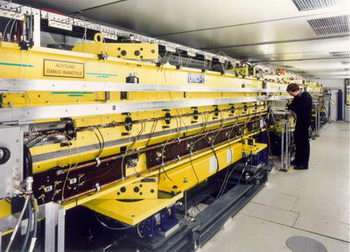
The first measuring period for external users at the new X-ray radiation source VUV-FEL at DESY in Hamburg (Germany) has been successfully concluded. Since its official startup in August 2005, a total of 14 research teams from ten countries have carried out first experiments using the facility’s intense laser beam.
“Both the external researchers and the DESY team gained most valuable experience with the new machine,” DESY research director Professor Jochen Schneider comments. “As a worldwide unique pioneering facility for free-electron lasers for the generation of X-ray radiation, the VUV-FEL for example offers completely new possibilities to trace various processes on extremely short time scales. The currently made first studies verify that these X-ray sources of the future will open another fascinating window for research.”
The free-electron laser VUV-FEL is the worldwide first and until 2009 the only source of intense laser radiation in the ultraviolet and the soft X-ray range. The 300-meter-long facility at DESY generated laser flashes with a wavelength of 32 nanometers for the first time in January 2005 – this is the shortest wavelength ever achieved with a free-electron laser. Since its official startup as a user facility in August 2005, the VUV-FEL has been at the disposal of research groups from all over the world for experiments in areas such as cluster physics, solid state physics, plasma research and biology. Four experimental stations are currently available, at which different instruments can be operated alternately.
“The VUV-FEL is an absolute novelty: for the first time, experiments with intense, pulsed laser radiation can now be carried out at these short wavelengths,” explains DESY physicist Josef Feldhaus, who is in charge of the coordination of the experiments at the VUV-FEL. “The researchers are thus venturing into completely uncharted terrain, of which nobody has any experience yet.” Most groups therefore came to Hamburg with newly constructed instruments that were specially designed to fit the unique properties of the VUV-FEL radiation. With great success: “Despite the complexity of the new experimental equipment and the teething troubles of a completely new radiation source that is not yet running stably on a routine basis, most of the groups were very satisfied. They went home with discs full of data, which they are now evaluating in detail.”
The experiments carried out during this first measuring period ranged from the generation and measurement of plasmas to studies of gases and clusters and to the first investigations of experimental methods for complex biomolecules, which will later be used at the European X-ray laser XFEL. As expected, the light flashes of the VUV-FEL are shorter than 50 femtoseconds (thousand million millionths of a second). This allowed several groups to trace various processes on extremely short time scales by taking time-resolved “snapshots” of the reaction process. The investigation of such time resolved processes with radiation of short wavelengths is one of the most important new applications that will be possible in the future with this kind of X-ray lasers.
Until user experiments resume in May 2006, the DESY team will now carry out machine studies to further improve the stability of the facility, increase the energy of the light pulses and further shorten the wavelength of the radiation to around 15 nanometers. During this time, various studies will also be done to prepare for the planned 3.4-kilometer-long European X-ray laser XFEL, which will generate even shorter wavelengths down to 0.085 nanometers and take up operation in Hamburg in 2013, as well as for the International Linear Collider ILC for particle physics. The shortest wavelength of 6 nanometers planned for the VUV-FEL will be reached after the installation of an additional accelerator module in 2007.
The free-electron laser VUV-FEL generates short-wavelength, intense laser light flashes according to the SASE principle of “self-amplified spontaneous emission”: in a first step, electrons are brought to high energies by a superconducting linear accelerator. They then race through a periodic arrangement of magnets, the so-called undulator, which forces them to follow a slalom course and thereby radiate flashes of light. Sophisticated beamlines then lead these laser flashes into the experimental hall, where they are distributed among the various measuring stations.
Link: http://www.xfel.net/en/index.html
Source: DESY


