Alaska glacier speed-up tied to internal plumbing issues
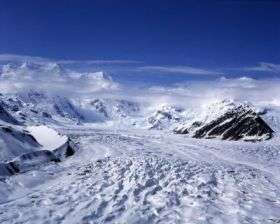
A University of Colorado at Boulder study indicates meltwater periodically overwhelms the interior drainpipes of Alaska's Kennicott Glacier and causes it to lurch forward, similar to processes that may help explain the acceleration of glaciers observed recently on the Greenland ice sheet that are contributing to global sea rise.
According to CU-Boulder Professor Robert Anderson of the Institute of Arctic and Alpine Research, the amount of water passing through conduits inside and underneath the Kennicott Glacier increases during seasonal melting and also following annual flooding from a nearby lake. The addition of excess water from melting and flooding causes water to back up into a honeycomb of passages inside the glacier, he said, suggesting the resulting increase in water pressure causes the glacier to slide more rapidly down its bedrock valley.
"The phenomenon is similar to the plumbing system of a house that is incapable of handling excess water or waste, causing it to back up," said Anderson. "This is a feedback we are still trying to understand and one that has big implications for understanding the dynamics of glaciers and ice sheets, including the behavior of outlet glaciers on the Greenland ice sheet."
A paper on the subject appears in the January edition of the new monthly scientific journal, Nature Geoscience. The study was authored by former CU-Boulder graduate student Timothy Bartholomaus, Robert Anderson, and INSTAAR's Suzanne Anderson. Robert Anderson is a faculty member in the CU-Boulder geological sciences department and Suzanne Anderson is a faculty member the geography department.
The sliding eventually halts when the moving glacier opens up spaces in its bed that can accommodate some of the excess water, helping to relieve the water pressure, the authors said. In addition, high rates of water flow eventually enlarge the conduits and ducts permeating the glacier, "melting them back and allowing more water to bleed from the system, further decreasing the pressure," said Robert Anderson.
The Kennicott Glacier roughly doubled its normal 1-to-2 feet of movement per day during the 2006 sliding episodes tied to water pressure, said Anderson. When the glacier responded to a 2006 "outburst" flood -- when water from Hidden Creek Lake adjacent to the glacier rushed into the sub-glacial tunnel system and released an estimated 10 billion gallons of water under the glacier -- the pace ramped up to nearly 9 feet a day for the duration of the two-day period.
The team used GPS receivers positioned on the glacier as well as pressure gauges, temperature sensors, sonic distance measuring sensors and electrical conductivity probes. The conductivity levels in the water draining out of the glacier rose after backpressure in the glacier dissipated and expelled water high in chloride ions abundant in the salty bedrock beneath the ice, said co-author Suzanne Anderson.
"Nature essentially provided us with an extra probe to determine these sub-glacial processes, and ultimately provided an additional avenue of support for our model of how this system works," said Robert Anderson. The National Science Foundation funded the research.
An awareness of such glacial dynamics is important information for glaciologists studying the Greenland ice sheet, which is undergoing record surface melt and the subsequent drainage of large volumes of water through the ice sheet and associated outlet glaciers, the researchers said. Some of Greenland's outlet glaciers have sped up from 50 percent to 100 percent during the annual melt season and discharged substantially more ice into the seas, according to recent research led by CU-Boulder glaciologist Konrad Steffen.
"There are a number of catastrophic draining events of slush ponds on the Greenland ice sheet that may well promote increased sliding of the ice sheet as this water is jammed into a sub-glacial pipe system that is ill-prepared for such inputs," Robert Anderson said. "This phenomenon is also relevant to small glaciers around the world, because it may help to explain their nonsteady rates of sliding.
"People are becoming increasingly aware that sea-level rise is a very real problem," he said. "As scientists, we need to acknowledge the role of all of the world's ice masses and to understand the physical mechanisms by which they deliver water to the sea."
Source: University of Colorado at Boulder


