MESSENGER flyby of Mercury
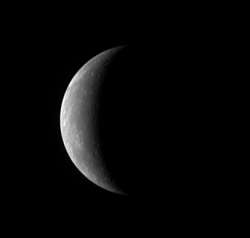
January 15, 2008
MESSENGER flyby of Mercury

Credit: NASA/Johns Hopkins University Applied Physics Laboratory/Carnegie Institution of Washington

At 2:04 p.m. EST on Monday, MESSENGER skimmed 200 kilometers (124 miles) above the surface of Mercury in the first of three flybys of the planet. Initial indications from the radio signals indicate the spacecraft is still operating nominally. The first science data return from the flyby was received today, just minutes before the closest approach point with the planet, as planned.

“The engineers and operators at the Deep Space Network (DSN) in Goldstone, Calif., in conjunction with engineers at the Johns Hopkins University Applied Physics Laboratory (APL) in Laurel, Md., pulled off a tremendous feat, acquiring and locking onto the downlink signal from the spacecraft within seconds, providing the necessary Doppler measurements for the Radio Science team” said MESSENGER Mission Systems Engineer Eric Finnegan of APL.

“The spacecraft is continuing to collect imagery and other scientific measurements from the planet as we now depart Mercury from the illuminated side, documenting for the first time the previously unseen surface of the planet.”

On Tuesday at noon EST, the spacecraft will turn back towards the Earth to start down-linking the on-board stored data. Measurements of this Doppler signal from the spacecraft will allow improve knowledge of Mercury’s gravity field.

Keeping a Rendezvous with Mercury

Between January 9 and 13, 2008, as the MESSENGER probe approached Mercury for its first flyby, the Narrow Angle Camera, part of the Mercury Dual Imaging System (MDIS), acquired a series of images of the planet in support of spacecraft navigation. These images have been put together as frames in a movie. The final frame of the movie has the highest spatial resolution (20 km/pixel, 12 miles/pixel) and was recorded when the spacecraft was at a distance of about 760,000 kilometers (470,000 miles) from Mercury. Mercury is about 4,880 kilometers (about 3,030 miles) in diameter.

As part of MESSENGER's flyby on January 14, MDIS was to obtain high-resolution image sequences with the Narrow Angle Camera, and the Wide Angle Camera will collect images in eleven colors. The images will cover portions of the planet never before seen by spacecraft, as well as regions that were photographed by Mariner 10 in 1974 and 1975. The new data for the previously studied areas of Mercury will help scientists to interpret the data for the parts of the planet that MESSENGER will reveal for the first time.

Source: Johns Hopkins University

4.2 /5 (6 votes)  

Rank 4.2 /5 (6 votes)
Tags

Related Stories
Relevant PhysicsForums posts
  • Is Venus Slowing Down?
    created11 hours ago
  • Never ending outer space.....
    createdFeb 11, 2012
  • Neutron Star fragments?
    createdFeb 11, 2012
  • stationary or not?
    createdFeb 11, 2012
  • Scale of the Universe
    createdFeb 10, 2012
  • Titan's lack of impact craters
    createdFeb 09, 2012
  • More from Physics Forums - General Astronomy

More news stories

Scientists discover reason for Mt. Hood's non-explosive nature

(PhysOrg.com) -- For a half-million years, Mount Hood has towered over the landscape, but unlike some of its cousins in Oregon’s Cascade Mountains and many other volcanoes around the Pacific “Rim ...

Space & Earth / Earth Sciences

created 41 minutes ago | popularity 5 / 5 (1) | comments 0 | with audio podcast

Time of year important in projections of climate change effects on ecosystems

(PhysOrg.com) -- Does it matter whether long periods of hot weather, such as last year's heat wave that gripped the U.S. Midwest, happen in June or July, August or September?

Space & Earth / Environment

created 13 minutes ago | popularity 5 / 5 (1) | comments 0 | with audio podcast

Missing dark matter located: Intergalactic space is filled with dark matter

Researchers at the University of Tokyo’s Institute for the Physics and Mathematics of the Universe (IPMU) and Nagoya University used large-scale computer simulations and recent observational data of gravitational ...

Space & Earth / Astronomy

created 1 hour ago | popularity 4 / 5 (4) | comments 3 | with audio podcast

Planck mission steps closer to the cosmic blueprint

(PhysOrg.com) -- ESA's Planck mission has revealed that our Galaxy contains previously undiscovered islands of cold gas and a mysterious haze of microwaves. These results give scientists new treasure to mine ...

Space & Earth / Astronomy

created 9 hours ago | popularity 5 / 5 (8) | comments 2 | with audio podcast

Scientists say Obama Mars cuts to hit research (Update)

The United States will scale back Mars exploration under a proposed budget by President Barack Obama released Monday that has some scientists fuming over the risk of a NASA brain-drain.

Space & Earth / Space Exploration

created 7 hours ago | popularity 5 / 5 (3) | comments 23


First-of-its-kind stem cell study re-grows healthy heart muscle in heart attack patients

Results from a Cedars-Sinai Heart Institute clinical trial show that treating heart attack patients with an infusion of their own heart-derived cells helps damaged hearts re-grow healthy muscle.

Discovery paves way for salmonella vaccine

(Medical Xpress) -- An international research team led by a University of California, Davis, immunologist has taken an important step toward an effective vaccine against salmonella, a group of increasingly antibiotic-resistant ...

Smoking bans lead to less, not more, smoking at home: study

Smoking bans in public/workplaces don't drive smokers to light up more at home, suggests a study of four European countries with smoke free legislation, published online in Tobacco Control.

Ovarian cancer arises in fallopian tube of knockout mice

(Medical Xpress) -- The most deadly form of "ovarian" cancer arises in the fallopian tubes – not the ovaries – of knockout mice that lack two genes associated with the disease, said researchers led by Baylor College ...

UK cases of progressive sight loss condition set to rise a third by 2020

New cases of the progressive sight loss condition, known as age-related macular degeneration, or AMD for short, are set to rise by a third in the UK over the next decade, reveals research published online in the British Jo ...

Medical school link to wide variations in pass rate for specialist exam

Wide variations in doctors' pass rates, for a professional exam that is essential for one type of specialty training, seem to be linked to the particular medical school where the student graduated, indicates research published ...