New techniques create butanol -- biofuel superior to ethanol
January 15, 2008 New techniques create butanol

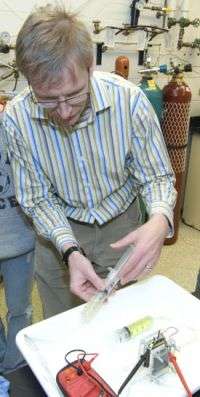
Lars Angenent, WUSTL environmental engineer, in his Urbauer Hall laboratory. Angenent is part of a team using new techniques to produce the biofuel butanol.

A team of researchers headed by an environmental engineer at Washington University in St. Louis is plying new techniques to produce a biofuel superior to ethanol.

The fuel is butanol; it can be derived from lignocellulosic materials, which are plant biomass parts that range from woody stems and straw to agricultural residues, corn fiber and husks, all containing in large part cellulose and some lignin.

Butanol is considered to be a better biofuel than ethanol because it's less corrosive and has a higher caloric value, giving it a higher energy value. Like ethanol, butanol is being considered as an additive to gasoline.

Lars Angenent, Ph.D., assistant professor of energy, environmental and chemical engineering, takes pre-treated corn fiber, a byproduct of corn-to-ethanol production, from his collaborators at the United States Department of Agricultural (USDA) research facility in Peoria, Ill., and places the lignocellulosic biomass into digesters comprised of a selected mixed culture of thousands of different microbes to convert the biomass into butyrate.

From there, the material is sent back to Peoria where another collaborator, Nasib Qureshi. Ph.D., converts the butyrate to butanol using fermenters.

The USDA researchers Bruce Dien, Ph.D., and Michael Cotta, Ph.D. use physical and chemical techniques to make the hard-to-degrade lignocellulosic material more amenable to degrade, an important step that allows Angenent's mixed media culture to work its magic.

He uses a mixed culture containing thousands of different microorganisms and optimizes environmental conditions to select for a bacterial community that makes an environment conducive to the conversion of the corn fiber to butyrate.

Mixed culture magic

"The thrust of my lab is the use of mixed cultures," said Angenent. "The advantage of mixed cultures is that it can take just about any waste material, and through our manipulations, convert it into something valuable. For instance, I can alter the pH in this culture. By keeping it neutral, I can get methane gas, but when I lower the pH, I can get butyrate. If I have a pure culture, on the other hand, I have to worry about other organisms slipping in and altering or contaminating the environment.

"Lignocellulosic biomass is plentiful, renewable and a good way to deal with wastes. By using it, we open the door for better economic opportunities for crop producers and rural communities. And because this kind of biomass is carbon-neutral, we don't worry about carbon dioxide being released into the atmosphere."

Using microbial fuel cells and his mixed media cultures, Angenent, in recent years, has produced electricity or hydrogen in the process of treating wastewater.

He is the principal investigator of a USDA grant for $425,000 for this research, along with his co-P.I.s from USDA.

The butanol bandwagon is growing. In 2006, chemical maker DuPont and the British oil company BP announced a collaboration with British Sugar to introduce butanol made from sugar beets as a gasoline-blending additive in the United Kingdom.

Source: Washington University in St. Louis


print this article email this article download pdf blog this article bookmark this article     Stumble it Digg this share on Facebook retweet share on Reddit add to delicious
Rate this story - 4.3 /5 (39 votes)

Rank Filter

Move the slider to adjust rank threshold, so that you can hide some of the comments.


Display comments: newest first

  • NotParker - Jan 15, 2008
    • Rank: 5 / 5 (1)
    In October 2007, Nobel Laureate Paul Crutzen published findings that the release of Nitrous Oxide (N2O) among the commonly used biofuels, such as biodiesel from rapeseed and bioethanol from corn (maize), can contribute as much or more to global warming than fossil fuel savings do to global cooling.
  • Charlie_O - Jan 15, 2008
    • Rank: not rated yet

    A friend of mine filled up his flex-fuel vehicle with e85 a few weeks ago, because he came across a place that sells it. The price was marginally lower, and the fuel economy was lots lower ... I didn't get exact numbers from him, but he said its not worth it.

    It seems as it e85 will cause as much if not more problems than it solves. And just an FYI the process only yields 25% more energy than what goes in via fertilizers and other fossil fuel products. So its not very efficient. Growing some varieties of grass and using that to make this fuel yields something in the neighborhood of 400% more energy than what is put into it. Plus benefits mentioned in the article itself.

January 15, 2008 all stories

Comments: 2

4.3 /5 (39 votes)
  • Stumble this up

  • Digg this

  • share this

  • hide
  • Related Stories

  • Internet believers: Pastors open online churches
    created Nov 02, 2009 | popularity not rated yet | comments 0
  • Examining genetic variations among the Huichol population of Mexico
    created Oct 26, 2009 | popularity not rated yet | comments 0
  • Classroom behavior: Why it's hard to be good
    created Sep 20, 2009 | popularity not rated yet | comments 0
  • Probing Question: Is football similar to Roman gladiator games?
    created Sep 17, 2009 | popularity not rated yet | comments 0
  • Replacing coal with cattle
    created Sep 16, 2009 | popularity not rated yet | comments 0


Other News

H1N1 Virus Can Be Killed by Acidic Ozone Water

H1N1 Virus Can Be Killed by Acidic Ozone Water

Chemistry / Biochemistry

created Nov 09, 2009 | popularity 4.5 / 5 (34) | comments 14

(PhysOrg.com) -- Scientists have found that acidic ozone water can deactivate H1N1 viruses very effectively, offering a promising disinfectant for the millions of people trying to avoid the disease. Acidic ...


New evidence that dark chocolate helps ease emotional stress

New evidence that dark chocolate helps ease emotional stress

Chemistry / Biochemistry

created Nov 11, 2009 | popularity 5 / 5 (3) | comments 2

The "chocolate cure" for emotional stress is getting new support from a clinical trial published online in ACS' Journal of Proteome Research.


Energy-saving powder

Energy-saving powder: Converting methane to methanol

Chemistry / Other

created Nov 11, 2009 | popularity 3.6 / 5 (5) | comments 2

It is currently estimated that natural gas resources will be exhausted in 130 years; however, those reserves where extraction is cost-effective will only flow for another 60 years or so.


Study reveals why certain drug combinations backfire

Chemistry / Biochemistry

created Nov 13, 2009 | popularity 4.5 / 5 (4) | comments 0

Combination drug therapy has become a staple for treating many infections. For instance, doctors treat extensively drug resistant forms of tuberculosis with one drug that breaks down the pathogen's protective barriers and ...


Vibrations key to efficiency of green fluorescent protein

Vibrations key to efficiency of green fluorescent protein

Chemistry / Biochemistry

created Nov 11, 2009 | popularity 4.8 / 5 (5) | comments 1

University of California, Berkeley, chemists have discovered the secret to the success of a jellyfish protein whose green glow has made it the darling of biologists and the subject of the 2008 Nobel Prize ...