NASA Unveils Cosmic Images Book in Braille for Blind Readers
January 15, 2008 NASA Unveils Cosmic Images Book in Braille for Blind Readers

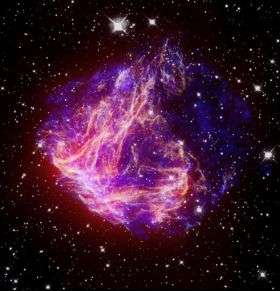
This is a composite image of N49, the brightest supernova remnant in optical light in the Large Magellanic Cloud. Data from Spitzer, Hubble and Chandra contributed to this image. Credit: NASA

At a ceremony held today at the National Federation of the Blind, NASA unveiled a new book that brings majestic images taken by its Great Observatories to the fingertips of the blind. The Great Observatories include NASA's Hubble, Chandra and Spitzer space telescopes.

"Touch the Invisible Sky" is a 60-page book with color images of nebulae, stars, galaxies and some of the telescopes that captured the original pictures. Each image is embossed with lines, bumps and other textures. These raised patterns translate colors, shapes and other intricate details of the cosmic objects, allowing visually impaired people to experience them. Braille and large-print descriptions accompany each of the book's 28 photographs, making the book's design accessible to readers of all visual abilities.

The book contains spectacular images from the Great Observatories and powerful ground-based telescopes. The celestial objects are presented as they appear through visible-light telescopes and different spectral regions invisible to the naked eye, from radio to infrared, visible, ultraviolet and X-ray light.

The book introduces the concept of light and the spectrum and explains how the different observatories complement each others' findings. Readers take a cosmic journey beginning with images of the sun, and travel out into the galaxy to visit relics of exploding and dying stars, as well as the Whirlpool galaxy and colliding Antennae galaxies.

"Touch the Invisible Sky" was written by astronomy educator and accessibility specialist Noreen Grice of You Can Do Astronomy LLC and the Museum of Science, Boston, with authors Simon Steel, an astronomer with the Harvard-Smithsonian Center for Astrophysics in Cambridge, Mass., and Doris Daou, an astronomer at NASA Headquarters, Washington.

"About 10 million visually impaired people live in the United States," Grice said. "I hope this book will be a unique resource for people who are sighted or blind to better understand the part of the universe that is invisible to all of us."

The book will be available to the public through a wide variety of sources, including the National Federation of the Blind, Library of Congress repositories, schools for the blind, libraries, museums, science centers and Ozone Publishing.

"We wanted to show that the beauty and complexity of the universe goes far beyond what we can see with our eyes!" Daou said.

"The study of the universe is a detective story, a cosmic 'CSI,' where clues to the inner workings of the universe are revealed by the amazing technology of modern telescopes," Steel said. "This book invites everyone to join in the quest to unlock the secrets of the cosmos."

"One of the greatest challenges faced by blind students who are interested in scientific study is that certain kinds of information are not available to them in a non-visual form," said Marc Maurer, president of the National Federation of the Blind. "Books like this one are an invaluable resource because they allow the blind access to information that is normally presented through visual observation and media. Given access to this information, blind students can study and compete in scientific fields as well as their sighted peers."

The prototype for this book was funded by an education grant from the Chandra mission, and production was a collaborative effort by the NASA space science missions, which provide the images, and other agency sources.

Source: NASA


print this article email this article download pdf blog this article bookmark this article     Stumble it Digg this share on Facebook retweet share on Reddit add to delicious
Rate this story - 4.4 /5 (5 votes)


January 15, 2008 all stories

Comments: 0

4.4 /5 (5 votes)
  • Stumble this up

  • Digg this

  • share this

  • hide
  • Related Stories

  • Mysterious 1934 Disappearance of Explorer Everett Ruess in Utah Solved
    created Apr 30, 2009 | popularity not rated yet | comments 0
  • Scientists hope to unlock mysteries of proteins
    created Apr 14, 2009 | popularity not rated yet | comments 0
  • Braille converter bridges the information gap
    created May 07, 2008 | popularity not rated yet | comments 0
  • Astrobiologist helps IMAX director film
    created Jan 16, 2005 | popularity not rated yet | comments 0
  • Statistics experts reject global cooling claims
    created Oct 26, 2009 | popularity not rated yet | comments 0


  • hide
  • Relevant PhysicsForums posts

  • The shape of our solar system's orbits.
    created 17 hours ago
  • Above or Below the Line of Nodes
    created 21 hours ago
  • Supernova vs. Nova?
    created Nov 07, 2009
  • Supernova's Gamma Rays and Comets
    created Nov 06, 2009
  • More from Physics Forums - General Astronomy

Other News

Deep creep means milder, more frequent earthquakes along Southern California's San Jacinto fault

Deep creep means milder, more frequent earthquakes along Southern California's San Jacinto fault

Space & Earth / Earth Sciences

created 3 hours ago | popularity 4 / 5 (1) | comments 0

With an average of four mini-earthquakes per day, Southern California's San Jacinto fault constantly adjusts to make it a less likely candidate for a major earthquake than its quiet neighbor to the east, the ...


Success in 'space elevator' competition (AP)

Success in 'space elevator' competition (Update 3)

Space & Earth / Space Exploration

created Nov 05, 2009 | popularity 4.3 / 5 (33) | comments 50

(AP) -- A robot powered by a ground-based laser beam climbed a long cable dangling from a helicopter on Wednesday to qualify for prize money in a $2 million competition to test the potential reality of the ...


'Dropouts' pinpoint earliest galaxies

'Dropouts' pinpoint earliest galaxies

Space & Earth / Astronomy

created Nov 06, 2009 | popularity 4.1 / 5 (9) | comments 12

Astronomers, conducting the broadest survey to date of galaxies from about 800 million years after the Big Bang, have found 22 early galaxies and confirmed the age of one by its characteristic hydrogen signature ...


Space hotel taking bookings for 2012 opening

Space hotel taking bookings for 2012 opening

Space & Earth / Space Exploration

created Nov 05, 2009 | popularity 4.4 / 5 (20) | comments 11

(PhysOrg.com) -- The first orbiting space hotel is on track to open for its first customers in 2012, but hurry, as bookings are filling fast.


In a Galaxy Far, Far Away...

In a Galaxy Far, Far Away...

Space & Earth / Astronomy

created Nov 06, 2009 | popularity 4.8 / 5 (4) | comments 11

(PhysOrg.com) -- Astronomers have published the discovery of the farthest known object in the cosmos: a star that exploded when the universe was only 630 million years old -- only 4.6% of its current age. ...