Penn engineers create carbon nanopipettes that are smaller than cells and measure electric current
January 15, 2008
Penn engineers create carbon nanopipettes that are smaller than cells and measure electric current

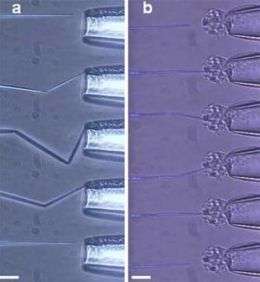
From top to bottom: the carbon pipe tip of the CNP buckles when pushed against the wall of a glass pipette and recovers its initial shape once the force is removed. (b) From top to bottom: a CNP penetrates through the membrane of a smooth muscle cell. The cell is held in place by glass micropipette aspiration. Scale bars, 15 µm. Credit: Reprinted with permission from IOP Publishing

University of Pennsylvania engineers and physicians have developed a carbon nanopipette thousands of times thinner than a human hair that measures electric current and delivers fluids into cells. Researchers developed this tiny carbon-based tool to probe cells with minimal intrusion and inject fluids without damaging or inhibiting cell growth.

Glass micropipettes are found in almost every cell laboratory in the world but are fragile at small scales, can cause irreparable cell damage and cannot be used as injectors and electrodes simultaneously. Haim Bau, a professor in the Department of Mechanical Engineering and Applied Mechanics at Penn, and his team developed tiny carbon-based pipettes that can be mass-produced to eliminate the problems associated with glass micropipettes.

Although they range in size from a few tens to a few hundred nanometers, they are far stronger and more flexible than traditional glass micropipettes. If the tip of a carbon nanopipette, or CNP, is pressed against a surface, the carbon tip bends and flexes, then recovers its initial shape. They are rigid enough to penetrate muscle cells, carcinoma cells and neurons.

Researchers believe the pipettes will be useful for concurrently measuring electrical signals of cells during fluid injection. In addition, the pipettes are transparent to X rays and electrons, making them useful when imaging even at the molecular level. Adding a functionalized protein to the pipette creates a nanoscale biosensor that can detect the presence of proteins.

“Penn’s Micro-Nano Fluidics Laboratory now mass-produces these pipettes and uses them to inject reagents into cells without damaging the cells,” Bau said. "We are ultimately interested in developing nanosurgery tools to monitor cellular processes and control or alter cellular functions. We feel CNPs will help scientists gain a better understanding of how a cell functions and help develop new drugs and therapeutics."

Just as important as the mechanical properties of carbon nanopipettes, however, is the ease of fabrication, said Michael Schrlau, a doctoral candidate and first author of the study, “Carbon Nanopipettes for Cell Probes and Intracellular Injection,” published in the most recent issue of Nanotechnology. “After depositing a carbon film inside quartz micropipettes, we wet-etch away the quartz tip to expose a carbon nanopipe. We can simultaneously produce hundreds of these integrated nanoscale devices without any complex assembly,” he said.

The next challenge for researchers is fully utilizing the new tools in nanosurgery.

"We will need to go beyond the proof-of-concept, development stage into the utilization stage," Schrlau said. "This includes finding the appropriate collaborations across engineering, life science and medical disciplines."

Source: University of Pennsylvania

4.7 /5 (21 votes)  

Rank 4.7 /5 (21 votes)
Tags

Relevant PhysicsForums posts
  • What is the number of significant digits in a integer with trailing 0's ?
    created2 hours ago
  • Forces of Magnets Attraction>Repulsion?
    created2 hours ago
  • Underwater projectile affected by Coriolis Effect
    created2 hours ago
  • Thermodynamics q
    created6 hours ago
  • what is electricity???
    created10 hours ago
  • Can Plasma Be Solid
    created10 hours ago
  • More from Physics Forums - General Physics

More news stories

Lab study raises questions over nano-particle impact

Tests involving chickens have raised questions about the impact on health from engineered nano-particles, the ultra-fine grains commonly used in drugs and processed foods, scientists said on Sunday.

Nanotechnology / Bio & Medicine

created 15 hours ago | popularity 5 / 5 (8) | comments 4

New kind of solar cell could capture significantly more energy than current cells

New solar cells could increase the maximum efficiency of solar panels by over 25%, according to scientists from the University of Cambridge.

Nanotechnology / Nanophysics

created Feb 08, 2012 | popularity 4.5 / 5 (13) | comments 14 | with audio podcast

Nanoshell whispering galleries improve thin solar panels

Visitors to Statuary Hall in the U.S. Capitol Building may have experienced a curious acoustic feature that allows a person to whisper softly at one side of the cavernous, half-domed room and for another on ...

Nanotechnology / Nanomaterials

created Feb 07, 2012 | popularity 4.4 / 5 (7) | comments 6 | with audio podcast

'Dark plasmons' transmit energy

Microscopic channels of gold nanoparticles have the ability to transmit electromagnetic energy that starts as light and propagates via "dark plasmons," according to researchers at Rice University.

Nanotechnology / Nanophysics

created Feb 09, 2012 | popularity 4.8 / 5 (10) | comments 1 | with audio podcast

Revealing how a battery material works

Since its discovery 15 years ago, lithium iron phosphate (LiFePO4) has become one of the most promising materials for rechargeable batteries because of its stability, durability, safety and ability to deliver ...

Nanotechnology / Nanomaterials

created Feb 08, 2012 | popularity 5 / 5 (6) | comments 0 | with audio podcast


Rapunzel, Leonardo and the physics of the ponytail

(PhysOrg.com) -- New research provides the first mathematical understanding of the shape of a ponytail and could have implications for the textile industry, computer animation and personal care products.

Climate change causes harmful algal blooms in North Atlantic: study

Warming oceans and increases in windiness could be causing of an abundance of harmful algal blooms in the North Atlantic Ocean and North Sea, according to new research.

Hacker claims porn site users compromised

A hacker claims to have compromised the personal information of more than 350,000 users after breaking into a disused website operated by pornography provider Brazzers.

Cognitive impairment in older adults often unrecognized in the primary care setting

A new study published in the Journal of the American Geriatrics Society reveals that brief cognitive screenings combined with offering further evaluation increased new diagnoses of cognitive impairment in older veterans two to ...

AT&T customers surprised by 'unlimited data' limit

(AP) -- Mike Trang likes to use his iPhone 4 as a GPS device, helping him get around in his job. Now and then, his younger cousins get ahold of it, and play some YouTube videos and games.

Scientists discover molecular secrets of 2,000-year-old Chinese herbal remedy

For roughly two thousand years, Chinese herbalists have treated Malaria using a root extract, commonly known as Chang Shan, from a type of hydrangea that grows in Tibet and Nepal. More recent studies suggest that halofuginone, ...