Mapping tool allows emergency management personnel to visually track resources
January 16, 2008
Mapping tool allows emergency management personnel to visually track resources

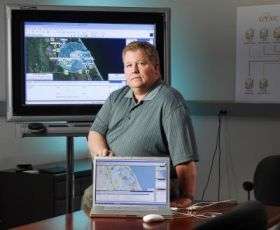
Kirk Pennywitt, a senior research engineer in the Georgia Tech Research Institute, demonstrates GTVC, a mapping tool that allows emergency management personnel to visually track resources such as hospitals and water. Georgia Tech Photo: Gary Meek

Tracking the location and availability of resources such as hospitals, transportation equipment and water during an emergency situation can be life-saving.

A collaborative mapping tool developed by the Georgia Tech Research Institute (GTRI) is helping emergency management officials better coordinate event and incident planning – and real-time response.

GTRI has teamed with Atlanta-based company Emergency Visions to provide mapping capabilities for a resource database the firm developed to identify, activate, track and coordinate response assets. The GTRI and Emergency Visions applications were selected by the Florida Division of Emergency Management in June 2007 as part of a solution that combines these comprehensive technology tools with the training and management expertise of a team led by the International City/County Management Association (ICMA).

“A lot of mapping systems are pretty complex to operate. Our system was deliberately designed to be easy to use for people who are not mapping experts,” said Kirk Pennywitt, a senior research engineer in GTRI’s Information Technology and Telecommunications Laboratory (ITTL).

Researchers began developing the Geographic Tool for Visualization and Collaboration (GTVC) in 2000 for military applications, but it has since been tailored to the needs of the emergency management community and first responders.

GTVC can track chemical or smoke plumes and help management personnel plan evacuation routes for emergencies such as hurricanes, fires or flooding. To do this, the system tracks resources including the locations of hospitals, fire stations, schools, nursing homes, sand bags, dump trucks, water, personnel and supplies in an affected region. The map can also indicate the status of those assets, such as the number of beds available in a specific hospital.

Emergency planners can immediately get a snapshot of what is going on without relying solely on traditional voice communications. The symbols displayed on the map are the Department of Homeland Security’s official emergency management icons.

During an event, electronic feeds can alert users to new incidents and display the location of the events live on the map. Also, GTVC records every user’s actions so that those in command can review them after the event to improve planning for future events.

Pennywitt’s software development team spent two months improving GTVC to provide Florida with new capabilities – including real-time tracking of resources. Researchers also included the ability to:

-- Track mobile assets with the global positioning system (GPS)
-- Manage warehouse resources
-- Display real-time availability of a resource
-- Aggregate multiple resources in the same location with a single icon
-- Simultaneously show location coordinates in multiple formats, such as latitude/longitude and military grid reference system
-- Update the status of a resource by clicking on its map icon as an alternative to using the database interface

“We will soon be adding an option to allow users to provide their own custom topographic, photographic or aerial maps,” explained Pennywitt. Currently, users can view street maps, aerial imagery or a combination of both.

The combined mapping and database system provides Florida with a robust networked emergency management system that it plans to implement in all 67 of the state’s counties.

The Georgia Emergency Management Agency has been using the system since 2005 to track forest fires and hurricanes. Hillsborough County, Florida and Dakota County, Minnesota have also licensed the emergency management software for their incident preparedness plans.

“We’ve also had interest from more than 100 other cities, counties and local agencies,” added Pennywitt.

Source: Georgia Institute of Technology

4.7 /5 (3 votes)  

Rank 4.7 /5 (3 votes)
Tags

Relevant PhysicsForums posts
  • How to calculate total compressibility in liquid porous solid system
    created5 hours ago
  • Need help reading 3-D
    createdFeb 11, 2012
  • A way to send and receive wireless data
    createdFeb 11, 2012
  • Calling function with no input argument
    createdFeb 10, 2012
  • Force free body diagram problem on gym equipment
    createdFeb 10, 2012
  • Empirical data regarding shower heads and water
    createdFeb 10, 2012
  • More from Physics Forums - General Engineering

More news stories

Google might launch Drive for cloud storage soon

(PhysOrg.com) -- Google's next big move, according to the Wall Street Journal, is a cloud storage service called Drive. Hardly first to the plate, Google is simply catching up to introducing its cloud reposi ...

Technology / Internet

created 13 hours ago | popularity 4.8 / 5 (5) | comments 5 | with audio podcast report

Iran blocks email, restricts net access: reports

Iran has further restricted access to the Internet and blocked popular email services for the past few days, in a move a top lawmaker said could "cost the regime dearly," media reports said on Sunday.

Technology / Internet

created 6 hours ago | popularity 5 / 5 (2) | comments 3

Love a click away in Indonesia's Twitter Republic

He was a geeky kid from Yogyakarta, she a glamorous city girl in Jakarta. In a country with one of the world's most vibrant social networking scenes they fell in love on Twitter.

Technology / Internet

created 14 hours ago | popularity 4 / 5 (1) | comments 0

Walney offshore wind farm is world's biggest (for now)

(PhysOrg.com) -- The Walney wind farm on the Irish Sea--characterized by high tides, waves and windy weather--officially opened this week. The farm is treated in the press as a very big deal as the Walney ...

Technology / Energy & Green Tech

created Feb 11, 2012 | popularity 4.1 / 5 (14) | comments 51 | with audio podcast weblog

Navy to begin tests on electromagnetic railgun prototype launcher

The Office of Naval Research (ONR)'s Electromagnetic (EM) Railgun program will take an important step forward in the coming weeks when the first industry railgun prototype launcher is tested at a facility ...

Technology / Engineering

created Feb 06, 2012 | popularity 4.5 / 5 (19) | comments 94 | with audio podcast


Scientists discover molecular secrets of 2,000-year-old Chinese herbal remedy

For roughly two thousand years, Chinese herbalists have treated Malaria using a root extract, commonly known as Chang Shan, from a type of hydrangea that grows in Tibet and Nepal. More recent studies suggest that halofuginone, ...

New method to examine batteries -- MRI from the inside

There is an ever-increasing need for advanced batteries for portable electronics, such as phones, cameras, and music players, but also to power electric vehicles and to facilitate the distribution and storage of energy derived ...

Overeating may double risk of memory loss

New research suggests that consuming between 2,100 and 6,000 calories per day may double the risk of memory loss, or mild cognitive impairment (MCI), among people age 70 and older. The study was released today and will be ...

A mitosis mystery solved: How chromosomes align perfectly in a dividing cell

Although the process of mitotic cell division has been studied intensely for more than 50 years, Whitehead Institute researchers have only now solved the mystery of how cells correctly align their chromosomes during symmetric ...

Lab study raises questions over nano-particle impact

Tests involving chickens have raised questions about the impact on health from engineered nano-particles, the ultra-fine grains commonly used in drugs and processed foods, scientists said on Sunday.

Starve a virus, feed a cure? Findings show how some cells protect themselves against HIV

A protein that protects some of our immune cells from the most common and virulent form of HIV works by starving the virus of the molecular building blocks that it needs to replicate, according to research published online ...