January 16, 2008 feature
Nanoparticles Generate Supersonic Shock Waves to Target Cancer
By mixing nanomaterials that act as fuel and oxidizer, researchers have created a combustible nano explosive that can generate shock waves with Mach numbers up to 3.
The team of researchers, a collaboration from the University of Missouri-Columbia (UMC) and the U.S. Army, hope that this nano-sized “smart bomb” can target drug delivery to cancer cells, and leave healthy cells unharmed. Their study is published in a recent issue of Applied Physics Letters.
“Nanoengineered thermites can produce shock waves, and their properties are similar to some primary lead-based explosives,” Shubhra Gangopadhyay, Professor of Electrical and Computer Engineering at UMC, told PhysOrg.com. “Hence these materials may be able to replace lead-based primary explosives. We are also able to integrate this material with micro-chip technology and produce shock waves using these compact micro-chip systems. This micro system has many applications in defense, as well as in life sciences, such as targeted drug and gene delivery.”
The researchers explain that nanothermite composites, made of metallic fuel and inorganic oxidizer, have “outstanding” combustion characteristics. Mixing a low-density composite of copper oxide nanorods (fuel) and aluminum nanoparticles (oxidizer) results in a large contact area between the fuel and oxidizer. On the nanoscale, the low density and large contact area of the nanothermite composite can lead to a fast-propagating combustion.
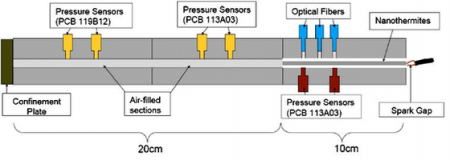
The team tested the combustion in a shock tube studded with optical fibers and pressure sensors to measure the combustion wave speed. They found that the nano composites could generate combustion waves with velocities ranging from 1500 to 2300 meters per second, which is in the Mach 3 range.
The power of these nano explosives could lead to a breakthrough in drug delivery for cancer and HIV, the researchers explain. First, drugs would be administered with a needle as usual, dispersing through the entire body. But then a hand-held device aimed at the tumor would send a pulse into the tumor. The shock waves created by the pulse would make tiny holes in the cells it was aimed at, allowing the drug to enter the tumor cells. Further, the force of the shock waves would push the drugs to those cells within milliseconds.
The researchers have tested the method on animal tissue, and have demonstrated a 99% success rate – almost all of the cells have properly accepted the drugs. Healthy cells, on the other hand, demonstrate much fewer side effects than with conventional treatments such as chemotherapy. As Gangopadhyay explains, the nano explosives have some different characteristics than conventional explosives.
“In conventional explosives, shock waves are generated during detonation,” she says. “In nanothermites, fast propagating chemical reactions can create shock waves without detonation.” Generating shock waves without detonation is the key to this technology, she says.
If everything goes well, the researchers hope to have the device ready to use in two to five years. Besides biomedical applications, the nano explosives could be useful in other areas, such as geology and seismology. Originally, the technology was used in the Army for IED (improvised explosive device) detection, where shock waves sent into the ground could give an image of what lies beneath.
More information: S. Apperson, et al. “Generation of fast propagating combustion and shock waves with copper aluminum nanothermite composites.” Applied Physics Letters 91, 243109 (2007).
Copyright 2008 PhysOrg.com.
All rights reserved. This material may not be published, broadcast, rewritten or redistributed in whole or part without the express written permission of PhysOrg.com.


