How baby fish find a home
January 16, 2008
How baby fish find a home

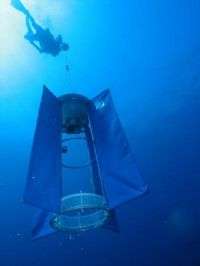
How tiny coral reef fish larvae locate the reef habitat across vast expanses of water has remained an enduring mystery. An innovative observational tool, the OWNFOR (Orientation With No Frame Of Reference) designed by UM Rosenstiel School researchers, is breaking new ground by allowing scientists to detect and quantify the orientation of larval coral reef fish in the pelagic environment; an often pitch black void with little or no frame of reference to navigate. Credit: Evan D'Alessandro

One of the most significant questions facing marine ecologists today, is just how much of an impact global variations in the environment are having on the dispersal of larval and juvenile marine species from open oceans to coral reefs.

Previously, tracking how fish larvae migrate was done through direct observation by divers on older larvae found near the reefs, after they’d spent weeks to months in the plankton. This method did not permit divers to follow small larvae, diving larvae or larvae as they returned to the reefs at night. How tiny coral reef fish larvae locate the reef habitat across vast expanses of water has remained an enduring mystery.

An innovative research tool, designed by UM Rosenstiel School of Marine and Atmospheric Science, division of Applied Marine Physics Assistant Professor, Dr. Claire B. Paris and Senior Research Associate Cedric Guigand is making the task possible on younger larvae as they move with currents. Dubbed the OWNFOR (Orientation With No Frame Of Reference) system, this drifting observational device, which resembles a kite, allows researchers to observe marine larvae naturally influenced by factors in the open ocean. The floating chamber is designed to detect and quantify the orientation of larval coral reef fish in the pelagic environment; an often pitch black void with little or no frame of reference to navigate.

The OWNFOR system is deployed at sea and drifts while videotaping the movement of a larva placed within a clear, circular arena. It will also be possible to change their immediate environment and manipulate orientation cues, such as acoustic, chemical, or magnetic fields that larvae may use to navigate. This new system will be equipped with an infrared camera that can verify the larvae’s orientation at night.

Through a research grant from The Hermon Slade Foundation and a fellowship from the Australian Museum, she will be putting her new larval monitoring system to the test in early 2008. Paris and colleagues are interested in gathering data on the successful identification of larval abilities to orientate as they mature.

“Typical research on larvae is assessed in laboratory experiments or in studies done in situ with the naked eye, but it does not provide information on whether or not larvae use cues to find a home, when in their life history they use them, or how far from the reef they can sense the cues. We’re hoping to find out how the larvae behaviorally interact with the blue-water environment minimizing human intervention,” said Paris. “The success of this new device in recording true orientation in fish larvae opens new possibilities for research in the field of larval ecology.”

Working at the Lizard Island Research Station, a satellite-facility of the Australian Museum on the Great Barrier Reef, Paris will directly compare her research methods with those of Lizard Island researcher, Dr. J.M. Leis, who published his results diving and following larval fish. Researchers hope that OWNFOR will provide minimal interference in the natural migration of organisms, helping to understanding just what influences these organisms to settle on a final reef home after days or weeks in a relatively featureless open ocean landscape.

“The larval phase is often the main opportunity in benthic organisms to colonize new habitats, but how far from home are these new habitats? They can range from tens of kilometers away to the natal reef (reef of origin). Ideally, we’ll discover crucial inputs for a new generation of biophysical larval dispersal models vital to achieving a better understanding of larval connectivity in marine systems,” said Paris. “The implications will have global impacts on the effective management of fisheries, conservation of marine biodiversity, including design of marine reserves, and helping to predict the effects of climate change on marine systems.”

Source: University of Miami Rosenstiel School


Rank 4 /5 (2 votes)
Tags

Relevant PhysicsForums posts

More news stories

Integrated pest management recommendations for the southern pine beetle

The southern pine beetle, Dendroctonus frontalis Zimmermann, is a chronic insect pest within pine forests in the southeastern United States. Under favorable environmental and host conditions, it is an agg ...

Biology / Ecology

created 1 hour ago | popularity not rated yet | comments 0

A mitosis mystery solved: How chromosomes align perfectly in a dividing cell

Although the process of mitotic cell division has been studied intensely for more than 50 years, Whitehead Institute researchers have only now solved the mystery of how cells correctly align their chromosomes during symmetric ...

Biology / Cell & Microbiology

created 16 hours ago | popularity 4.5 / 5 (22) | comments 0 | with audio podcast

Researchers find extensive RNA editing in human transcriptome

In a new study published online in Nature Biotechnology, researchers from BGI, the world's largest genomics organization, reported the evidence of extensive RNA editing in a human cell line by analysis of RNA-seq data, demons ...

Biology / Biotechnology

created 16 hours ago | popularity 5 / 5 (4) | comments 0 | with audio podcast

The proteins ensuring genome protection

Researchers from the University of Geneva (UNIGE), Switzerland, have discovered the crucial role of two proteins in developing a cell 'anti-enzyme shield'. This protection system, which operates at the level of molecular ...

Biology / Cell & Microbiology

created 16 hours ago | popularity 5 / 5 (3) | comments 0 | with audio podcast

Entire genome of extinct human decoded from fossil

(PhysOrg.com) -- In 2010, Svante Pääbo and his colleagues presented a draft version of the genome from a small fragment of a human finger bone discovered in Denisova Cave in southern Siberia. The ...

Biology / Biotechnology

created Feb 07, 2012 | popularity 4.7 / 5 (60) | comments 51 | with audio podcast


Rapunzel, Leonardo and the physics of the ponytail

(PhysOrg.com) -- New research provides the first mathematical understanding of the shape of a ponytail and could have implications for the textile industry, computer animation and personal care products.

Cognitive impairment in older adults often unrecognized in the primary care setting

A new study published in the Journal of the American Geriatrics Society reveals that brief cognitive screenings combined with offering further evaluation increased new diagnoses of cognitive impairment in older veterans two to ...

Climate change causes harmful algal blooms in North Atlantic: study

Warming oceans and increases in windiness could be causing of an abundance of harmful algal blooms in the North Atlantic Ocean and North Sea, according to new research.

Hacker claims porn site users compromised

A hacker claims to have compromised the personal information of more than 350,000 users after breaking into a disused website operated by pornography provider Brazzers.

Primary care program helps obese teen girls manage weight, improve body image and behavior

Teenage girls gained less weight, improved their body image, ate less fast food, and had more family meals after participating in a 6- month program that involved weekly peer meetings, consultations with primary care providers ...

AT&T customers surprised by 'unlimited data' limit

(AP) -- Mike Trang likes to use his iPhone 4 as a GPS device, helping him get around in his job. Now and then, his younger cousins get ahold of it, and play some YouTube videos and games.