Fast learning bumblebees reap greater nectar rewards
January 16, 2008 Fast learning bumblebees reap greater nectar rewards

Colonies which learn colours quickly are more successful.

The speed with which bees learn affects their ability to collect food from flowers, according to a new study from Queen Mary, University of London.

As nectar levels in flowers change from minute-to-minute, faster learning bees are more likely to keep track of which blooms are most rewarding, and thrive as a result.

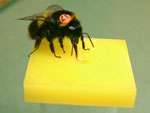
Dr Nigel Raine and Professor Lars Chittka from Queen Mary’s School of Biological and Chemical Sciences presented twelve bumblebee (Bombus terrestris) colonies with flight arenas containing blue and yellow artificial flowers, which were stocked with different amounts of nectar reward. The bees were challenged to overcome their natural preference for ‘blue’ flowers, and to learn that the ‘yellow’ flowers were more rewarding. The team found that the colonies which learned colours quickly, were more successful foragers.

The colonies’ learning speeds varied by a factor of nearly five; those colonies which learnt to associate the yellow, nectar-rich flowers, with rewards fastest in the laboratory, went on to harvest 66 per cent more nectar than the slowest learning colonies, from real flowers under field conditions.

Dr Raine explains: “It is often assumed that the learning abilities of animals are adapted to the environments in which they live and that faster learning animals should be at an advantage. Our study is the first to go out and test this assumption looking at an animal in the wild. We indeed find that faster learning bees appear to have an advantage when looking for food.”

Foraging bees use a variety of cues, including floral colour, pattern and scent, to recognize, discriminate and learn the flowers from which they collect food. As bees naturally forage in an environment in which the most rewarding flower type often changes, it seems likely that bees which learn quickly have the flexibility to keep track of the most rewarding flowers.

The team’s findings, which will be published online in the journal Proceedings of the Royal Society B, suggest that differences in learning performance have important evolutionary consequences for animal foraging and fitness under natural conditions.

“Rather like us, some bees learn from their mistakes more quickly than others. These faster learning bees also collect more nectar from flowers, which ultimately means their colony will be more successful,” explains Raine.

Source: Queen Mary, University of London


print this article email this article download pdf blog this article bookmark this article     Stumble it Digg this share on Facebook retweet share on Reddit add to delicious
Rate this story - 3 /5 (1 vote)


January 16, 2008 all stories

Comments: 0

3 /5 (1 vote)
  • Stumble this up

  • Digg this

  • share this

  • hide
  • Related Stories

  • Bee smart, bee healthy
    created Oct 30, 2008 | popularity not rated yet | comments 0
  • Bees go 'off-color' when they are sickly
    created Jul 16, 2008 | popularity not rated yet | comments 0
  • Memory in honeybees: What the right and left antenna tell the left and right brain
    created Jun 04, 2008 | popularity not rated yet | comments 0
  • Bees like it hot
    created Aug 02, 2006 | popularity not rated yet | comments 0
  • Study: How bees handle complex colors
    created Nov 01, 2005 | popularity not rated yet | comments 0


Other News

Fish food fight: Fish don't eat trees after all, says new study

Fish food fight: Fish don't eat trees after all, says new study

Biology / Ecology

created 1hour ago | popularity not rated yet | comments 0

(PhysOrg.com) -- What constitutes fish food is a matter of debate. A high-profile study a few years ago suggested that fish get almost 50 percent of their carbon from trees and leaves, evidence for a very ...


Computational microscope peers into the working ribosome

Computational microscope peers into the working ribosome (w/ Video)

Biology / Cell & Microbiology

created 21 hours ago | popularity 4.9 / 5 (8) | comments 0

Two new studies reveal in unprecedented detail how the ribosome interacts with other molecules to assemble new proteins and guide them toward their destination in biological cells. The studies used molecular ...


New chameleon species discovered in East Africa

New chameleon species discovered in East Africa (w/ Podcast)

Biology / Plants & Animals

created 23 hours ago | popularity 5 / 5 (1) | comments 0

A new species of chameleon has been discovered in Tanzania by a team of scientists.


Spider secrets decoded in world-first database

Biology / Plants & Animals

created 16 hours ago | popularity not rated yet | comments 0

(PhysOrg.com) -- Queensland scientists have developed a world-first database that catalogues the venom components from hundreds of spiders.


A year after discovery, Congo's 'mother lode' of gorillas remains vulnerable

A year after discovery, Congo's 'mother lode' of gorillas remains vulnerable

Biology / Plants & Animals

created 19 hours ago | popularity 5 / 5 (1) | comments 0

A new study by the Wildlife Conservation Society says that western lowland gorillas living in a large swamp in the Republic of Congo—part of the "mother lode" of more than 125,000 gorillas discovered last ...