Nanotubes Help Advance Brain Tumor Research
January 16, 2008
Nanotubes Help Advance Brain Tumor Research

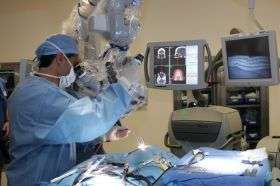
Benham Badie, M.D., director of the Department of Neurosurgery and the Brain Tumor program at City of Hope, performs a minimally invasive procedure to surgically remove a pituitary tumor. Nanotube technology may help in the development of new treatments that would require only minimally invasive procedures no matter the location of the brain tumor. Image credit: City of Hope

The potential of carbon nanotubes to diagnose and treat brain tumors is being explored through a partnership between NASA's Jet Propulsion Laboratory, Pasadena, Calif., and City of Hope, a leading cancer research and treatment center in Duarte, Calif.

Nanotechnology may help revolutionize medicine in the future with its promise to play a role in selective cancer therapy. City of Hope researchers hope to boost the brain's own immune response against tumors by delivering cancer-fighting agents via nanotubes. A nanotube is about 50,000 times narrower than a human hair, but it length can extend up to several centimeters.

If nanotube technology can be effectively applied to brain tumors, it might also be used to treat stroke, trauma, neurodegenerative disorders and other disease processes in the brain, said Dr. Behnam Badie, City of Hope's director of neurosurgery and of its brain tumor program.

"I'm very optimistic of how this nanotechnology will work out," he said. "We are hoping to begin testing in humans in about five years, and we have ideas about where to go next."

The Nano and Micro Systems Group at JPL, which has been researching nanotubes since about 2000, creates these tiny, cylindrical multi-walled carbon tubes for City of Hope.

City of Hope researchers, who began their quest in 2006, found good results: The nanotubes, which they used on mice, were non-toxic in brain cells, did not change cell reproduction and were capable of carrying DNA and siRNA, two types of molecules that encode genetic information.

JPL's Nano and Micro Systems Group grows the nanotubes on silicon strips a few square millimeters in area. The growth process forms them into hollow tubes as if by rolling sheets of graphite-like carbon.

Carbon nanotubes are extremely strong, flexible, heat-resistant, and have very sharp tips. Consequently, JPL uses nanotubes as field-emission cathodes -- vehicles that help produce electrons -- for various space applications such as x-ray and mass spectroscopy instruments, vacuum microelectronics and high-frequency communications.

"Nanotubes are important for miniaturizing spectroscopic instruments for space applications, developing extreme environment electronics, as well as for remote sensing," said Harish Manohara, the technical group supervisor for JPL's Nano and Micro Systems Group.

Nanotubes are a fairly new innovation, so they are not yet routinely used in current NASA missions, he added. However, they may be used in gas-analysis or mineralogical instruments for future missions to Mars, Venus and the Jupiter system.

JPL's collaboration with City of Hope began last year, after Manohara, Badie and Dr. Babak Kateb, City of Hope's former director of research and development in the brain tumor program, discussed using nanostructures to better diagnose and treat brain cancer. Badie said his team's nanomedical research continues, and the next goal will be to functionalize and attach inhibitory RNA to the nanotubes and deliver it to specific areas of the brain.

The JPL and City of Hope teams published the results of the study earlier this year in the journal NeuroImage.

Badie says that JPL's contribution to City of Hope's nanomedicine research has been invaluable.

"The fact that we can get pristine and really clean nanotubes from Manohara's department is unique," he said. "The fact that we are both collaborating for biological purposes is also really unique."

Source: JPL/NASA

4.4 /5 (16 votes)  

Rank 4.4 /5 (16 votes)
Tags

Relevant PhysicsForums posts
  • Factors affecting beet root cell membrane
    created11 hours ago
  • Stem cell question.
    createdFeb 10, 2012
  • Protease cleavage
    createdFeb 10, 2012
  • Pertubance in a model
    createdFeb 10, 2012
  • Cancer drugs and Alzheimer's, Oh my!
    createdFeb 09, 2012
  • Squishing cells
    createdFeb 09, 2012
  • More from Physics Forums - Biology

More news stories

Lab study raises questions over nano-particle impact

Tests involving chickens have raised questions about the impact on health from engineered nano-particles, the ultra-fine grains commonly used in drugs and processed foods, scientists said on Sunday.

Nanotechnology / Bio & Medicine

created 7 hours ago | popularity 5 / 5 (5) | comments 0

New kind of solar cell could capture significantly more energy than current cells

New solar cells could increase the maximum efficiency of solar panels by over 25%, according to scientists from the University of Cambridge.

Nanotechnology / Nanophysics

created Feb 08, 2012 | popularity 4.5 / 5 (13) | comments 14 | with audio podcast

Nanoshell whispering galleries improve thin solar panels

Visitors to Statuary Hall in the U.S. Capitol Building may have experienced a curious acoustic feature that allows a person to whisper softly at one side of the cavernous, half-domed room and for another on ...

Nanotechnology / Nanomaterials

created Feb 07, 2012 | popularity 4.4 / 5 (7) | comments 6 | with audio podcast

'Dark plasmons' transmit energy

Microscopic channels of gold nanoparticles have the ability to transmit electromagnetic energy that starts as light and propagates via "dark plasmons," according to researchers at Rice University.

Nanotechnology / Nanophysics

created Feb 09, 2012 | popularity 4.8 / 5 (10) | comments 1 | with audio podcast

Revealing how a battery material works

Since its discovery 15 years ago, lithium iron phosphate (LiFePO4) has become one of the most promising materials for rechargeable batteries because of its stability, durability, safety and ability to deliver ...

Nanotechnology / Nanomaterials

created Feb 08, 2012 | popularity 5 / 5 (6) | comments 0 | with audio podcast


Scientists discover molecular secrets of 2,000-year-old Chinese herbal remedy

For roughly two thousand years, Chinese herbalists have treated Malaria using a root extract, commonly known as Chang Shan, from a type of hydrangea that grows in Tibet and Nepal. More recent studies suggest that halofuginone, ...

New method to examine batteries -- MRI from the inside

There is an ever-increasing need for advanced batteries for portable electronics, such as phones, cameras, and music players, but also to power electric vehicles and to facilitate the distribution and storage of energy derived ...

A mitosis mystery solved: How chromosomes align perfectly in a dividing cell

Although the process of mitotic cell division has been studied intensely for more than 50 years, Whitehead Institute researchers have only now solved the mystery of how cells correctly align their chromosomes during symmetric ...

Google might launch Drive for cloud storage soon

(PhysOrg.com) -- Google's next big move, according to the Wall Street Journal, is a cloud storage service called Drive. Hardly first to the plate, Google is simply catching up to introducing its cloud reposi ...

Overeating may double risk of memory loss

New research suggests that consuming between 2,100 and 6,000 calories per day may double the risk of memory loss, or mild cognitive impairment (MCI), among people age 70 and older. The study was released today and will be ...

Starve a virus, feed a cure? Findings show how some cells protect themselves against HIV

A protein that protects some of our immune cells from the most common and virulent form of HIV works by starving the virus of the molecular building blocks that it needs to replicate, according to research published online ...