Math Models Snowflakes
January 17, 2008 Math models snowflakes

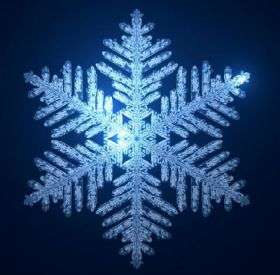
This dendritic snowflake was created using a computer model developed by Janko Gravner at UC Davis and David Griffeath at the University of Wisconsin-Madison. Credit: Janko Gravner and David Griffeath

Three-dimensional snowflakes can now be grown in a computer using a program developed by mathematicians at UC Davis and the University of Wisconsin-Madison.

No two snowflakes are truly alike, but they can be very similar to each other, said Janko Gravner, a mathematics professor at UC Davis. Why they are not more different from each other is a mystery, Gravner said. Being able to model the process might answer some of these questions.

Intricate, incredibly variable and beautiful, snowflakes have been puzzling mathematicians since at least 1611, when Johannes Kepler predicted that the six-pointed structure would reflect an underlying crystal structure.

Snowflakes grow from water vapor around some kind of nucleus, such as a bit of dust. The surface of the growing crystal is a complex, semi-liquid layer where water molecules from the surrounding vapor can attach or detach. Water molecules are more likely to attach at concavities in the crystal shape.

The model built by Gravner and David Griffeath of the University of Wisconsin-Madison takes these factors, as well as temperature, atmospheric pressure and water vapor density, into account. By running the model under different conditions, the researchers were able to recreate a wide range of natural snowflake shapes.

Rather than trying to model every water molecule, it divides the space into three-dimensional chunks one micrometer across. The program takes about 24 hours to produce one "snowfake" on a modern desktop computer.

As in the real world, needles are the most common pattern of computer-generated snowflake. The classic six-pointed "dendritic" or feathery snowflake is relatively rare, both in the computer simulation and in nature.

Gravner and Griffeath also managed to generate some novel snowflakes, such as a "butterflake" that looks like three butterflies stuck together along the body. Gravner said there seemed to be no reason these shapes could not appear in nature, but they would be very fragile and unstable.

One surprise was that three-dimensional structure is often important, with complex structures often growing between two plates -- a feature that is difficult to see when observing actual snowflakes, but has been observed in careful studies of real snowflakes with electron microscopes.

A paper describing the model has been submitted for publication.

Images and movies of snowflake growth models: http://psoup.math.wisc.edu/Snowfakes.htm

Source: University of California - Davis


print this article email this article download pdf blog this article bookmark this article     Stumble it Digg this share on Facebook retweet share on Reddit add to delicious
Rate this story - 4.4 /5 (32 votes)

Rank Filter

Move the slider to adjust rank threshold, so that you can hide some of the comments.


Display comments: newest first

  • David6502 - Jan 17, 2008
    • Rank: not rated yet
    Why are all six arms identical? As the arms grow how does each arm "know" how to grow or is it simply that each arm is subject to EXACTLY the same shape determining factors of temperature, atmospheric pressure and water vapor density?
  • ShadowRam - Jan 17, 2008
    • Rank: not rated yet
    Also why 6?
    Why is a snowflake basically 2D?

    Does other substances (not water) make flakes? do they follow the same 6 armed pattern?
  • mattytheory - Jan 17, 2008
    • Rank: not rated yet
    David: this is intriguing to me as well. It is perhaps similar to other phenomena involving completely different influential factors. Check out these links:

    Sand and shape:
    http://www.youtub...Kl9ZvbaI

    Ferro-fluid demonstration:
    http://www.youtub...29D9nyq0

January 17, 2008 all stories

Comments: 3

4.4 /5 (32 votes)
  • Stumble this up

  • Digg this

  • share this

  • hide
  • Related Stories


  • hide
  • Relevant PhysicsForums posts

  • Invariant moments of 2d images
    created 10 hours ago
  • integral of exponential
    created 12 hours ago
  • any technique or "trick" for finding the coefficient
    created 20 hours ago
  • MATH SYMBOL... Help Figure?
    created 22 hours ago
  • More from Physics Forums - General Math

Other News

Study: Credit crisis, debt load a double whammy for investment

Other Sciences / Economics

created 4 hours ago | popularity not rated yet | comments 0

Firms with heavy long-term debt that came due amid the nation's recent credit crisis slashed investment more than three times as much as companies whose paybacks ducked the meltdown, a new University of Illinois study found.


Failing the sniff test: Researchers find new way to spot fraud

Other Sciences / Economics

created 13 hours ago | popularity not rated yet | comments 1

Companies that commit fraud can find innovative ways to fudge the numbers, making it hard to tell something is wrong by just looking at their financial statements. But research from North Carolina State University unveils ...


Remains of Minoan-style painting discovered during excavations of Canaanite palace

Other Sciences / Archaeology & Fossils

created 10 hours ago | popularity 4.5 / 5 (2) | comments 0

The remains of a Minoan-style wall painting, recognizable by a blue background, the first of its kind to be found in Israel, was discovered in the course of the recent excavation season at Tel Kabri. This fresco joins others ...


National anti-gun violence program largely successful, study finds

Other Sciences / Social Sciences

created 7 hours ago | popularity 5 / 5 (3) | comments 0

Project Safe Neighborhoods - a community-based policing effort launched in 2001 - has been largely successful in its goal of reducing violent crime, according to an analysis by Michigan State University, the national research ...


RIT scholars explore the impact of imaging on our reality

Other Sciences / Social Sciences

created 8 hours ago | popularity not rated yet | comments 0

Imaging is the use of machines to enhance humans' ability to perceive things, often by producing visible phenomena that cannot be seen with the naked eye. But, can imaging technology distort reality and even change what humans ...